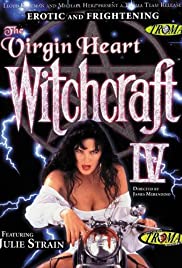
Witchcraft IV: The Virgin Heart (1993, directed by James Merendino)


Witchcraft IV continues the endless story of William Spanner, warlock-turned-attorney.

When this movie begins, William is no longer working for the public defender’s office.  Instead, he now handles insurance law.  He comments that it’s been years since he last used his powers and he’s happy that he is, once again, living a normal life.  However, when Lily Wild (Lisa Jay Harrington) shows up at his office and tells him that her 17 year-old brother, Pete Wild (Orien Richmond), has been arrested for a murder that he didn’t commit, William agrees to serve as Pete’s attorney.

The police are convinced that Pete not only murdered his girlfriend but that he’s also a serial killer who has been responsible for killing at least six other women and removing their hearts.  With the police refusing to be of much help and also apparently withholding evidence so that it doesn’t inspire a copycat killer (?), William decides that the only way to defend Pete is to solve the murder on his own.

Searching the scene of the crime, William finds a matchbook with the word “Coven” on it.  Coven is a club and William’s investigation leads him to both a stripper named Belladonna (Julie Strain) and Santara (Clive Pearson), the club owner who makes aspiring rockers famous in return for their immortal soul.  Santara has not only a very famous father but also a connection to William.  No matter how much William tries to escape his past, he keeps getting pulled back in.

Witchcraft IV is unique among the franchise in that it features William narrating his story.   William obviously learned how to narrate by watching old film noirs but it’s appropriate because Witchcraft IV is more of a direct-to-video neonoir than a horror film.  The horror and supernatural elements are there, of course.  But Witchcraft IV is more interested in the mystery aspect of the story than the horror aspect.  Unfortunately, the mystery itself isn’t particularly challenging and it seems as if William, given his past, should have been able to figure things out quicker than he did.

The best thing that Witchcraft IV has going for it is Julie Strain in the role of Belladonna.  Strain gives a typically uninhibited and forceful performance, one that suggests that, if she had been born many years earlier, she could have had a good career as a noir femme fatale.

Witchcraft IV was directed by James Merendino, who later achieved cult success with SLC Punk!  This would also be the last time that Charles Solomon would play the role of William Spanner.  In Part V, the role would be played by Marklen Kennedy.

Witchcraft III: The Kiss of Death (1991, directed by Rachel L. Feldman)


After being a baby during the first Witchcraft and a horny high school student during the second Witchcraft, William Spanner becomes a public defender in the third Witchcraft movie.

William (Charles Solomon) is still trying to hide from his heritage as a warlock.  He refuses to discuss his family with his girlfriend, Charlotte (Lisa Toothman) and instead tries to concentrate on helping underprivileged people who have run afoul of the legal system.  His latest client, a teenager named Rubin Carter (Ahmad Reese), claims that he didn’t commit the murder that he’s been accused of.  William is determined to make sure that Rubin gets a fair trial, despite the machinations of the ruthless DA, Vivian Hill (Nicole Lauren).  William has found a way to be useful to society without having to use his magical powers.

However, events are conspiring to force William to embrace his warlock heritage.  Louis (Dominic Luciana) is hitting the bar scene and picking up women so he can give them the “kiss of death” and transfer their lifeforce to his girlfriend, Roxy (Lena Hall).  After Louis arranges to befriend William, he focuses his attentions on Charlotte.  In order to save his girlfriend, William is going to have use the same powers that he’s spent years trying to deny.

Particularly when compared to some of the films that would come after it, Witchcraft III isn’t bad.  William’s motivations for hiding from his past actually make sense and Louis is an enjoyably cheesy villain.  The film features William getting advice from a witch doctor, which introduces the idea that there’s all sorts of different magic in the world.  It’s an intriguing idea, or at least it is when compared with what usually passes for a deep thought in a Witchcraft movie.  That’s the whole key to enjoying Witchcraft III.  Don’t compare it to a real movie.  Compare it to the other Witchcraft films.

I like the idea of a warlock lawyer.  It seems like it could have been a good TV show.  Instead, it would just be a part of horror’s longest-running franchise.  Witchcraft III was enough of a direct-to-video success that Witchcraft IV soon followed.

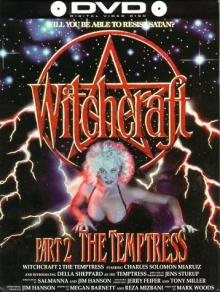
Witchcraft II: The Temptress (1990, directed by Mark Woods)


The second of the never-ending Witchcraft series continues the saga of William Churchill Adams Spanner.

We last we saw William, he was just a baby and he and his mother had only barely managed to escape from two 300 year-old witches.  In Witchcraft II, William is now 18 years old, which leads to some odd continuity issues.  Since the first Witchcraft was clearly set in the late late 80s, this would suggest that Witchcraft II is taking place in the early 21st Century.  However, judging by the clothing, the cars, and the slang, Witchcraft II is taking place in the year that it was made, 1990.  So, I guess despite all appearances to the contrary, Witchcraft was actually taking place in 1972.

(Then again, Witchcraft II is a Troma film so it’s even more probable that no one involved gave it any of that any thought.)

Having been adopted by Mr. and Mrs. Adams (two white witches who fled the evil coven), William (Charles Solomon) is now a typical teenager and is obsessed with getting laid.  Unfortunately, his girlfriend, Michelle (Mia Ruiz), isn’t sure if she’s ready to do that, which leads to William whining and trying to change her mind be playing air guitar.  Yes, air guitar.

While William is playing his invisible instruments, the evil witches are coming up with a plan to bring William back over to the dark side and, not surprisingly, it all centers around William’s need for sex.  Elizabeth, who was the main witch in the first film and who apparently didn’t actually die at the end of that film despite the fact that everyone who watched it saw that she very clearly did, has been transformed into Deloris Jones (Penthouse model Delia Sheppard), and she is now living next door to the Adamses.  While William has hallucinations of Michelle cheating on him with his best friend, Deloris plans to capture William’s soul (and much more) by leaving strange packages on his doorstep and frequently baring her breasts.

The first Witchcraft was low-budge but it still felt like a real movie, albeit not a very good one.  Witchcraft II, on the other hand, is very much a direct-to-video production.  It has the look of an amateur 80s music video and the actors struggle with even the simplest of lines.  The film’s tone is unexpectedly serious, which makes it even stranger when mysterious pentagrams starts to appear on everyone’s chest.

Probably because of the buxom presence of Delia Sheppard (who was very prominently featured on the movie’s VHS and, later, DVD covers), Witchcraft II was a direct-to-video hit.  This, of course, led to Witchcraft III.