October True Crime: Sins of the Mother (dir by John Patterson)


In the city of Spokane, Washington, Kevin Coe (Dale Midkiff) is a real estate agent who always tries to come across as being the slickest guy in the room.  With his quick smile and his moderately expensive suits, Kevin certainly seems to fit the stereotype.  It’s only when you start to look a little closer that the surface starts to crack.

For someone who goes out of his way to come across as being confident, Kevin is actually very immature and more than a little whiny.  He’s living with a perfectly nice young woman named Ginny (Heather Fairfield) but it’s obvious that he’s keeping secrets from her.  He comes home one morning with scratches on his face and, when she asks about them, he claims that 1) he got mauled by a dog and 2) he doesn’t need any sort of medical attention.  Kevin is someone who frequently loses his job because he’s just not that good at it.  When one boss fires him, Kevin replies that he’s going to start his own business and someday, maybe he’ll be the one doing the hiring and firing.  It’s classic empty cope.

And then there’s Kevin’s mother.  Ruth Coe (Elizabeth Montgomery) is someone who likes to present herself as being a grand diva, in the manner of a Golden Screen star.  She’s extremely close to her son, at times overprotective and at times overly critical.  Kevin often goes from yelling at his mom to dancing with her within minutes.  Ruth makes it clear that she doesn’t like Ginny and Ginny eventually grows to dread seeing Ruth wandering around their house, uninvited.  And yet, despite all of the time that Kevin spends talking about how wants to get away from his mother and to live his own life, Kevin doesn’t really make much of an effort to do that.

Meanwhile, Detective Liz Trent (Talia Balsam) is investigating a series of rapes that have been committed in Spokane.  When she comes to suspect that Kevin is the rapist, Kevin claims that it’s not true and it’s just another case of the world treating him unfairly.  Ruth stands by her son and eventually shocks everyone with just how far she’s willing to go to try to keep him out of prison.

Sins of the Mother is based on a true story.  Kevin Coe may have only been convicted of four rapes but he is suspected of having committed at least 41.  In prison, he insisted he was innocent and refused to attend any counseling programs.  He also refused to apply for parole, even after he became eligible.  After his criminal sentence was completed in 2008, he was sent to the Special Commitment Center on Washington’s McNeil Island, which is a institution that houses sexual predators who are likely to reoffend.  I’m writing this review on September 15th.  Coe, as of this writing, is scheduled to be released from McNeil on October 3rd so, by the time you’re reading this, he could already be out.  Coe is 78 and is reported to be in fragile health.

As for the movie, it’s mostly memorable for Elizabeth Montgomery’s over the top performance as Ruth Coe.  Sweeping into every scene and delivering her lines in what appears to be a deliberately fake-sounding Southern accent, Montgomery chews the scenery with gusto.  While the rest of the cast often seems to be going through the motions, Montgomery grabs hold of this movie and refuses to surrender it.

No Holds Barred (1989, directed by Thomas J. Wright)


In No Holds Barred, Hulk Hogan plays a professional wrestler who is best-known for his mustache, his thinning blonde hair, and for ripping his shirt in half when he climbs in the ring.  Hulk Hogan is playing himself except that everyone in the movie calls him Rip Thomas.  Why is Hogan renamed Rip Thomas?  It seems strange because No Holds Barred features “Mean Gene” Okerlund and Jesse “The Body” Ventura as themselves and there’s nothing about Rip that’s any different from Hulk Hogan’s own wrestling persona.

Rip is the World Wrestling Federation Champion and is loved by fans across the globe.  Rip may be fierce in the ring but outside of the ring,  he loves children and is devoted to looking after his younger brother, Randy (Mark Pellegrino).  Tom Brell (Kurt Fuller), the evil owner of World Television Network, wants to harness the star power of Rip but, when Rip refuses to sign with WTN, Brell goes his own way and hires ex-convict Zeus (Tiny Lister) to star in The Battle Of The Tough Guys.

Rip still wants nothing to do with Brell, not even when Brell sends Samantha Moore (Joan Severance) to seduce him.  In fact, Rip is such a beacon of goodness that he brings Samantha over to his side.  But when Zeus puts Randy in the hospital, Rip has no choice but to seek revenge in the ring.

No Holds Barred is a movie with an identity crisis.  It’s a pro wrestling movie that was made to capitalize on Hulkamania and a lot of the humor was meant to appeal to the kids who were a huge part of Hogan’s fanbase but it’s also a movie in which people die, Samantha is nearly raped, and Randy is crippled by Zeus.  The movie lacks the sense of fun that has made professional wrestling a worldwide phenomena.  The most surprising thing about No Holds Barred is that Hulk Hogan has very little screen presence.  I don’t think anyone would expect him to be a great actor but he also shows little of the charisma that made him a phenomena back in the day.  Especially when compared to the ferocious Tiny Lister, Hogan is just boring.  Maybe that’s the difference between Rip Thomas and Hulk Hogan.

David Paymer has a small role in No Holds Barred, playing a nervous television executive.  Out of the cast, Paymer was the only one who later went on to be nominated for an Oscar and Jesse Ventura was the only one to later be elected governor of a state, at least so far.  Hulk Hogan’s only 71.  He’s still got time.

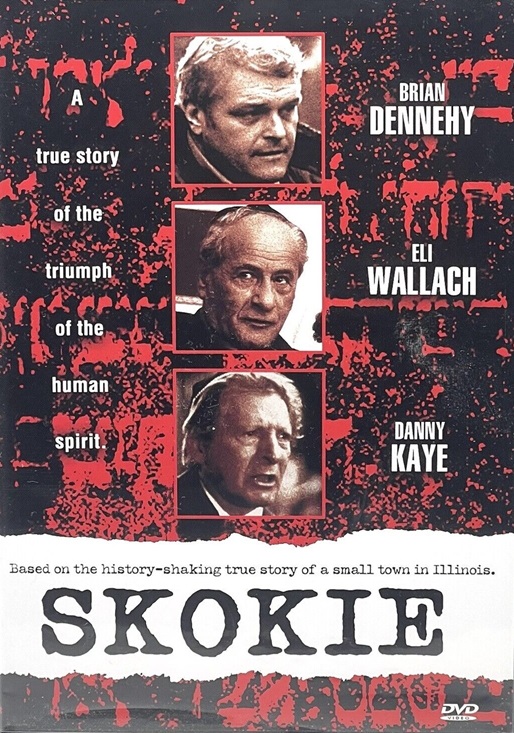
Made-For-Television Movie Review: Skokie (dir by Herbert Wise)


Skokie, a 1981 made-for-television movies, opens in a shabby Chicago office.

A group of men, all wearing brownshirts and swastika armbands, listen to their leader, Frank Collin (George Dzundza).  Collin says that they will be holding their next rally in the town of Skokie.  Collin explains that Skokie has a large Jewish population, many of whom came to the United States after World War II.  Collin wants to march through their town on Hitler’s birthday.

If not for the swastika and the brownshirt, the overweight Collin could easily pass for a middle-aged insurance salesman, someone with a nice house in the suburbs and an office job in the city.  However, Frank Collin is the head of the American National Socialist Party. a small but very loud group of Nazis who specialize in marching through towns with large Jewish populations and getting fee media attention as a result of people confronting them.  Making Frank Collin all the more disturbing is that he isn’t just a character in a made-for-television movie.  Frank Collin is a real person and Skokie is based on a true story.

The Mayor (Ed Flanders) and the police chief (Brian Dennehy) of Skokie are, needless to say, not happy about the idea of modern-day Nazis marching through their city.  Though they inform Collin that he will have to pay for insurance before he and his people will be allowed to hold their rally, they know that the courts have been striking down the insurance requirement as being a violation of the First Amendment.  While the mayor and the police chief worry about the political fallout of the rally, the Jewish citizens of Skokie debate amongst themselves how to deal with the Nazis.  Bert Silverman (Eli Wallach) and Abbot Rosen (Carl Reiner) argue that the best way to deal with Collin and his Nazis is to refuse to acknowledge them, to “quarantine” them.  As Rosen explains it, Collin is only marching to get the free publicity that comes with being confronted.  If he’s not confronted, he won’t make the evening news and his rally will have been for nothing.  However, many citizens of Skokie — including Holocaust survivor Max Feldman (Danny Kaye) — are tired to turning their back on and ignoring the Nazis.  They demand that the Nazis be kept out and that, if they do enter the city, they be confronted.

With the support of the ACLU, Collin sues for his right to march through Skokie.  The ACLU is represented by Herb Lewishon (John Rubinstein), a Jewish attorney who hates Collin and everything that he stands for but who also feels that the First Amendment must be respected no matter what.  When Lewishon is asked how he, as a Jew, can accept a Nazi as a client, Lewishon relies that his client is the U.S. Constitution.

Skokie is a thought-provoking film, all the more so today when there’s so much debate about who should and should not be allowed a platform online.  (Indeed, Collin and his Nazis would have loved social media.)  Lewishon argues that taking away any group’s First Amendment rights, regardless of how terrible that group may be, will lead to slippery slope and soon everyone’s First Amendment rights will be at risk.  Max Feldman, and others argue that the issue isn’t free speech.  Instead, the issue is standing up to and defeating evil.  The film gives both sides their say while, at the same time, making it clear that Frank Collin and his Nazis are a bunch of fascist losers.  It’s a well-acted and intelligently written movie, one that rejects easy answers.  Needless to say, at a time when so many people feel free to be openly anti-Semitic, it’s a film that’s still very relevant.

As for the real Frank Collin, he would eventually be charged with and convicted of child molestation.  After three years in prison, he changed his name to Frank Joseph and became a writer a New Age literature.  He’s looking for Atlantis but I doubt they’d want him either.