Lisa Marie Reviews The Oscar Winners: Mutiny on the Bounty (dir by Frank Lloyd)


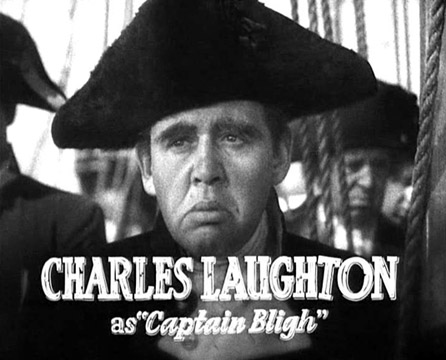
Charles Laughton

It’s been a strange Oscar season and it could get even stranger.  Several critics and industry insiders are speculating that, on February 24th, Argo might win the Oscar for best picture without winning in any other category.  As strange as that may sound, Argo would not be alone in achieving this distinction.  In the past, 3 films have won best picture without winning anything else.

Mutiny on the Bounty, the best picture of 1935, is one of those films.

Based (rather loosely, according to many historians) on a true story, Mutiny on the Bounty tells the story of one of the most controversial events in maritime history.  The HMS Bounty leaves England in 1787 on a two-year voyage to Tahiti.  The Bounty is manned by a disgruntled crew (many of whom have been forced into Naval service) and is captained by a tyrant named William Bligh (Charles Laughton).  Bligh has little use for the majority of his crew and thinks nothing of having a man whipped until he is dead for even the pettiest of infractions.

Blight’s lieutenant is Fletcher Christian (Clark Gable), a compassionate man who disapproves of Bligh’s methods.  As the voyage continues, Christian grows more and more vocal with his disgust towards Bligh.  When the ship finally reaches Tahiti, Christian falls in love with a local Tahitian girl and defies Bligh’s direct orders so that he can spend time with her.

It’s only after the ship leaves Tahiti and Bligh’s tyranny leads to the death of an alcoholic crew member that Christian finally leads the mutiny of the film’s title. The rest of the film is divided between Bligh’s surprisingly heroic efforts to survive after being set adrift in a lifeboat and Christian’s attempts to avoid being captured by British authorities.  Caught up in the middle of all of this is Christian’s friend (and audience surrogate), Roger Byam (Franchot Tone).

Mutiny on the Bounty was one of the biggest box office hits of 1935 and it received 8 Academy Award nominations, including Best Picture, Best Director, and a record-setting 3 nods for Best Actor with Clark Gable, Charles Laughton, and Franchot Tone all receiving nominations.  However, out of those 8 nominations, Mutiny only won the award for Best Picture while John Ford’s The Informer took home the Oscars for Best Director and Actor.  Mutiny on the Bounty was the third (and, as of this writing, the last) best picture winner to fail to win any other categories.

For a film that lost dramatically more awards than it won, Mutiny on the Bounty still holds up pretty well.  Director Frank Lloyd keeps the film moving at a quick pace and perfectly captures not only the misery of the Bounty but the joyful paradise of Tahiti as well.  Lloyd is at his best during the short sequence of scenes that depict Bligh’s efforts to reach safety after being forced off of the Bounty.  During this sequence, the audience is forced to reconsider both Captain Bligh and everything that we’ve seen before.  It introduces an intriguing hint of ambiguity that is not often associated with films released in either the 1930s or today.

Of the three nominated actors, Clark Gable and Charles Laughton both give  performances that remain impressive today.  In the role of Fletcher Christian, Gable is the literal personification of masculinity and virility.  Meanwhile, in the role of Bligh, Laughton is hardly subtle but he is perfectly cast.  If Gable’s performance is epitomized by his charming smile than Laughton’s is epitomized by his constant glower.  Wisely, neither the film nor Laughton ever make Bligh out to be an incompetent captain.  As is shown after the mutiny, the film’s Bligh truly is as capable a navigator and leader as everyone initially believes him to be.  Unlike many cinematic tyrants, Blight’s tyranny is not the result of insecurity.  Instead, Bligh is simply a tyrant because he can be.  Laughton and Gable are both so charismatic and memorable that Franchot Tone suffers by comparison.  However, even Tone’s bland performance works to the film’s advantage.  By being so normal and boring, Roger Byam is established as truly being the sensible middle between Gable’s revolutionary and Laughton’s tyrant.

Mutiny on the Bounty remains an exciting adventure film and it certainly holds up better than some of the other films that were named best picture during the Academy’s early years.  If Argo only wins one Academy Award next Sunday, it’ll be in good company.
Film Review: Les Miserables (dir. by Richard Boleslawski)


Every year, I set a few goals for myself.  In 2012, for instance, my goal was to stop worrying so much about achieving unrealistic goals.  For 2013, my goal is to post a film review a day, alternating between reviews of films that have been nominated for Academy Awards and films that most assuredly were not.

With that in mind, I’d like to get things started by taking a look at Les Miserables.  Now, I’m not talking about the Tom Hooper-directed musical extravaganza that’s currently playing at a theater near you.  Instead, I’m talking about the Les Miserables that was directed by Richard Boleslawski and which was nominated for best picture of 1935.  (It lost to another literary adaptation that featured Charles Laughton as a classic villain, Mutiny On The Bounty.)  As opposed to Hooper’s film, this version of Les Miserables is not based on a Broadway musical.  Instead, it’s a condensed version of Victor Hugo’s original novel.

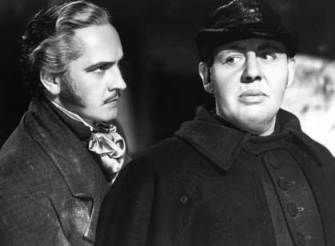
As opposed to the novel, Les Miserables takes a straight-forward chronological approach to telling the story of Jean Valjean.  We start with Valjean (played here by Fredric March) being sentenced to prison and then follow him through his experiences in prison.  We watch as the embittered Valjean first meets the kindly bishop (played here by Cedric Hardwicke) who turns his life around.  Valjean becomes both a mayor and the protector of the young Cosette, who eventually ends up falling in love with the young revolutionary Marius.  Thoughout all of this, Valjean is pursued by the obsessive Inspector Javert (Charles Laughton).

As a film, Les Miserables is more faithful to the spirit of Hugo’s original novel than to the exact details.  For instance, in this film, Javert first encounters Valjean while the latter is in prison.  While this is clearly different from the novel, it works perfectly from a cinematic point of view.  As well, the film jettisons many of the book’s longer digressions and instead, it focuses on the characters of Valjean and Javert.  As such, characters like Cosette and Marius are only important (and considered) in how they relate to the two main characters.  Fortunately, Valjean and Javert are played by two of the best actors to ever appear on screen.

While Charles Laughton, in the role of Javert, gets to the give the showier performance, the film is rightfully dominated by Fredric March’s quietly determined performance as Jean Valjean.  Valjean is a truly complex character who, over the course of the film, goes from being bitter and angry to kindly and strong and March perfectly captures each side of Valjean’s personality.  As an actor, Fredric March is not as well-remembered as some of his contemporaries (like Charles Laughton, for instance).  However, in this film, Fredric March proves himself to be the perfect Jean Valjean.  He is the Jean Valjean that all other Valjeans must be judged against.

While director Richard Boleslaswki is hardly a household name (I have to admit that I had never heard of him before I saw this film), his work on Les Miserables is impressive.  Interestingly, he directs the film almost as if it was a combination of a Warner Bros. gangster film and a Universal monster film.  (It’s easy to imagine some alternative universe where his version of Les Miserables starred Edward G. Robinson as Valjean and Boris Karloff as Javert.)  He’s at his strongest is the dream-like sequence where Valjean carries the wounded Marius through the sewers of Paris.

While Les Miserables may not be a perfect film, it is the perfect introduction to Hugo’s novel. Incidentally, the most faithful cinematic adaptation of Les Miserables actually came out a year before the Boleslawski version.  It was a French film that had a running time of five hours.  It occasionally turns up on TCM and, like the 1935 version, it’s well-worth watching.

Film Review: The Private Life of Henry VIII (dir. by Alexander Korda)


This afternoon, as part of my mission to see every single film ever nominated for best picture, I watched Alexander Korda’s 1933 biopic The Private Life of Henry VIII.

Now, I have to admit that I’ve never been a big fan of the historical King Henry VIII as I have a hard time finding much sympathy for a man who beheads one wife, not to mention two of them.   I like to imagine that he met his end in much the same way that Joe Spinell meets his end at the end of Maniac, with all of his dead wives suddenly showing up and ripping off his head.  But, Henry is one of those larger-than-life historical figures that always seems to end up as the subject of movies, speculative fiction, and, of course, Showtime television series. 

The Private Life of Henry VIII is one of the better known recreation of Henry’s life on-screen.  For the most part, the film ignores Henry’s policies as king and instead is a darkly humorous recreation of his relationships with five of his six wives.  (His first marriage, to Catherine of Aragon, is ignored.)  The episodic film opens with the execution of Anne Boyelen (Merle Oberon).  This sequence establishes the film’s tone early and it’s actually a lot more cynical than we usually expect a film from 1933 to be.  In between shots of Boyelen waiting to meet her fate, we get extended scenes of two executioners — one French and one English — arguing about which nationality is better when it comes to chopping off heads.  Meanwhile, the members of Henry’s court spend their time whispering innuendo about Henry’s new wife, Jane Seymour (Wendy Barrie).  When Henry (played by Charles Laughton) finally shows up on the scene, he turns out to be a buffoon, a childish man who happens to control the destiny of England.  After Jane dies in childbirth, Henry marries Anne of Cleves (played by Laughton’s wife, Elsa Lanchester).  Anne, however, finds Henry to be repulsive and, in the film’s most obviously comedic segment, she goes out of her way to make herself as sexually unappealing as possible in order to convince Henry to give her a divorce.  (This, of course, led to the split between England and the Catholic Church but the film doesn’t dwell on that.  This is a comedy, not Man For All Seasons.)  After the divorce, Henry finally marries Catherine Howard (Binnie Barnes) who has spent the whole movie pursuing Henry.  For the first time in the movie, Henry is portrayed as being truly in love, unaware (at first) that Catherine only married him for his crown and is actually having an affair with Thomas Culpepper (Robert Donat). 

The Private Life of Henry VIII was not the first movie to be made about Henry VIII but it’s probably the most influential because of Charles Laughton’s Oscar-winning performance in the title role.  Laughton’s performance pretty much set the standard as far as future Henry’s were concerned.  His Henry is buffoonish womanizer who does everything to excess.  (This is the film that pretty much created the whole image of monarchs as men who don’t use forks, knives, or spoons.)  However, as over-the-top as Laughton’s performance may seem, it’s actually full of very subtle moments that suggest the actual human being lurking underneath all of the bluster.  It’s hard not to sympathize with Laughton’s Henry as he struggles to explain what sex is to Anne of Cleves or with his obvious pain when he discovers that he’s been betrayed by the only one of his wives that he actually loved.

(Of course, any similarity between Laughton’s Henry and the real-life Henry is probably a coincidence.)

The Private Life of Henry VIII was the first British film ever nominated for best picture and, perhaps because it wasn’t made by the Hollywood establishment, it hasn’t aged as terribly as most films from the 30s.  While the film does have its slow spots, the performances of Laughton, Oberon, and Lanchester still hold up well and some of the film’s dark comedy almost feel contemporary.  Oddly enough, this British film about English history lost to an American film about English history, Cavalcade

(I should mention that I haven’t seen Cavalcade so I can’t say whether it was a better film.  I’m going to have to see Cavalcade eventually but it’ll be later than sooner as the movie is only available as part of a DVD boxed set that costs close to 300 dollars.  Agck!)