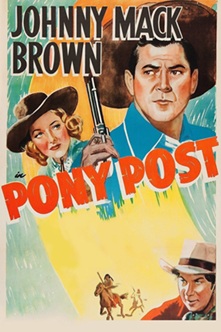
Pony Post (1940, directed by Ray Taylor)


In the days of the Old West, Griff Atkins (Stanley Blystone) manages a Pony Express station but, because of his gambling debts, he actually encourages the Indians and the outlaw Richard brothers (John Rockwell and Ray Teal) to attack the Pony Express riders and steal their horses.  Major Goodwin (Tom Chatterton) tries to put a stop to all this by firing Griff and putting Cal Sheridan (Johnny Mack Brown) in charge.  Griff and the Richard brothers continue their outlaw ways and eventually, the head of one of the relay stations is killed in one of their raids.  While the dead man’s daughter, Norma (Nell O’Day), investigates the murder, Cal works to bring peace the line and falls in love with Goodwin’s daughter, Alice (Dorothy Short).  Meanwhile, aspiring Pony Express rider Shorty (Fuzzy Knight) tries to invent a trampoline system that will help him to mount a horse.

No matter how bad things get in the west, you can always count on Johnny Mack Brown to bring some order and to get it done in less than an hour.  Johnny Mack Brown was always a good hero and that’s the case here.  Eventually this film has all of the horse riding and tough fighting that fans of the genre expect from these westerns but, for a short movie (it only runs for 59 minutes), it still seems to take a while for it to really get going.  The first half of the movie is more about Fuzzy Knight singing songs and trying to become a rider than it is about anything else.  I usually enjoy Fuzzy’s antics but, like the B-western themselves, they are definitely an acquired taste for most viewers.

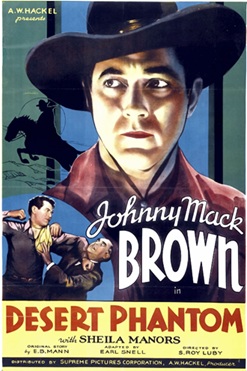
Desert Phantom (1936, directed by S. Roy Luby)


In a frontier town, rancher Jean Halloran (Sheila Bromley) has a big problem.  Someone is shooting and killing all of her ranch hands and sending her notes in which he tells her to give up her ranch and leave town.  When an ammunition salesman and trick shooter named Billy Donavon (Johnny Mack Brown), Jean hires him to serve as a bodyguard and to track down the mysterious Phantom.  Billy, however, has a secret of his own.

Desert Phantom is a remake of an old Harry Carey film.  I don’t know why Poverty Row did remakes since all of their films pretty much had the same plot regardless.  A stranger comes into town and gets involved with a female rancher and a bad guy who is trying to hide his actual identity.  In this one, Nelson McDowell gets to supply the comic relief as a befuddled veterinarian while familiar faces like Ted Adams and Karl Hackett are there to keep us guessing about how the Phantom could actually be.  If you’ve watched enough of these movies, though, you’ll always be able to guess who the bad guy is.

This isn’t the best of Johnny Mack Brown’s movies.  The Phantom’s story seems like it could have been interesting but that would have meant taking more risks than most of the Poverty Row studios were willing to do.  Johnny Mack Brown is as convincing a cowboy as always and is the film’s saving grace.  Brown was a western star precisely because he could make even something like Desert Phantom watchable.

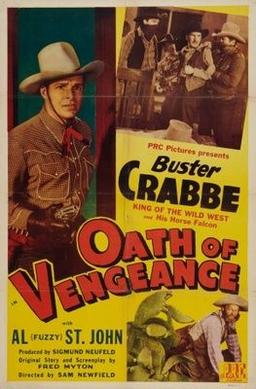
Oath of Vengeance (1944, directed by Sam Newfield)


In a small frontier town, the ranchers and the farmers are nearly at war with each other.  Cattle are being rustled.  The head of the farmers (Karl Hackett) is accused of killing a ranch hand.  Store owner Fuzzy Q. Jones (Al St. John) suspects that it’s all a set-up and he’s not going to stand for it.  If the farmers kill all the ranchers and the ranchers kill all the farmers, there won’t be anyone left to shop at his store.  Fuzzy calls in his friend, Billy Carson (Buster Crabbe).

Buster Crabbe may have gotten his start in the westerns by playing Billy the Kid but the producers of his films eventually realized that there was only so long that Buster could play a character known as “the Kid” and Billy the Kid’s reputation as an outlaw was actually not helpful at the box office because parents didn’t want to send their kids to a matinee that might teach them the wrong lessons.  After a handful of “Billy the Kid” films, Buster’s western hero suddenly had a new name.  Billy Carson was a standard western do-gooder, called in whenever a town needed to be cleaned up or his old sidekick Fuzzy needed some help around the store.  Crabbe was a convincing hero no matter what but the Billy Carson films lacked the thing that made the Billy the Kid films interesting.  Usually, no one was trying to arrest Billy Carson.

Oath of Vengeance isn’t bad, at least not by the standards of Poverty Row westerns.  There’s plenty of fights and Crabbe, being a former Olympian, looks convincing with he throws a punch.  The plot is a pretty standard B-western plot but Crabbe’s natural likability carries the day.  Fans of the genre will be happy to see Charles King and Kermit Maynard, playing bad guys.  Frank Ellis plays the ranch hand whose murder sets off the story.  It’s always good to see the old gang back together again.

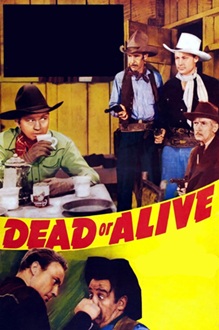
Dead Or Alive (1944, directed by Elmer Cifton)


In this Poverty Row western, the Texas Rangers, a trio of western do-gooders who appeared in a handful of films, are sent to a small town to stop the Yackey Gang, led by the town’s saloon keeper (Ray Bennett).

The Texas Rangers are led by Tex Haines (Tex Ritter), who is known as the Idaho Kid despite apparently being from Texas.  Tex goes undercover as a lawyer and tries to rally the community to stand up the Yackey Gang.  Tex also sings some songs because he’s a singing cowboy along with being a cowboy who can hold his own in bar brawl.  Maybe if he didn’t sing so much, there wouldn’t be as many brawls.  Dave Wyatt (Dave O’Brien) is the younger Ranger who goes undercover and joins that Yackey Gang.  Panhandle Perkins (Guy Wilkinson) is the comic relief, who loses a lot of money at Yackey’s casino but only to help Dave maintain his cover.  The film was an obvious rush job and the plot is far more difficult to follow than any 54-minute film should be.  The kids at the matinee probably enjoyed it, though.  It delivers exactly what fans of the old B-westerns expect, including Charles King as yet another villain.

Tex Ritter, who appeared in a lot of these films, was also the father of actor John Ritter.  In 1970, long after the days of the poverty row westerns, Tex Ritter ran for the Senate in Tennessee but he lost the primary.  If he had won, he would have been the Republican candidate against Al Gore’s father.  That would have been a battle for the ages.

Shadows of Death (1945, directed by Sam Newfield)


After a railroad agent is murdered and his map of the future locations of the railroad is stolen, Billy Carson (Buster Crabbe) rides into a frontier town and searches for the guilty party.  Fortunately, for Billy, his best Fuzzy Q. Jones is the mayor, the sheriff, and the town barber!  Unfortunately, local gunslinger Clay Kincaid (Eddie Hall) wants to make a name for himself by taking on the famous Billy Carson.  Corrupt businessman Landreau (Charles King) encourages Clay by lying to him and telling him that Bully is planning on stealing Clay’s girl, Babs (Dona Dax).

A standard Poverty Row western, Shadows of Death was made by the same crew and cast who were involved with most of Buster Crabbe’s Billy The Kid films.  I’m not sure if Billy Carson is meant to be the same character as Billy the Kid, though.  Billy the Kid always had bounty hunters after him but Billy Carson works for the railroad.  However, it would be strange if Fuzzy Q. Jones just happened to be the favored sidekick of two gunslingers who just happen to both be named Billy.  Along with Fuzzy’s vaudeville style comedy, one thing that audiences could always take for granted was that Charles King would play the villain in these movies and Frank Ellis would always be his henchman.  I always wonder if audiences in the 40s noticed that Charles King’s businessman and Frank Ellis’s gunslinger always returned from the dead with every B-western that came out.

My favorite scene in this one is Billy bursting into Landreau’s office, just for Landreau to say that he expects visitors to knock.  Billy pauses long enough to knock on the door before getting down to the business of frontier justice.

Cattle Stampede (1943, directed by Sam Newfield)


Billy the Kid (Buster Crabbe), that western do-gooder who has been framed for crimes that he didn’t commit, narrowly escapes being captured by a group of bounty hunters.  To thank the man who helped him and his sidekick, Fuzzy Q. Jones (Al  St. John), escape, Billy agrees to help the man’s family make a cattle drive.  It turns out that local ranchers are being targeted by rustlers who cause the cattle to stampede and then buy up what’s left of the herd at a discount.  Even though Mary Dawson (Frances Gladwin) doesn’t trust Billy and initially suspects him of being one of the rustlers, Billy and Fuzzy take over the cattle drive and protect the family from Coulter (Glenn Strange) and Elkins (Frank Ellis).  They even prove their worth by rescuing Mary after she’s kidnapped by the villains.

This is one of the many Poverty Row westerns to feature Billy the Kid not as an outlaw but instead as a hero.  Best-known for playing Tarzan, Flash Gordon, and Buck Rogers, Buster Crabbe was a believable hero even if he was more than a little too old to be nicknamed “the kid.”  Al St. John provides the comedic relief and veteran bad guys Charles King, Glenn Strange and Frank Ellis go through the motions as the villains, much as they did in countless other westerns of the era.  Cattle Stampede is typical of the cheap western programmers that came out of the Poverty Row studios in the 40s.  It was simplistic and predictable but featured enough western action to keep the kids in the audience entertained.  Today, its main selling point is a nostalgic one.

The Billy the Kid films are always strange because they avoid the reason why Billy is being pursued by the law and instead just present him as being another generic western hero.  It seems like a waste of a good legend.

The Lawless Nineties (1936, directed by Joseph Kane)


The year is 1890 and Wyoming is on the verge of voting for statehood.  Newspaperman Major Carter (George “Gabby” Hayes) believes that it’s time for Wyoming to become a state and most of the locals agree with him.  Businessman Charles Plummer (Harry Woods) does not want Wyoming to become a state and he’s willing to send out his main henchman, Steele (Al Bridge), to intimidate the voters and to silence Carter.  Plummer has a profitable racket going and the last thing he wants is for the U.S. government to get involved in his activities.  It falls to two federal agents, John Tipton (John Wayne) and Bridger (Lane Chandler), to supervise the voting and protect the citizen.  When Major Carter is shot by a drunk anti-statehood activist, the mission to make Wyoming a part of the Union becomes personal.

The Lawless Nineties is typical of the B-movies that John Wayne made for Republic Pictures before John Ford resurrected his struggling career by casting him as The Ringo Kid in Stagecoach.  There are plenty of gunfights and horse chases and explosions as the bad guys try to keep the townspeople from voting and the federal agents set up their own sting operation to expose Plummer’s gang.  Wayne seems more relaxed here than he did in some of his other B-movies.  He was obviously getting more comfortable with being on camera and playing the hero.  Probably the most interesting thing about this film is that Gabby Hayes (credited as George Hayes, without his famous nickname) plays the renowned and intelligent Major Carter.  Hayes was just a year away from establishing himself as a perennial B-movie sidekick and supplier comedy relief.  He would soon be best-known for playing characters who had little in common with the intelligent and well-spoken Major Carter.  In The Lawless Nineties, Hayes gets a chance to play something other than the comedic relief and turns out to be petty good at it.

This is another one of those westerns that will be enjoyed by fans of the genre.  It’s nothing special but it does allow Wayne to show hints of his future stardom and it also gives Gabby Hayes a chance to show what he was actually capable of.

Idaho Kid (1936, directed by Robert F. Hill)


When the wife of rancher Clint Hollister (Earl Dwire) died in childbirth, Clint was so distraught that he rejected his son, Todd.  Todd was raised by a rival rancher, John Endicott (Lafe McKee).  Hollister resented Endicott for taking his son and a feud developed between the two families.  Hoping the end the feud, 15 year-old Todd ran away from home and made a new life for himself as a frontier scout named Idaho.

15 years later, Idaho (Rex Bell) returns home with his sidekick, a reformed outlaw known as The Kid (David Sharpe).  Neither Hollister nor Endicott recognize Idaho and, without revealing his identity, Idaho tries to stop their feud.  Hollister’s men want to keep the feud going and they manipulate Hollister into challenging his own son to a duel.

Idaho Kid is one of the better B-westerns that Rex Bell made between 1928 and 1936.  Though the film has its share of action scenes, Idaho Kid‘s intelligent script puts more emphasis on character development than most B-westerns, with Hollister especially being portrayed as a complex character as opposed to just a stock western villain.  Rex Bell always seemed authentic whenever he was riding a horse or shooting a gun.  Idaho Kid shows that he could also play more than just a standard western hero.

Though he was being pushed for stardom by Fox Film, Rex Bell voluntarily retired from the film industry in 1936 and instead pursued a career in politics.  He was the Lieutenant Governor of Nevada when he died of a heart attack in 1962.


Riders of the West (1942, directed by Howard Bretherton)


In a frontier town, a gang of rustlers are stealing cattle as a part of a plot to force cash-strapped ranchers to take out exorbitant mortgages on their ranches.  Ma Turner (Sarah Padden) summons her old friend, Marshal Buck Roberts (Buck Jones), to come to town and take on the rustlers.  When the town’s corrupt banker is murdered and Ma Turner’s son, Steve (Dennis Moore), is framed for the crime, Roberts calls in his fellow Rough Riders, Tim McCall (Tim McCoy) and Sandy Hopkins (Raymond Hatton), to help him take down the gang.

In many ways, this is a familiar Rough Riders film, right down to the main bad guy being the owner of the town’s saloon and Charles King showing up as a member of the gang.  What sets it apart from the film that came before it is that, this time, Tim pretends to be an outlaw while Buck sets himself up as the new law in town.  Tim takes on the identity of Tim Steele, a sarsaparilla-drinking ne’er do well who has just gotten out of prison.  Jones and McCoy both seem to enjoy getting to switch their typical roles.  As for Sandy Hopkins, he goes undercover as a peddler of snake oil and provides the comic relief.  Riders of the West is a typical B-western but the chemistry between the three leads continues to shine through.

Previous Rough Rider Reviews:

  1. Arizona Bound
  2. The Gunman From Bodie
  3. Forbidden Trails
  4. Below the Border
  5. Ghost Town
  6. Down Texas Way

Ghost Town Law (1942, directed by Howard Bretherton)


When two U.S. marshals are ambushed and killed while searching for a group of outlaws in a nearly deserted ghost town, Marshal Tim McCall (Tim McCoy) leaves his ranch in Wyoming to investigate the crime.  He was friends with the two murdered men, making this case personal.  Of course, McCall’s two fellow Rough Riders ride into town to help McCall out.  Buck Roberts (Buck Jones) and Sandy Hopkins (Raymond Hatton) arrives separately and pretend to be prospectors.  Their investigation leads to the outlaws (led, as usual, by Charles King), a corrupt member of the community, and a network of underground tunnels that might lead to a gold mine.  As with all of the Rough Rider films, Ghost Town Law features a younger secondary protagonist who was there to appeal to audiences who didn’t remember Jones, McCoy, and Hatton from their silent and pre-code era heyday.  Virginia Carpenter plays Josie Hall, who comes to the town to search for her grandmother and brother.

Starting with the two marshals getting gunned down in the line of duty, this is one of the more violent of the Rough Riders films.  Since the Rough Riders are as interested in getting revenge as they are in getting justice, the Rough Riders themselves are quicker on the draw than usual.  The identity of the main villain will not be a shock to anyone who has watched any of the other Rough Rider films but the use of the underground tunnels adds a new element of danger to the movie.  For once, the outlaws and the Rough Riders seem evenly matched.  The film also features the very lovely and likable Virginia Carpenter, making the last of her five film appearances.

As always, the main appeal is watching Jones, McCoy, and Hatton acting opposite each other.  Due to the nature of the case, all three of them are more serious than usual in Ghost Town Law but it is still enjoyable to watch them discuss what’s been happening at their ranches since the last movie.

Previous Rough Rider Reviews:

  1. Arizona Bound
  2. The Gunman From Bodie
  3. Forbidden Trails
  4. Below the Border