Film Review: Cop (dir by James B. Harris)


First released in 1988, Cop stars James Woods as Lloyd Hopkins, a homicide detective who does not …. wait for it …. GO BY THE BOOK!

Actually, has there ever been a movie about a homicide detective who always made sure to go by the book?  I’m sure there has been but I really can’t think of any off the top of my head.  Whenever a homicide detective shows up as the main character of a movie, you can be sure that he’s going to drink too much, carouse too much, and get yelled at by his superiors.  If the movie involves a serial killer, you can be sure that the detective and the killer are going to be mirror images of each other, two renegades who have found differing ways to work out their issues with the world.

As much as we talk about the cliché of the cop who does it his way, would we really want to see a movie about a cop who plays by the rules?  I mean, most people dread having to deal with cops.  It’s not just that cops usually bring bad news.  It’s also that dealing with a cop means having to spend a lot of time while they slowly and methodically go through all of their procedures.  There have been so many times that I’ve been pulled over speeding and I’ve just wanted to yell, “Just write the ticket!”  Most people agree that we need some sort of police force, regardless of what the Defund folks say.  But most people also hate following the rules, especially when those rules feel rather arbitrary.  That’s the appeal of the renegade cop.  The renegade cop fills a purpose in society but, at the same time, he dislikes dealing with all of the usual cop nonsense as much as the rest of us.

As for Lloyd Hopkins, he’s hyperactive, jittery, sleazy, and a terrible father and husband.  He cheats on his wife.  He tells his daughter all about the gory details of his job.  (His daughter, it should be noted, seems to enjoy hearing them.)  He obsesses on the crimes that he investigates and he pursues murderers with a fanaticism that suggests that Lloyd knows that he’s just one bad life choice away from becoming one of them himself.  (And, indeed, Lloyd kills quite a few people over the course of Cop, even allowing one person to get into another room and get a shotgun just so Lloyd will have an excuse to shoot him.)  Lloyd is someone who is dangerous to know but, at the same time, he’s also probably the only person who can stop the killer who is seemingly committing random murders in Los Angeles.

The plot is typical of films about obsessive detectives pursuing faceless killers but Cop stands out due to the director of James B. Harris and the lead performance of James Woods.  Harris creates an atmosphere of continual unease, one in which the viewers gets the feeling that anyone could become the killer’s next victim at any moment.  James Woods, meanwhile, plays Lloyd as being a live wire, someone who simply cannot stop thinking and talking because he knows that the minute he does, he’s going to have to take a serious look at the wreck of his life and his own less-than-stable behavior.  Lloyd may be a self-destructive bastard but he’s a compelling self-destructive bastard and, in this film’s version of Los Angeles, he’s about as close as one can get to avenging angel.  The film is full of good actors, like Charles Durning, Lesley Ann Warren, and Raymond J. Barry, but it is ultimately James Woods’s show.  Lloyd gets the film’s final line and it’s a killer but it works because, by the time he utters it, the viewer feels as if they have gotten to know Lloyd.

Cop is based on Blood on the Moon, a novel by James Ellroy.  I have not read that novel so I don’t know how closely Cop sticks to Ellroy’s original plot.  Nor do I know how James Ellroy felt about Cop, which was the first movie to be based on his work.  That said, Ellroy’s writing and Harris’s film share a dark vision of humanity and a subversive sense of humor.  Ellroy has often declared himself to be the world’s great crime novelist and, from what I’ve read of his work, I would tend to agree.  Cop is certainly not the greatest crime movie ever made (nor is it the best film to ever be adapted from Ellroy’s writing) but it’s still pretty damn good.
Horror On TV: The Hitchhiker 5.17 “Coach” (dir by Eric Till)


In tonight’s episode of The Hitchhiker, a track coach (Charles Haid) is freaking out over the prospect of his son (Jonathan Crombie) breaking his 25 year-old track record.  The coach ends up taking things to extreme to try to preserve his record.

This episode features a ferocious performance from Charles Haid, who plays the coach as every high school student’s worst nightmare.  This episode has a lot to say about both the strange rituals of athletic competitiveness and how some people are so scared of getting old that they’ll go to any extreme to hold on to their accomplishments of youth.

The episode aired on September 30th, 1989.

In the Line of Duty: A Cop For The Killing (1990, directed by Dick Lowry)


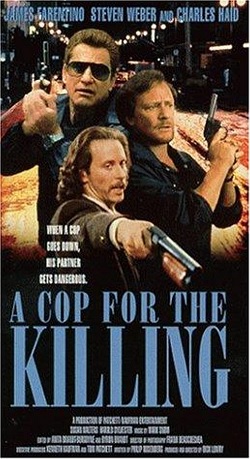
When an undercover narcotics operation goes wrong, a veteran cop (Charles Haid) is killed.  While the cop’s killer goes on trial, the members of the undercover squad struggle to deal with their feelings about what has happened.  The head of the squad (James Farentino) struggles with how much emotion he can show while still remaining a leader.  As his ex-wife puts it, he’s so busy staying strong for everyone else that he hasn’t been able to deal with his emotions.  Meanwhile, the dead cop’s partner (Steve Weber) has the opposite problem and starts to take dangerous risks on the job.  When it looks like the killer might get a plea deal from the district attorney, both Farentino and Weber are forced to come to terms with Haid’s death and their own feelings of anger and guilt.

In the early 90s, there was several “In the Line of Duty” films made for NBC.  They were all based (often loosely) on true stories and they dealt with members of the law enforcement who died while on the job.  The best known of these was probably Ambush in Waco, which went into production while the Branch Davidian siege was still ongoing.

A Cop For The Killing was the second of the In The Line of Duty films.  Unlike the later films in the series, it didn’t deal with a nationally-known case.  Instead, it just focused on one squad of cops and how the death of a member of the squad effected them.  With its ensemble of familiar television actors and Dick Lowry’s efficient but not particularly splashy direction, it feels more like a pilot than an actual movie.  Even though this film features the cops opening up about their feelings, there’s not much to distinguish it from other cop shows of the period.  If someone digitally replaced Steven Weber with Fred Dryer, it would be easy to mistake A Cop For The Killing for a two-hour episode of Hunter.  As with all of the In The Line of Duty films, there are a few scenes designed to show the comradery of the members of the squad but it again all feels too familiar to be effective.  Before Charles Haid dies, he and Steven Weber hang out at a bar and wrestle.  After Haid dies, Weber hangs out at a strip club that’s safe for prime time.  Judging from 90s television cop shows, undercover detectives were solely responsible for keeping most strip clubs profitable.

The cast is adequate.  Farentino is believable as the emotionally withdrawn commander.  Charles Haid makes the most of his limited screen time.  Tony Plana plays a smug drug lord who smiles even when he’s being booked.  It takes a while to adjust to Steven Weber playing a serious role but his courtroom meltdown is the movie’s highlight.  In The Line of Duty: A Cop For The Killing may not have led to a television series featuring Farentino and Weber taking down the bad guys but it did lead to another In The Line of Duty movie that I will take a look at tomorrow.

In The Line of Duty: Siege at Marion (1992, directed by Charles Haid)


After bombing several Mormon centers in Utah, religious extremist and polygamist Adam Swapp (Kyle Secord) has barricaded himself inside of a farm house with his wives and supporters. The FBI, led by Bob Bryant (Dennis Franz), have the house surrounded and are trying to convince Swapp to peacefully surrender. Swapp, however, has no intention of going down without a fight.

In the 1990s, NBC did a whole series of made-for-TV miniseries about real-life law enforcement operations that inevitably led to the death of at least one of the officers involved. They made so many of them and they churned them out so quickly that NBC even aired a movie about the Branch Davidian stand-off while it was still going on. Siege at Marion, the fourth of the In The Line of Duty films, feels like a precursor to what was eventually happen in Waco. Just as happened in Waco and with the attempts to arrest Randy Weaver at Ruby Ridge, critics claimed that the government came on too strong while the government claimed that they were merely enforcing the law.

Siege at Marion is the least interesting of all of the In The Line of Duty movies, mostly because the Marion siege was neither as mismanaged as what happened in Waco or as egregiously heavy-handed and disturbing as what happened in Ruby Ridge. Though based on a true story, Siege at Marion is a standard stand-off film with the only suspense coming from the film’s distasteful attempts to build up suspense as to whether it’ll be Dennis Franz, William H. Macy, or Ed Begley, Jr. who is killed in the line of duty. Since only one of them is given a backstory and a family, it’s easy to guess which one it will be.

The best thing about Siege of Marion is the cast. Dennis Franz was born to play cops and it’s interesting to see a pre-Fargo William H. Macy playing a non-nervous character. Kyle Secor is convincingly fanatical and unhinged as the messianic Adam Swapp. Secor would go on to star as Tim Bayliss on the much-missed Baltimore-set cop show, Homicide: Life on the Street. Speaking of classic cop shows, Siege at Marion was also directed by Charles Haid, who played Andy Renko on Hill Street Blues. As for the In The Line of Duty films, the last one was made in 1994 but they all live on in syndication.

Horror Film Review: Altered States (dir by Ken Russell)


You gotta watch out when it comes to those sensory deprivation tanks.  They may look like fun and it might seem like a pleasant idea to spend a while floating in and out of a state of consciousness but those tanks will mess you up.  Especially if you’ve got unresolved issues with your family and religion.

Also, if you’re going to go to Mexico to try a powerful hallucinogenic, make sure you’re not appearing in a Ken Russell film because again, those drugs will mess you up.  It’s like you’ll close your eyes and, when you reopen them, you’ll be in an 80s music video or something.

Now, to be honest, Altered States came out in 1980 so it’s a bit unfair to complain that it looks like a music video from the 80s or, for that matter, the 90s.  Instead, it’s more fair to say that a lot of the music videos from those two decades looked like Altered States.  That shouldn’t be particularly surprising since this film was directed by Ken Russell and Russell was a director who specialized in combining music with wild imagery.

Altered States may have been directed by Ken Russell but it was written by Paddy Chayefsky.  Chayefsky, of course, is best known for writing the script for Network.  (He also wrote the script for the Oscar-winning film, Marty.)  Chayefsky is one of those writers who is always cited as an inspiration by writers who are trying justify being heavy-handed.  For instance, when Aaron Sorkin was criticized for both Studio 60 On The Sunset Strip and The Newsroom, his supporters started talking about how he was just carrying on the proud tradition of Paddy Chayefsky.  In his autobiography, A British Picture, Ken Russell portrays Chayefsky as being a pompous control freak who refused to allow any changes to his dialogue-heavy script.  Russell responded by directing his actors to speak the dialogue as quickly as possible, rendering much of it incoherent.  In a few scenes, he even specifically had the actors eating so that their mouths would be full as they spoke.  Chayefsky was not amused and eventually demanded to be credited under his real name, Sidney Aaron.

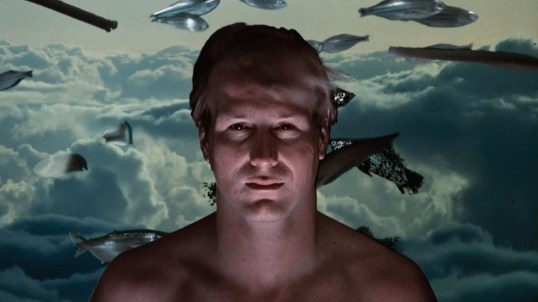
As for the film itself, it tells the story of Dr. Eddie Jessup (William Hurt, in his film debut), who is convinced that he can cure schizophrenia by exploring states of altered consciousness.  As mentioned above, this leads to him floating in a tank and taking hallucinogenics in Mexico.  Somehow, this leads to him turning briefly into a caveman and then into some sort of primordial energy creature.  His wife (Blair Brown) is not happy that Eddie appears to be determined to reverse evolution and return to mankind’s original form.  For that matter, Eddie’s bearded colleagues (Charles Haid and Bob Balaban) all think that he’s playing a dangerous game as well.  Eddie’s daughter (Drew Barrymore, making her film debut) isn’t particularly concerned but that’s just because she’s like five and probably thinks it would be fun to have a primordial energy monster to play with.  Anyway, it all becomes a question of whether or not all questions need to be answered and whether love can defeat science.

Anyway, this is a deeply silly movie but it’s also kind of compelling, mostly because the uneasy mix of Chayefsky’s pompous, serious-as-Hell script and Ken Russell’s aggressive and semi-satiric directorial style.  Chayefsky obviously meant for the story to be taken very seriously whereas Russell takes it not seriously at all.  Though Chayesfky and Russell ended up hating each other, Russell keeps the film from becoming the cinematic equivalent of Neil DeGrasse Tyson’s twitter account.  Chayefsky’s greatest objection was that Russell directed the actors to not only speak quickly but to also speak over each other but this actually works to the film’s advantage.  Eddie and his colleagues are young, arrogant, and determined to make their mark.  Of course, they’re going to speak quickly.  They’re excited and there’s no time to lose.  The film’s best moments are the early ones, where it’s hard not to get swept up in Eddie’s enthusiasm.  Of course, once Eddie turns into a caveman, it pretty much becomes impossible to take anything that follows seriously.

For all the talk about the origins of mankind and whether or not love can save the day, the main appeal of this film is to watch William Hurt totally freak out.  Jessup’s hallucinations allow Russell to do what he did best and they’re the highlight of the film.  Despite Chayefsky’s ambitions, you don’t watch this film for the science.  You watch it for the seven-eyed ram and the scenes of Eddie walking into a mushroom cloud.  Ken Russell was smart enough to know that audiences would take one look at William Hurt, with his WASP bearing, and totally want to see just how fucked up Eddie Jessup actually was.  On that front, Russell totally delivers.

This film is a mess but at least it’s a Ken Russell mess.


A Movie A Day #140: The Rescue (1988, directed by Ferdinand Fairfax)


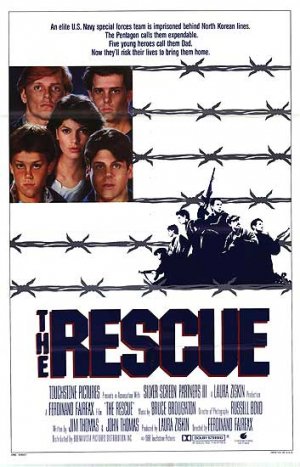
A group of Navy SEALs enter North Korea on a mission to destroy a submarine that has fallen into Kim Il-sung’s hands.  They destroy the submarine but are captured before they can safely cross the border back into South Korea.  With the SEALs facing a show trial and probable public execution, Admiral Rothman (James Cromwell) draws up a plan to rescure them.  The U.S. government, not wanting to escalate the situation, shoots down the plan.  (Americans giving up?  Is Carter still president?)  However, Rothman’s nerdy son, Max (Marc Price), gets a hold of the plan.  Before you can say “Why didn’t anyone else think of this?”, he and the children of the SEALs are sneaking into North Korea and rescuing their fathers!

This is a pure 1980s film.  Like Red Dawn, it shows that America is such a great country that even our teenagers are stronger than the average well-armed communist.  Of the actors playing the rescuers, the best known is Kevin Dillon.  He plays the rebel who smokes cigarettes and rides a motorcycle.  Though their relationship may be strained, his father (Edward Albert) is still happy when Dillon suddenly shows up in North Korea.  Soon, father and son are working together to blow up America’s enemies.  This movie’s about as dumb as they come and it’s another example of Hollywood presenting North Korea as just being the junior varsity version of China but it’s also undeniably entertaining, especially if you don’t care about things like plausibility.  Watch it the next time that Kim Jong-un threatens to blow you up.  Who needs Chuck Norris when you’ve got Kevin Dillon?