Welcome to Late Night Retro Television Reviews, a new feature where we review some of our favorite and least favorite shows of the past! On Fridays, I will be reviewing Friday the 13th: The Series, a show which ran in syndication from 1987 to 1990. The show can be found on YouTube!

This week, there’s something in the fog! Can Micki and Ryan stop the horror of the thing in the fog? FOG!
Episode 1.22 “The Pirate’s Promise”
(Dir by Bill Corcoran, originally aired on June 27th, 1988)
In the 18th century, a group of pirates killed their captain, Angus McBride, and stole his treasure. They used the money to start a seaside village in New England and to become respectable citizens. Over two hundred years later, the spirit of Captain McBride is hanging out in the fog and desiring vengeance on the descendants of his crew.
Hmmm …. this sounds familiar.
This episode has more than a little in common with John Carpenter’s The Fog. This time, as opposed to it being the result of an anniversary curse, it’s a crazed lighthouse keeper named Joe Fenton (Cedric Smith) who summons the ghost of Captain McBride with a cursed foghorn but otherwise, much of the plot and the show’s imagery feels as if it was lifted directly from Carpenter’s classic horror film. Captain McBride emerges from the fog several times during the episode. He kills his victim’s with a hook and then tosses a few coins at Joe.
Micki and Ryan show up in town to retrieve the foghorn. (This is another episode in which Jack is not present.) It’s interesting how these cursed antiques often tend to end up in small towns, like the one in this episode or The Quilt of Hathor. The previous few episodes featured Ryan having to say goodbye to someone as a result of a cursed item. This time, it’s Micki whose heart is broken when the sweet proprietor of the local history museum is stabbed with a saber while trying to protect her. The episode ends with Micki sobbing while Ryan tries to comfort her, which is quite a change from how these things usually go. For once, Micki is the one who gets to show emotion while Ryan is the one who takes a more pragmatic approach to dealing with the horrors of the cured antiques.
As for the episode, it wasn’t bad. Director Bill Corcoran did a good job of creating a properly ominous atmosphere and Cedric Smith was perfectly creepy as the evil lighthouse owner. The low-budget was evident by the fact that the time itself seemed to be nearly deserted. Even though the town was described as being small, it still seems like it should have been home to more than just a handful of people and I found myself wondering if maybe the show decided to save money by not hiring extras. That minor quibble aside, this was an effective episode as long as you were willing to overlook the plot’s similarity to Carpenter’s film.
Next week, hopefully, Jack will come back and maybe Micki will have cheered up. Someone likeable dies in every episode so you would think they would be used to it by now.
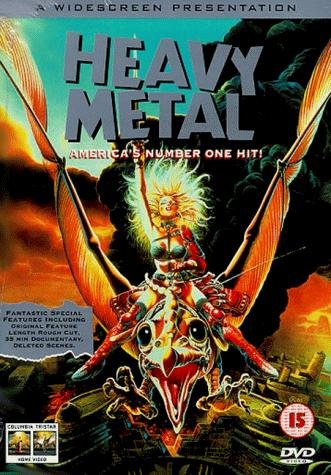 I think I was twelve when I first saw Heavy Metal. It came on HBO one night and I loved it. So did all of my friends. Can you blame us? It had everything that a twelve year-old boy (especially a 12 year-old boy who was more than a little on the nerdy side) could want out of a movie: boobs, loud music, and sci-fi violence. It was a tour of our secret fantasies. The fact that it was animated made it all the better. Animated films were not supposed to feature stuff like this. When my friends and I watched Heavy Metal, we felt like we were getting away with something.
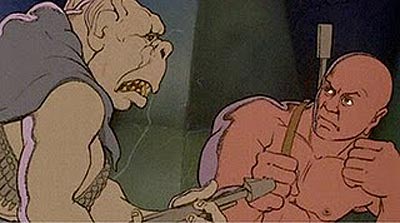 Den (directed by Jack Stokes, written by Richard Corben)
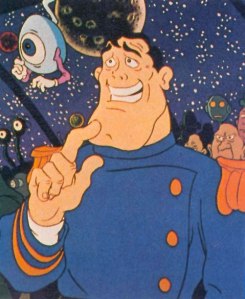 On a space station orbiting the Earth, Captain Lincoln F. Sternn is on trail for a countless number of offenses. Though guilty, Captain Sternn expects to be acquitted because he has bribed the prosecution’s star witness, Hanover Fiste. However, Hanover is holding the Loc-Nar in his hand and it causes him to tell the truth about Captain Sternn and eventually turn into a bloodthirsty giant. Captain Sternn saves the day by tricking Hanover into getting sucked out of an air lock.
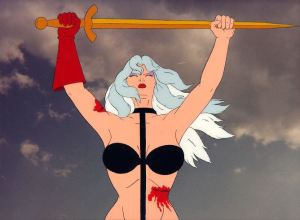 In the film’s final and most famous segment, Taarna, the blond warrior was featured on Heavy Metal‘s poster, rides a pterodactyl across a volcanic planet, killing barbarians, and finally confronting the Loc-Nar. She sacrifices herself to defeat the Loc-Nar but no worries! We return to Earth where, for some reason, the Loc-Nar explodes and the girl from the beginning of the film is revealed to be Taarna reborn. She even gets to fly away on her pterodactyl. Taarna was really great when I was twelve but today, it is impossible to watch it without flashing back to the Major Boobage episode of South Park.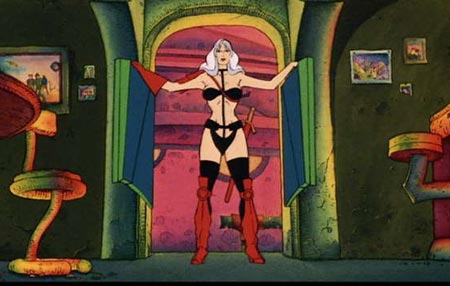
 Through the Shattered Lens