Amy (Denise Richards) grew up in the small town of Chestnut, where her Aunt Linda (Catherine Hicks) owned the local bakery and hosted the annual Christmas cookie contest. (Yum!) When Amy grew up, she moved away from Chestnut and got a job in New York at an advertising firm run by Don Dupree (Parker Stevenson). When Aunt Linda dies, she leaves half of the bakery to Amy. Aunt Linda’s last request was that Amy restart the annual cookie contest. The only problem is that the other half of the bakery has been left to Amy’s ex-boyfriend, Jack (Patrick Muldoon).
Sometimes, I wish that I lived in Hallmark Christmas movie because I would love to be able to just take off from my job and open a bakery in a small town. That would be a dream come true for me. I baked my first batch of Christmas cookie when I was six! (Mom helped.) Everyone said they were the best they had ever tasted! I think I could have won that cookie contest! Now, I wish I lived in Chestnut but I know that Chestnut is not a real place. It’s just somewhere that we all wish could be real.
I enjoyed A Christmas Reunion. It appealed to the romantic baker in me. Not only did Denise Richards and Patrick Muldoon spend a lot of time in the kitchen but they also outsmarted the crooked lawyer (Jake Busey) who wanted to sell the bakery to a Starbucks. I laughed when Busey gave them a contract to sign and said, “Just sign where the red flags are,” because his whole character was a red flag. A Christmas Reunion may not take place in the real world but it would be nice if it did.
A few months ago, I rewatched the original 1988 Child’s Play.
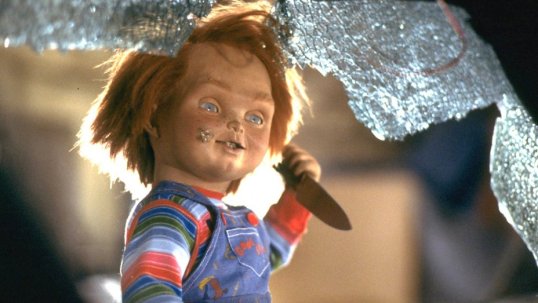
I have to say that I was surprised by just how well the film held up. Today, of course, everyone knows about Chucky. Everyone know that Chucky was originally Charles Lee Ray (Brad Dourif), a serial killer who was chased into a toy store by police detective Mike Norris (Chris Sarandon). Knowing that he had little chance of escaping and not wanting to go to back to prison or face the electric chair, Charles Lee Ray performed a quick occult ceremony. While lighting crashed all around the store, Charles transported his soul into a “Good Guy” doll.
That doll was later purchased by a hard-working, single mom named Karen Barclay (Catherine Hicks). She gave the doll to her six year-old son, Andy (Alex Vincent). There was nothing that Andy wanted more for his birthday than a talking Good Guy doll. Unfortunately, Good Guy dolls were also very expensive and Karen wasn’t sure if she’d ever be able to afford to buy one. But, when she ran into a homeless guy who happened to be selling stolen merchandise out of his shopping cart, Karen was able to make Andy’s birthday a happy one! Andy unwrapped the doll and smiled as the doll introduced himself as being “Chucky” and asked if he wanted to play.
Unfortunately, it soon turned out that Charles Lee Ray wasn’t going to stop killing people just because he was now trapped inside the doll. If anything, being trapped in the doll made Ray even more homicidal. It makes sense if you think about it. I’m sure that Charles Lee Ray didn’t realize that performing that voodoo curse would cause him to wake up as a plastic toy wearing overalls and being expected to be a 6 year-old’s best friend.
Anyway, Chucky went on a rampage, killed several people, and everyone blamed Andy. Not even Karen believed Andy when Andy explained that Chucky was the one killing people with toy hammers and blowing up houses. Or, at least, Karen didn’t believe Andy until she herself was attacked by Chucky. With Chucky freaking out about the prospect of being stuck in the doll’s body for the rest of his existence and wanting to possess his new owner instead, Karen and Mike teamed up to protect Andy from the world’s worst birthday present.
To be honest, Child’s Play shouldn’t work as well as it does. The story is ludicrous, even by the standards of late 80s horror. There’s no way that a doll should be able to do things like throw a hammer with enough force to send someone flying out of a window. (Making the scene even stranger is the fact that it’s not even a real hammer but instead a little plastic Good Guy hammer.) And yet, the film does work and not just as an example of nostalgic camp. This is a scary and emotionally effective story, even if you already know the truth about Chucky. It helps that Alex Vincent gives a totally natural, uncutesy performance as Andy. Your heart really breaks for him as he begs the adults in his life to understand that it’s Chucky who is doing all of the bad things and not him. As well, Catherine Hicks deserves a lot of credit for taking her role seriously. And finally, the great Brad Dourif does wonders with just his voice. At first, it’s undeniably funny to hear his angry voice coming out of Chucky but Dourif delivers his lines with such unhinged conviction that it’s actually rather frightening when he suddenly drops the act and starts cursing out Karen. After all of the sequels and the subsequent television shows, Chucky himself has become a bit of a pop cultural icon. He’s almost as lovable as Freddy and Jason combined. But in the first Child’s Play, that doll is seriously scary. He may be small but he has the energy and ruthlessness of a feral beast. When he attacks, you have no doubt that he’s not going to stop until he’s gotten what he wants and what he wants is usually for someone to die.
The first Child’s Play earns its status as a horror classic by being surprisingly scary and also surprisingly emotional. You really do end up caring about Karen and Andy. When Karen finally went after that smug, murderous doll, I definitely cheered a little. Take that, Chucky!
It takes a great director to come up with a movie as bad as Fever Pitch and, in his day, Richard Brooks was a great director. Among Brooks’s films as a director you’ll find titles like Blackboard Jungle, Cat on a Hot Tin Roof, Elmer Gantry, The Professionals, and In Cold Blood. These were all films that took risks and broke new ground and which were willing to defy the conventions of the time. Brooks was a director who told hard-boiled stories that dealt honestly with real-life issues.
Unfortunately, as often happens with great filmmakers, Brooks struggled to remain relevant as he got older. Hollywood’s sensibility eventually caught up with Brooks’s sensibility and then moved past it. While Brooks remained an interesting director, his final films often seemed to be the work of a grumpy old man who just wanted all those young people to stay off his lawn.
Fever Pitch, Brooks’s final film, stars Ryan O’Neal as Steve Taggart. Taggart is a sports writer for The Los Angeles Herald Examiner. He’s been writing a series of stories about a compulsive gambler named Mr. Green. The stories are so popular that his editor (John Saxon) has no problem giving Taggart $10,000 so that Taggart can then give the money to Mr. Green so that Mr. Green can continue to gamble. What anyone, especially the editor of a major newspaper, should be able to figure out is that Mr. Green is actually Steve Taggart.
Taggart takes the money to Las Vegas, where he hits the casinos while also researching the root causes of gambling. On the one hand, Brooks includes a lot of scenes of Taggart listening to real people explain the history and the dangers of gambling, often in the most didactic ways possible. (Hank Greenspun, the legendary publisher of The Las Vegas Sun, appears as himself and shows why he became a publisher and not an actor.) On other other hand, MGM not only produced the film but allowed it to be filmed at the MGM Grand Resort & Casino in Las Vegas. Fever Pitch is anti-gambling film that also doubles as a commercial for a casino. It’s like an anti-smoking film that gives everyone in the audience a free pack of Camels.
Steve hooks up with an unbelievable wholesome prostitute played by Catherine Hicks. He also has to deal with several shady characters, including a veteran gambler named Charlie (Giancarlo Giannini) ad a debt collector named The Hat (played by William Smith). Taggart is obsessed with gambling but he doesn’t seem to be very good at it, as he keeps getting beat up and threatened. Eventually, he goes to a Gamblers Anonymous meeting and he seems to be ready to admit that he has a problem and that it’s keeping him from being a good father to his daughter. That might seem like the ideal place for the movie to end but instead, Taggart has to try his luck with just one last slot machine.
Fever Pitch is doomed from the minute Ryan O’Neal starts his narration. Nothing about O’Neal suggests that he could be capable of writing a hard-hitting expose about the life of a compulsive gambler. In this film, he doesn’t even come across like he would be capable of reading it. O’Neal is too passive of an actor to be a convincing gambler and his wooden performance clashes with Brooks’s attempts to create a hyperkinetic feel to the Vegas scenes. While everyone in the film is lecturing him about the dangers of gambling, O’Neal sit there with same blank look on his face.
A critical and a commercial failure, Fever Pitch was Brooks’s final film. He died seven years later, leaving behind a legacy of important movies that cannot be tarnished even by something like Fever Pitch.
The 1989 film, She’s Out of Control, tells the story of Doug Simpson (Tony Danza, showing why he never became a movie star), a radio manager and the single father of two daughters. When Doug goes out of town, his girlfriend, Janet (Catherine Hicks), gives 16 year-old Katie Simpson (Ami Dolenz) a make-over. When Doug leaves, Katie is awkward and wears braces and thick glasses. When he returns, she’s lost the braces, she’s switched to contacts, and every boy in the neighborhood wants a date with her. Doug freaks out.
And listen, I get it. I know that the point of the film is that parents are protective and I know that when I first started to develop and get noticed by boys, certain members of my family freaked out as well. (Of course, I was a little bit younger than Katie, who is portrayed as being the most absurdly sheltered 16 year-old of all time.) And I also understand that this film is not only a comedy but also an 80s comedy and, on top of that, an 80s comedy starring Tony Danza. So, I’m willing to accept that Doug’s reaction had to be exaggerated a bit for the joke, as it is, to qualify as being a joke.
But seriously, Doug freaks out so much that it’s just really creepy, not to mention a little bit insulting to teenage girls in general. Katie loses her glasses and her braces and suddenly, Doug is incapable of seeing her as being anything other than some sort of hypersexualized vixen. Doug goes from being protective to being rather obsessive and, since the film is told from his point of view, that means that, whenever the camera ogles Katie, it comes across as if Doug is ogling his own daughter and …. I mean, yeah, it’s pretty icky. The film’s title may be She’s Out Of Control but that’s never an accurate description of anything that Katie does over the course of the film. Instead, the only person who is truly out of control is Doug but he’s out of control to such an extent that it’s hard to watch him without hearing the voice of Dr. Phil in background, saying, “I’m a mandated reporter so I’m going to be makin’ a call as soon as the show is over….”
Speaking of everyone’s favorite unlicensed TV doctor, Doug starts to see a psychologist who is an even bigger jackass than Dr. Phil and that’s probably a good thing. Not only does Doug clearly need some mental help but it also allows the film to introduce Wallace Shawn as Dr. Fishbinder, the pompous author of a book that deals with how to raise an unruly teenager. Shawn is one of the film’s few good points. He plays Fishbinder as being such a self-important little weasel that he’s always entertaining to watch. Fishbinder encourages Doug to be strict and warns him that, if he isn’t, Katie will be pregnant in no time. Definitely, don’t let her to go to prom. “That’s where 87% of teenage girls lose their virginity!” Fishbinder exclaims, news to which Tony Danza responds by mugging for the camera like an extra in a Roger Corman monster film.
Katie has many suitors over the course of the film, some of whom are more memorable than others. Dana Ashbrook (who played drug dealer-turned-deputy Bobby Briggs on Twin Peaks) is the rebel with a heart of gold. A very young Matthew Perry is the spoiled rich kid who is only interested in one thing. An even younger Dustin Diamond (you might know him better as Screech Powers on Saved By The Bell) pops up as a kid who gawks at Katie on the beach. And while Doug comes across as being a jerk for most of the film, one can understand why anyone would be upset at the thought of Dustin Diamond coming any parent would be upset by the thought of Dustin Diamond coming anywhere near their daughter.
In the end, the main problem with the movie is that it asks you to sympathize with Doug Simpson but he’s so obviously overreacting to every little thing that you quickly grow tired of him and his worries. Of course, it doesn’t help that he’s played by Tony Danza, whose eyes often seem as if they’re on the verge of popping out of his head. Danza wanders through the movie with a perpetually shocked expression on his face and it gets old after a while. By the time he’s forcing his daughter’s friends to listen to songs from his old vinyl collection, most viewers will be done with him. It doesn’t help that Doug is described as being some sort of former hippie protester type. It’s hard to think of any other boomer actor who would be less convincing as a former hippie than Tony Danza.
She’s Out Of Control is a forgettable and, quit frankly, rather annoying little film. However, it has achieved a certain bit of fame because it was one of the film’s that Roger Ebert consistently cited as being one of the worst that he had ever reviewed. You have to keep in mind that Ebert was a film reviewer for over 40 years and during that time, he reviewed a lot of movies that he disliked. He even published at least three books devoted to negative reviews that he had written. Considering the amount of bad films that Ebert watched, the fact that he specifically cited She’s Out Of Control as one of the absolute worst films that he had ever sat through …. well, it was enough to encourage me to actually watch the film when I came across it on Starz. And, in this case, Ebert was right. It was pretty bad.
She’s Out Of Control is a dumb movie about dumb people doing dumb things. The key word is dumb.
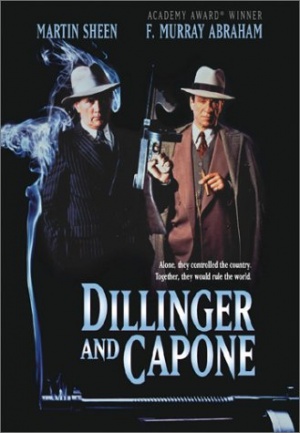
1934. Chicago. The FBI guns down a man outside of a movie theater and announces that they have finally killed John Dillinger. What the FBI doesn’t realize it that they didn’t get Dillinger. Instead they killed Dillinger’s look-alike brother. The real John Dillinger (played by Martin Sheen) has escaped. Over the next five years, under an assumed name, Dillinger goes straight, gets married, starts a farm, and lives an upstanding life. Only a few people know his secret and, unfortunately, one of them is Al Capone (F. Murray Abraham). Only recently released from prison and being driven mad by syphilis, Capone demands that Dillinger come out of retirement and pull one last job. Capone has millions of dollars stashed away in a hotel vault and he wants Dillinger to steal it for him. Just to make sure that Dillinger comes through for him, Capone is holding Dillinger’s family hostage.
This film, which was produced by Roger Corman, combines two popular but probably untrue rumors, that Dillinger faked his own death and that Al Capone had millions of dollars stashed somewhere in Chicago. Though the two never met in real life (and moved in very different criminal circles), the idea of bringing Dillinger and Capone together sounds like a good one. Unfortunately, the execution leaves a lot to be desired. Sheen and Murray are both miscast in the lead roles, with Sheen especially being too old to be believable as the 40 something Dillinger, and the script never takes advantage of their notoriety. In this movie, Dillinger could just as easily be any retired bank robber while Capone could just as easily be any unstable mob boss. In classic Corman fashion, more thought was given to the title than to the story.
One things that does work about the movie is the supporting cast, which is full of familiar faces. Clint Howard, Don Stroud, Bert Remsen, Jeffrey Dean Morgan, Catherine Hicks, Maria Ford, and Martin Sheen’s brother, Joe Estevez, are all present and accounted for. Especially be sure to keep an eye out for Jeffrey Combs, playing an FBI agent who suspects that Dillinger may still be alive. He may not get to do much but he’s still Jeffrey Combs.
(Lisa recently discovered that she only has about 8 hours of space left on her DVR! It turns out that she’s been recording movies from July and she just hasn’t gotten around to watching and reviewing them yet. So, once again, Lisa is cleaning out her DVR! She is going to try to watch and review 52 movies by Wednesday, November 30th! Will she make it? Keep checking the site to find out!)
Now that Thanksgiving has passed and that I’m back home, it’s time for me to get back to cleaning out the DVR. As a result of my own arbitrary time limit, I have 4 days to watch and review 40 films. Will I make it!? Well, we’re about to find out.
Earlier today, I finally got around to watching Honeymoon From Hell! Honeymoon from Hell originally aired on the Lifetime Movie Network on July 16th! I can’t remember exactly why I missed it. Maybe I was watching a killer shark movie. But anyway, I just watched it and I’m glad that I did!
Honeymoon From Hell was originally entitled The Legend of Alice Flagg. Who, you might be asking, is Alice Flagg? In 1849, Alice Flagg was a young woman living in South Carolina. Alice’s wealthy family was aghast when she fell in love with a common lumberman. Alice, however, refused to end their relationship. When the lumberman gave her an engagement ring, Alice knew she couldn’t wear it on her finger so, instead, she attached it to a ribbon and wore it around her neck. After briefly trying to run away from her controlling family, Alice was taken ill and died. Her father refused to allow her to be buried with her wedding ring and, as a result, it’s said that the ghost of Alice still haunts South Carolina. She comes out at night and searches for her wedding ring.
Honeymoon From Hell opens with newlyweds Julia (Lexi Giovagnoli) and Rivers (Adam Hagenbach) listening as a tour guide tells the story of Alice Flagg. Julia immediately relates to the story. She also comes from a wealthy family and she has also upset her father by marrying someone from “outside of her class.” Rivers, on the other hand, is dismissive of the story. When the tour guide mentions that Alice’s spirit can be summoned by running in a circle around her grave, Rivers proceeds to do just that.
Bad Rivers!
However, at the moment, Rivers and Julia are more concerned with the hurricane that is projected to be heading towards South Carolina. They get a room in a bed and breakfast that’s run by a seemingly friendly but somewhat odd woman named Hazel (Catherine Hicks).
Julia, who has yet to tell Rivers that she’s pregnant, soon starts to feel that something bad is about to happen. She’s having strange dreams and, occasionally, she thinks that she sees a mysterious young woman watching her. (And yet, the woman is always gone upon a second look.) When Julia sees her husband talking to the flirtatious Janelle Gamble (Cameron Richardson), she starts to get paranoid. The nightmares get worse. And then, of course, someone tries to stuff a pillow over her face…
Meanwhile, the storm is approaching…
And Julia has lost her wedding ring…
Honeymoon From Hell was full of atmosphere and creepy melodrama. Lexi Giovagnoli and Adam Hagenbach make for a likable couple while Cameron Richardson gets all the best lines as Janelle. Catherine Hicks is wonderfully eccentric as the odd Hazel. Lifetime’s track record with the horror genre may be uneven but Honeymoon From Hell was a lot of fun.



 1934. Chicago. The FBI guns down a man outside of a movie theater and announces that they have finally killed John Dillinger. What the FBI doesn’t realize it that they didn’t get Dillinger. Instead they killed Dillinger’s look-alike brother. The real John Dillinger (played by Martin Sheen) has escaped. Over the next five years, under an assumed name, Dillinger goes straight, gets married, starts a farm, and lives an upstanding life. Only a few people know his secret and, unfortunately, one of them is Al Capone (F. Murray Abraham). Only recently released from prison and being driven mad by syphilis, Capone demands that Dillinger come out of retirement and pull one last job. Capone has millions of dollars stashed away in a hotel vault and he wants Dillinger to steal it for him. Just to make sure that Dillinger comes through for him, Capone is holding Dillinger’s family hostage.
 Through the Shattered Lens