Late Night Retro Television Review: Baywatch Nights 2.11 “Possessed”


Welcome to Late Night Retro Television Reviews, a feature where we review some of our favorite and least favorite shows of the past!  On Tuesdays, I will be reviewing Baywatch Nights, a detective show that ran in Syndication from 1995 to 1997.  The entire show is currently streaming on YouTube!
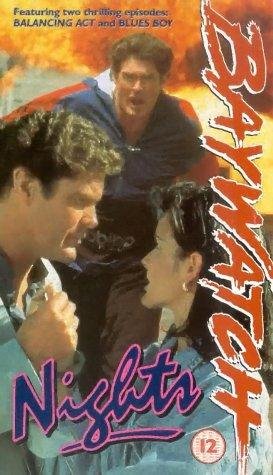
This week, Donna’s got a knife!

Episode 2.11 “Possessed”

(Dir by David W. Hagar, originally aired on February 2nd, 1997)

A notorious serial killer dies when a prison bus is struck by several cars.  His blood gets on several of the people present at the accident and, as a result, he starts possessing them person-by-person.  He inhabits a body, commits several murders, and, once his current body expires, he moves on to the next person.

For instance, lifeguard Donna DiMarco was on the scene of the accident and soon, she finds herself putting on sexy lingerie, grabbing a knife, and driving around in search of young hitchhikers to seduce and kill.  Oh no!  That’s not the Donna that we all know.  Fortunately, Mitch and Ryan realize what’s happening and Mitch is able to track Donna down before she kills her first hitchhiker.  The killer’s spirit flees Donna’s spirt and possesses its next victim.

Ray Reegun (Robert Ginty) is a cop who was one of the first people on the scene of the accident.  When he becomes possessed by the killer, he immediately heads down to Mitch’s office and kidnaps Ryan.  While Mitch tries to find them, Ray takes Ryan to an abandoned movie theater and tells her about all of the great movies that have premiered at the theater.

“Is this you or is this the killer?” Ryan asks.

It seems like a strange question to ask.  I mean, does it really matter?  Ray is possessed by a serial killer and is holding Ryan prisoner.  So, whether it’s Ray or the killer who is into the movies really doesn’t seem that important.  Bad people can like movies too, after all.  And Ray’s married so if he’s the one flirting with Ryan at the theater, that’s not a good thing.

Fear not, though.  Mitch is able to save both Ryan and Ray.  It’s left ambiguous as to whether or not the evil spirit has truly been defeated after it leaves Ray’s body.  The episode actually ends with Ryan and Mitch leaving to check on another person who was at the accident so who know?  We know that Mitch went back to being a lifeguard after the end of this season but we don’t know what happened to Ryan.  Maybe she’s still running around the country, trying to track down that spirit.

It’s an interesting idea.  I liked the idea of the spirit jumping from person-to-person and the idea of the spirit moving in the order of the people who arrived at the scene of the accident predates the Final Destination films.  The first half of the show, which featured Donna trying to kill that hitchhiker, was enjoyably absurd,  But the stuff with Ray and Ryan got bogged down with Ray giving that endless monologue in the theater.  Watching this, one gets the feeling that whoever wrote the episode lost intrest about halfway through.  Not even the presence of Robert Ginty can liven things up.

Oh well.  Next week — two Vikings come back to life and they’re mad!  Woo hoo!

For Your Consideration #2: The Purge: Anarchy (dir by James DeMonaco)


The_Purge_–_Anarchy_Poster

Yes, I know what you’re saying.

“Seriously, Lisa!?  We should give awards consideration to The Purge: Anarchy!?  Are you serious!?”

Yes, actually I am quite serious.  Notice that I didn’t say that we should necessarily give The Purge: Anarchy any awards or that we should even nominate it.  I just said consideration.  For whatever flaws that The Purge: Anarchy may have, it’s actually one of the better and, in its way, one of the more thought-provoking mainstream American films released this year.  Working within the guise of being a simple genre film, The Purge: Anarchy is one of the few films to give serious consideration to the politics and culture that could both lead to and result from dystopia.

What I’m saying is that — despite what the critics may have said last summer — The Purge: Anarchy is actually one of the most subversive and intellectually curious films released this year.  You just have to be willing to look past all of the action conventions and instead focus on the film’s subtext.

The Purge: Anarchy takes place one year after the end of the first Purge film.  America is still led by the New Founding Fathers and every year, for one night, all crime is legal.  As the national media constantly assures everyone, the Purge is responsible for every good thing about America.  And even though there are a few rebels who claim that the Purge is not necessarily a good thing, most people chose to believe that — as long as it’s government-sanctioned — it’s for the best.

Whereas the first Purge film took place solely inside one family’s house and focused on the domestic melodrama within, The Purge: Anarchy focuses on what goes on outside of the gated sanctuaries of the rich.  As quickly becomes apparent, the Purge is less about purging negative feelings and more about keeping the non-rich, non-white population under control.  While the poor kill each other in the streets, the rich pay for the privilege to kill poverty-stricken “volunteers” in the safety of their own homes.  (Some of the volunteers agree to die out of the hope that their family will be sent some money.  Most are just rounded up on the streets, killed, and forgotten.)

Perhaps even more so than the first film, The Purge: Anarchy works because it feels so plausible.  We live in a society where we are continually told that moral rights and wrongs can be determined by man-made laws.  When a man is filmed being literally choked to death by a pack of police officers, we’re told that it was the man’s fault because he was failing to respect authority and many choose to believe it because “the law is the law.”  (Never mind, of course, whether the law is being fairly applied or makes any sense to begin with.)  If a man in uniform is murdered, it’s rightfully called a crime.  If a man in uniform commits a murder, we’re told it’s simply a part of the job.

And so, that’s why I suggest that The Purge: Anarchy deserves greater consideration than it’s been given.  Yes, it is a genre film and yes, it is an installment in an action franchise.  However, it’s also far closer to the truth than many people are willing to acknowledge.