Late Night Retro Television Review: CHiPs 1.17 “Hitch-Hiking Hitch”


Welcome to Late Night Retro Television Reviews, a feature where we review some of our favorite and least favorite shows of the past!  On Mondays, I will be reviewing CHiPs, which ran on NBC from 1977 to 1983.  The entire show is currently streaming on Freevee!

This week, Baker solves everything!

Episode 1.17 “Hitch-Hiking Hitch”

(Dir by Phil Bondelli, originally aired on February 9th, 1978)

It’s another crazy week on the highways of California.

Baker saves a wind sailor who loses control of his boat while testing it on the freeway.  Baker saves a trucker when the brakes go out on his rig.  Baker helps out an old man (George Chandler) who refuses to leave his home until he’s promised that he and his dog won’t be put in an assisted living facility.  Baker tells two teenagers, Jenny (Lark Gein) and Marge (Stacy Nelkin), about the dangers of hitchhiking on the highways.

In other words, this is yet another first season episode of CHiPs where the main theme seems to be that Ponch is thoroughly useless.  Oh, don’t get me wrong.  Ponch definitely helps out.  When Baker tells Ponch to direct traffic, Ponch hops off his motorcycle and starts waving at cars to either stop or go.  But it’s still hard not to notice that, when something needs to be done, Baker is the one who does it.  Indeed, Baker is usually the only one who knows how to do it.  You have to kind of wonder why he’s not in charge since he always knows what to do.

Still, Sgt. Getraer is the man in charge and he’s been named “Sergeant of the Month” by CHiPs Magazine.  Ponch and Baker are worried that Getraer is too humble to really enjoy the honor.  For some reason, Ponch thinks that playing a joke on Getraer by switching out his helmet will make Getraer enjoy life more.  It really doesn’t make much sense to me but this is Ponch that we’re talking about.

There’s an odd scene where Ponch and Baker are having lunch at a diner.  A man in a van pulls up and sees that their bikes are in the parking spot that he wants.  The man, who is rather large, picks up the bikes and puts them on the sidewalk.  He then picks up a car and moves it to the side.  Luckily, Getraer rolls up and gives the guy a ticket.

While Baker and Getraer are doing their jobs, Ponch is trying to get laid.  When Mary Kate (Katherine Cannon) comes to the station to bail out her sister (who is one of the hitchhikers), Ponch takes one look at her and says, “I bet you were named after your grandmother, who was also very beautiful.”  Mary Kate responds that she was named after two spinster aunts.  She goes on a few dates with Ponch and claims that her sister has been led astray by her friend.  It turns out Mary Kate is wrong and her sister is the one who keeps insisting on hitchhiking.

The hitchhiking nearly ends in disaster but fear not!  Baker is there to save Marge from some creeps driving a van.  Seriously, what would California do without Jon Baker?

Anyway, the scene with the out-of-control truck was kind of exciting but otherwise, this was a typical episode of CHiPs.  It wasn’t particularly memorable but the California scenery was lovely to look at.  Anyone want to go wind sailing?
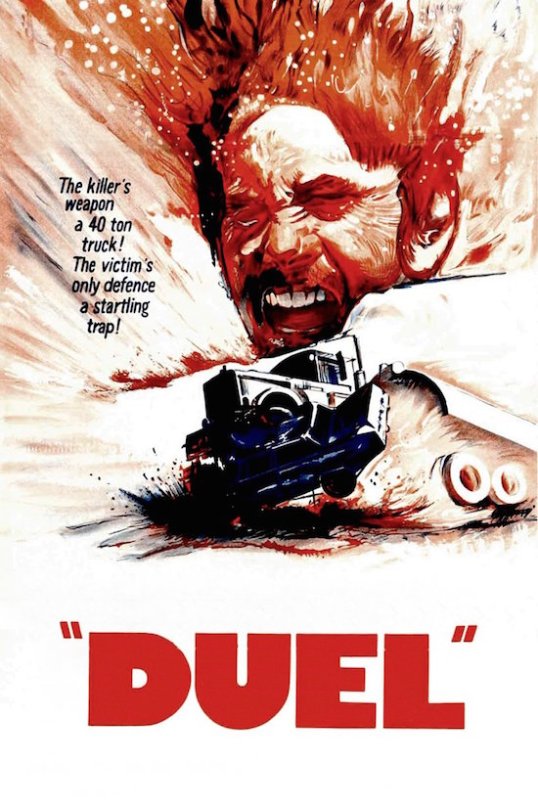
Cleaning Out The DVR Yet Again #24: Duel (dir by Steven Spielberg)


(Lisa recently discovered that she only has about 8 hours of space left on her DVR!  It turns out that she’s been recording movies from July and she just hasn’t gotten around to watching and reviewing them yet.  So, once again, Lisa is cleaning out her DVR!  She is going to try to watch and review 52 movies by the end of Tuesday, December 6th!  Will she make it?  Keep checking the site to find out!)

duel

On November 5th, I recorded the 1971 film Duel off of MeTV!

Duel tells the story of David Mann (played by Dennis Weaver).  The name is probably not a coincidence.  David is an “everyman,” if your idea of an everyman is a workaholic who is incapable of expressing his emotions.  David is driving through the California desert.  When he calls his wife (apparently, he left home in the morning without ever bothering to wake her), he tells her that he’s on a strict schedule and that he might lose an important sale if he’s delayed in any way.  You get the feeling, however, that David’s trip is less about business and more about a desire to get away from his life.  His conversation with his wife is strained and, when we watch him interact with a gas station attendant, we’re struck by how awkward David is.

Indeed, the only time that David seems to be really comfortable and relaxed is when he’s safely inside of his car.  When we first see him, he’s listening to a radio talk show and occasionally commenting on what he’s hearing.  David Mann has a better rapport with an unseen talk show host than he does with his own family.

Later, in the film, David is flagged down by a school bus that has stalled on the side of the road.  The bus driver asks David to give him a push.  For his part, David reacts with visible panic at the sight of several hyperactive children rushing towards his car. When they hop on his hood, David starts to frantically order them off.  It makes sense really.  The car is what he loves.

Of course, it’s not just bratty children that David has to deal with.  There’s also a gigantic truck traveling up and down the highway.  When David gets stuck behind the truck, he honks his horn.  He yells at the unseen driver.  He passes the truck at one point, just to have the truck promptly pass him so that it can continue to block him.  When the driver finally does motion for David to pass him, David changes lanes just to discover another car coming straight at him.

The truck’s driver, it turns out, wants to kill David.  Why does he want to kill David?  We’re never quite sure.  For that matter, we’re never quite sure what the truck is transporting, beyond the fact that it’s apparently flammable.  But the brilliance of Duel is that it doesn’t matter why the truck’s driver is trying to kill David. All that matters is that he’s determined to do so.

And David — the man who can’t even figure out how to have a conversation with his wife — must now try to figure out how to defeat a seemingly unstoppable predator…

Today, Duel is probably best known for being Steven Spielberg’s first film.  (It was a made-for-television production that got a theatrical release in Europe.)  Watching Duel (and Jaws, for that matter) it’s easy to imagine an alternative universe where, instead of becoming America’s best known creator of mainstream entertainment, Spielberg instead became one of America’s best horror director.  Duel is a suspense-filled thrill ride, one that’s scary because it remains rooted in reality.  Seriously, who hasn’t gotten nervous when they’ve found themselves sharing the road with a gigantic truck?

(If anything, I’d argue that Duel is scarier than Jaws.  I mean, I live in Dallas so it’s not like I have to worry about getting attacked by a shark.  On the other hand, I drive my car nearly every day.)

Dennis Weaver plays the archetype of what would become the typical Steven Spielberg protagonist and he does an excellent job in the role.  Weaver is on screen throughout the entire movie.  We see the entire story unfold through his eyes and Weaver gives a harrowing performance as a man who is slowly but steadily pushed to the verge of a breakdown by an enemy that he cannot even begin to comprehend.

If you haven’t seen Duel, you need to.