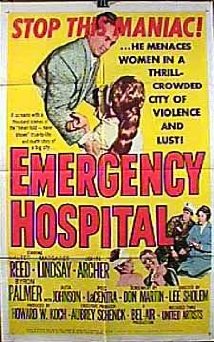
Right now, on Netflix, you can find Emergency Hospital, a low-budget film from 1956. Emergency Hospital, which probably was made to be the second feature on a double bill, covers the course of one night at a hospital. Patients come in. Crimes are investigated. Two doctors — one a man and one a woman and since this film was made in the 50s, that leads to all sorts of confusion — deal with all of the patients. The film manages to stuff a lot of incidents into just 61 minutes of running time.
If you look at the poster above, you’ll see that it implores us to “STOP THE MANIAC! He menaces women in a thrill-crowded city of violent and lust!” I’m not really sure which of the film’s many subplots that is meant to refer to. At one point, the son of a police detective is brought in after crashing his car. He briefly attempts to hold a nurse hostage with a scalpel but, in the end, he doesn’t turn out to be much of a maniac.
In fact, if there’s anything that really distinguishes Emergency Hospital is just how low-key it is. For the most part, the film emphasizes the fact that everyone at the hospital is focused on doing her or his job. The patients all come in with their own individual melodramas but, for the most part, the doctors and the police all react calmly and rationally. It’s interesting to compare Emergency Hospital to something like Magnificent Obsession. Whereas Magnificent Obsession truly embraces the melodrama, Emergency Hospital invites the melodrama to pull up a chair and then tells it to calm down.
Perhaps because it was such a low-budget and obscure film, Emergency Hospital gets away with taking a look at and talking about issues that you normally wouldn’t expect to be so openly explored by a film made in the 50s. And, interestingly enough for a film made in a culturally reserved time, the doctors and nurses at Emergency Hospital take a rather open-minded and nonjudgmental approach to their patients. An anxious mother comes in with her bruised baby and is confronted about being an abusive parent. A teenage girl comes in after being raped and the doctors try to convince her father (who thinks his daughter’s reputation will be ruined) to call the police.
Now, make no mistake about it: Emergency Hospital is not a secret masterpiece. It’s an extremely low-budget movie that looks like an extremely low-budget movie. But, taking all that into consideration, it’s still a lot better than your typical 61 minute second feature.
Emergency Hospital can currently be watched on Netflix.

 Through the Shattered Lens