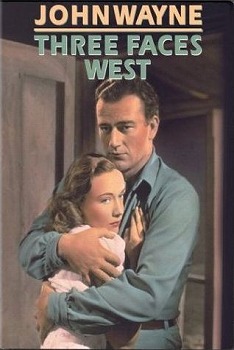
Three Faces West (1940, directed by Bernard Vorhaus)


When a small farming community in the Dakotas gets hit by an outbreak of the flu, farmer and community leader John Phillips (John Wayne) invites a Dr. Karl Braun (Charles Coburn) to come and be the town’s doctor.  A refugee from Austria, Dr. Braun arrives with his daughter, Leni (Sigrid Gurie).  At first, Leni is not happy living in the heart of the Dust Bowl but then she falls for John Phillips. However, Leni is still mourning his ex-fiancé (Roland Varno), who Leni and Braun believe sacrificed his life to help them reach America.

Eventually realizing that the town cannot prospers in the heart of the Dust Bowl, John suggests that everyone pack up and move to Oregon.  Almost everyone agrees and the one person who wants to go to California gets his van driven off the side of the road.  But Leni and Dr. Braun still take a detour to San Francisco because it turns out that Leni’s ex is not dead after all.  She and her father meet up with him and discover, to their horror, that he has become a fully committed Nazi.

This is an interesting change-of-pace for John Wayne.  Though the film is a western (and even features its own version of wagon train), it’s set in what was then contemporary times and it deals with issues like the Great Depression and the rise of Nazism in Germany.  The times may be hard but John Wayne isn’t going to let his community fall apart and, even more importantly, he’s not going to give up his beliefs or his ideals.  Even though the movie was made at a time when the United States was still officially neutral, the film is strongly anti-Nazi.  John Wayne, giving a strong performance, stands in for America while those who would collaborate with or make excuses for the Nazis represented by the weaselly Roland Varno.  Leni’s ex-fiancé had no problem selling out his beliefs and embracing Nazism.  Naturally, Leni and her father have no problem telling him off and then rejoining John Wayne in Oregon.  The United States may have officially been neutral but this movie had no problem letting everyone know where it stood.
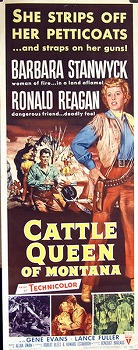
Cattle Queen of Montana (1954, directed by Allan Dwan)


Pop Jones (Morris Ankurm) and his daughter Sierra Nevada (Barbara Stanwyck) leave their ranch in Texas and head up to Montana to take over some land that Pop has inherited.  Evil Tom McCord (Gene Evans) wants the land for himself and conspires with a member of the local Blackfoot tribe, Natchakoa (Tony Caruso), to take it over.  After a surprise attack leaves Pop dead, Sierra is nursed back to health by Colorados (Lance Fuller), the son of the Blackfoot chief.  Sierra tries to reclaim her land from McCord, with the eventual help of the mysterious gunslinger Farrell (Ronald Reagan).

There are a lot of reasons why this B-western doesn’t really work, a huge one of them being that Barbara Stanwyck was several years too old to be playing Morris Ankrum’s innocent daughter.  The biggest problem though was casting Ronald Reagan as a mysterious gunslinger.  Farrell is a character who is supposed to keep us guessing.  We’re not supposed to know if he’s a good guy or a bad guy.  But as soon as Ronald Reagan shows up and starts to speak, we know everything we need to know about Farrell.  There was nothing enigmatic or even dangerous about Ronald Reagan’s screen persona.  He came across as being more open and honest as just about any other actor from Hollywood’s Golden Age.  For the role of Farrell, it appears that he went a day without shaving and he tried not to smile while on-camera but he’s still good old dependable Ronald Reagan.  That pleasantness and lack of danger may have kept him from becoming an enduring movie star but it did serve him very well when he moved into the political arena.

Cattle Queen of Montana was one of the 200 westerns that Allan Dwan directed over his long career.  It’s not one of his more interesting films, though he does manage a few good action sequences.  A far better Dwan/Reagan collaboration was Tennessee’s Partner, which was released four years after this film.

Halloween Havoc!: Boris Karloff in THE MAN THEY COULD NOT HANG (Columbia 1939)


gary loggins's avatarcracked rear viewer

maddoc1

Bela Lugosi ( see yesterday’s post ) wasn’t the only horror icon who starred in a series of low-budget shockers. Boris Karloff signed a five picture deal with Columbia Pictures that was later dubbed the “Mad Doctor” series and, while several notches above Lugosi’s “Monogram Nine”, they were cookie-cutter flicks intended for the lower half of double feature bills. The first of these was THE MAN THEY COULD NOT HANG, which sets the tone for the films to follow.

maddoc2

Karloff plays Dr. Henry Savaard, inventor of a new surgical technique that requires the patient to die, then reviving him with a mechanical heart after performing the operation. This later became standard operating procedure during open-heart surgery, but back in 1939 was considered science fiction! Anyway, Savaard’s young assistant Bob agrees to go through the experimental procedure, but his girlfriend freaks out and calls the cops, claiming Savaard is about to murder…

View original post 519 more words

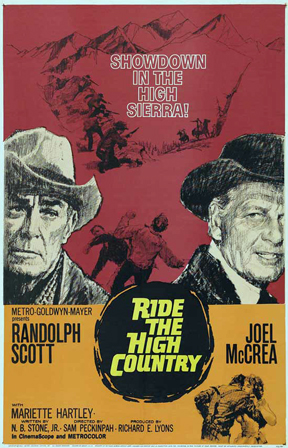
Thank You, Mr. Peckinpah: Ride the High Country (1962, directed by Sam Peckinpah)


rideIt’s the turn of the 20th century and the Old West is fading into legend.  When they were younger, Steve Judd (Joel McCrea) and Gil Westrum (Randolph Scott) were tough and respect lawmen but now, time has passed them by.  Judd now provides security for shady mining companies while Gil performs at county fairs under the name The Oregon Kid.  When Judd is hired to guard a shipment of gold, he enlists his former partner, Gil, to help.  Gil brings along his current protegé, Heck Longtree (Ron Starr).
On their way to the mining camp, they spend the night at the farm of Joshua Knudsen (R.G. Armstrong) and his daughter, Elsa (Mariette Hartley).  Elsa is eager to escape her domineering father and flirts with Heck.  When they leave the next morning, Elsa accompanies them, planning on meeting her fiancée, Billy Hammond (James Drury), at the mining camp.

When they reach the camp, they meet Bill and his four brothers (John Anderson, L.Q. Jones, John Davis Chandler, and the great Warren Oates).  Billy is a drunk who is planning on “sharing” Elsa with his brothers.  Gil, Judd, and Heck rescue Elsa and prepare for a final confrontation with the Hammond Brothers.  At the same time, Gil and Heck are planning on stealing the gold, with or without Judd’s help.

Ride the High Country was actually Sam Peckinpah’s second film but it’s the first of his films to truly feel like a Sam Peckinpah film.  (For his first film, The Deadly Companions, Peckinpah was largely a director-for-hire and had no say over the script or the final edit.)  Peckinpah rewrote N.B. Stone’s original script and reportedly based the noble Steve Judd on his own father.  All of Peckinpah’s usual themes are present in Ride the High Country, with Judd and, eventually, Gil representing the dying nobility of the old west and the Hammond brothers and the greedy mining companies representing the coming of the “modern” age.  Ride The High Country‘s final shoot-out and bittersweet ending even serve as a template for Peckinpah’s later work in The Wild Bunch.

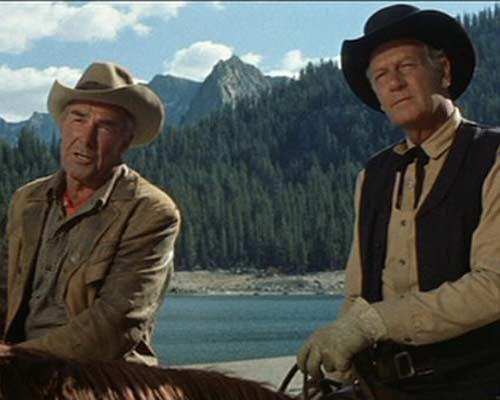
Much like the characters they were playing, Randolph Scott and Joel McCrea were two aging veterans on the verge of retirement.  For these two aging stars, who had starred in countless westerns before this one, Ride The High Country would provide both fitting farewell and moving tribute.  This would be the last chance that either of them would have to appear in a great movie and both of them obviously relish the opportunity.  The best moments in the film are the ones where Judd and Gil just talk with the majestic mountains of California in the background.

Among the supporting cast, Ron Starr and Mariette Hartley are well-cast as the young lovers but are never as compelling as Gil or Judd.  Future Peckinpah regulars R.G. Armstrong, L.Q. Jones, and Warren Oates all make early appearances.  Seven years after playing brothers in Ride the High Country, L.Q. Jones and Warren Oates would both appear in Peckinpah’s most celebrated film, The Wild Bunch.

The elegiac and beautifully-shot Ride The High Country was Sam Peckinpah’s first great film and it might be his best.

Randolph Scott and Joel McCrea in Ride The High Country

Randolph Scott and Joel McCrea in Ride The High Country