Billy The Kid Trapped (1942, directed by Sam Newfield)


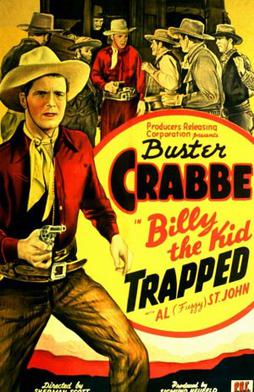
Billy “The Kid” Bonney (Buster Crabbe) and his two buddies Fuzzy (Al St. John) and Jeff (Bud McTaggart) are just trying to mind their own business and make a living in the old west but they keep getting accused of every crime that happens.  This time, they’re sentenced to hang for a crime they didn’t commit.  Luckily, a group of strangers break Billy and his friends out of jail and send them on their way to the next town.  However, the men who broke them out of jail are soon committing crimes while disguised as Billy, Fuzzy, and Jeff!  Billy teams up with Sherriff Masters (Ted Adams) to stop the imposters, who are working for Boss Jim Stanton (Glenn Strange).

One of the joys of Poverty Row westers like this one is that they always featured the same stock company.  Al St. John was everyone’s sidekick.  Ted Adams was often a sheriff.  Glenn Strange was always the criminal mastermind pulling the strings.  Milton Kibbee was always a corrupt judge or ranch owner.  George Cheseboro, Horace B. Carpenter, Jack Curtis, and Budd Buster are amongst the very familiar faces in Billy The Kid Trapped.  It gives each film a homey feel that will be appreciated by fans of the genre.  The hero of the films often changed but the stock company always remained the same.

I like the idea behind Billy The Kid Trapped but the film still feels repetitive, even though it’s less than an hour long.  After Billy captures the men who are imitating him and his friends, a crooked judge sets the men free and the immediately go back to imitating Billy.  Billy has to capture them all over again.  No wonder Billy aged so quickly!  (Buster Crabbe was in his mid-thirties when he was playing The Kid.)  The movie does have all the usual gunfights and horse chases that people watch these movies for.  It’s comforting that, no matter what, the villain is always going to turn out to be Glenn Strange.

Billy The Kid’s Smoking Guns (1942, directed by Sam Newfield)


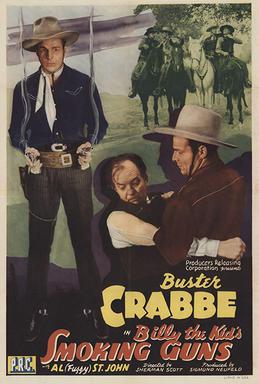
It’s a tale as old as time.  During the days when the west was wild, the U.S. Army is planning on setting up a new outpost near a town so the bad guys want to run all the ranchers off of their land so that they can be the ones to sell it.  Sheriff Carson (Ted Adams) is corrupt and working for the bad guys so the ranchers have to turn to Billy the Kid (Buster Crabbe) and his sidekicks, Jeff (Dave O’Brien) and Fuzzy (Al St. John) for help.  When Jeff is wounded in a fight, Fuzzy takes him to Doc Hagen (Milton Kibbee), little suspecting the doctor is actually the leader of the bad guys and using his medical practice to kill anyone who won’t give up their land!

Coming to us straight from Poverty Row, this B-western is interesting in that it seems to take a very cynical view of law enforcement.  Sheriff Carson is corrupt and Billy and his friends are running from the law themselves.  Buster Crabbe’s Billy the Kid films always kept it unclear why Billy was in trouble with the authorities.  Crabbe’s Billy the Kid always seemed to be the nicest guy in the west.  (Of course, Crabbe was also 33 and no longer seemed like he should have been known as “the Kid.”)  Eventually, the series was retconned and Buster Crabbe was no longer playing Billy the Kid but instead he was playing an upstanding citizen named Billy Carson.

Crabbe may not be a convincing outlaw but he is a convincing hero, which is all these films really required.  Billy the Kid’s Smoking Guns is a little bit interesting because of the character of Doc Hagen, whose occupation makes him a little more memorable than typical B-western bad guy.  The film is also interesting in that, for once, there’s no love interest.  Instead, it’s just men in hats shooting at each other.  That probably made the film’s youthful target audience happy.

The real-life Billy The Kid was killed when he was only 21 and after he had been an outlaw for only three years.  Buster Crabbe would g0 on to play Billy (or o some variation of Billy) until he was closing in on 40.


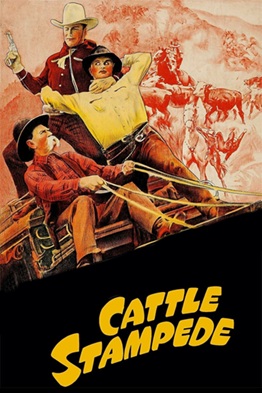
Cattle Stampede (1943, directed by Sam Newfield)


Billy the Kid (Buster Crabbe), that western do-gooder who has been framed for crimes that he didn’t commit, narrowly escapes being captured by a group of bounty hunters.  To thank the man who helped him and his sidekick, Fuzzy Q. Jones (Al  St. John), escape, Billy agrees to help the man’s family make a cattle drive.  It turns out that local ranchers are being targeted by rustlers who cause the cattle to stampede and then buy up what’s left of the herd at a discount.  Even though Mary Dawson (Frances Gladwin) doesn’t trust Billy and initially suspects him of being one of the rustlers, Billy and Fuzzy take over the cattle drive and protect the family from Coulter (Glenn Strange) and Elkins (Frank Ellis).  They even prove their worth by rescuing Mary after she’s kidnapped by the villains.

This is one of the many Poverty Row westerns to feature Billy the Kid not as an outlaw but instead as a hero.  Best-known for playing Tarzan, Flash Gordon, and Buck Rogers, Buster Crabbe was a believable hero even if he was more than a little too old to be nicknamed “the kid.”  Al St. John provides the comedic relief and veteran bad guys Charles King, Glenn Strange and Frank Ellis go through the motions as the villains, much as they did in countless other westerns of the era.  Cattle Stampede is typical of the cheap western programmers that came out of the Poverty Row studios in the 40s.  It was simplistic and predictable but featured enough western action to keep the kids in the audience entertained.  Today, its main selling point is a nostalgic one.

The Billy the Kid films are always strange because they avoid the reason why Billy is being pursued by the law and instead just present him as being another generic western hero.  It seems like a waste of a good legend.

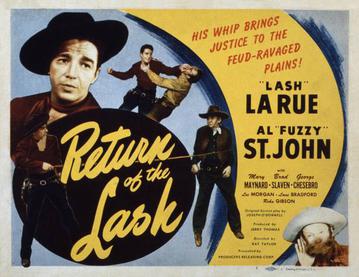
Return of the Lash (1947, directed by Ray Taylor)


There’s another range war brewing on the frontier.  Big Jim Kirby (George Chesebro) knows there’s plans for a new railroad so he wants to steal the land from the ranchers so he can make a fortune off a selling it.  Kirby calls in everyone’s mortgage, knowing they’ll never be able to pay.  Rancher Tom Grant (Buster Slaven) reaches out to Cheyenne Davis (Lash LaRue, a look alike for Humphrey Bogart)) and Fuzzy Q. Jones (Al St. John) for help.  Cheyenne raises the money but then he makes the mistake of trusting Fuzzy to deliver it.  Fuzzy takes a knock to the noggin and now, he’s got amnesia.  Where’s the money?

This is a standard B-western and you know the drill.  Big Jim’s henchmen don’t want that money to get paid.  Cheyenne is on the side of the angels.  Fuzzy provides comic relief.  Lash LaRue appeared in several B-westerns.  He never became as big a star as some of his contemporaries but he did have a gimmick that made him memorable.  Most westerns stars used guns.  LaRue had a bullwhip.  When LaRue was first offered the role of Cheyenne, he lied and said he could crack a whip.  After he struggled to teach himself, tiny production company PRC hired a professional trainer.  That was a huge expense for a poverty row studio but it paid off because LaRue became proficient with the whip and he had a surprisingly long career.  He was born Alfred LaRue.  The studio came up with the Lash nickname.  Many western stars, like Johnny Mack Brown, played characters who shared their name.  Lash almost always played Cheyenne Davis.

Lash LaRue’s movies were cheap and never that memorable.  In this one, Lash barely appears and most of the action is carried out by Al St. John as Fuzzy.  But Lash LaRue did play an important part in Hollywood history when he briefly came out of retirement to teach Harrison Ford how to crack a whip for a little film called Raiders of the Lost Ark.

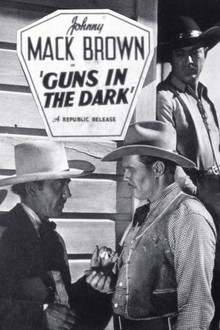
Guns In The Dark (1937, directed by Sam Newfield)


In Mexico, two American cowboys, Johnny Darrel (Johnny Mack Brown) and Dick Martin (Julian Madison) join a poker game to try to win some money and help out their buddy, Oscar (Sid Saylor).  When they discover that cantina owner Manuel Mendez (Ted Adams) has rigged the game, a fight breaks out.  The lights turn off.  In the darkness, several guns are fired.  When the lights come back up, Dick is dead.  Mendez convinces Johnny that he accidentally shot his friend in the fight.  Guilt-stricken, Johnny tosses aside his guns and returns to Texas.

Johnny has sworn that he will never shoot another gun but when he’s hired to work at a ranch owned by Joan Williams (Claire Rochelle), he finds himself in the middle of a range war between Joan and Brace Stevens (Dick Curtis), with Mendez also making an unwelcome return to Johnny’s life.  Even after Johnny discovers the truth about what happened that night at the cantina, he doesn’t pick up a gun.  Instead, Johnny fights the bad guys with lassos and plates.

Guns In The Dark is only 54 minutes long and it features actors who will be familiar to any fan of the old B-westerns.  Sidekcick Sid Saylor’s stuttering schtick gets old quickly but Johnny Mack Brown is as likable as always in Guns In The Dark and he comes across as being an authentic cowboy even when he’s not carrying a gun  Given that this film features even more horse chases than the typical Johnny Mack Brown b-western, it’s good that Brown is so convincing.  What isn’t convincing is how stupid Johnny Darrel is required to be in order for him to fall for Mendez’s lie in the first place.  I appreciated the change of pace from Brown just using a gun to stop the bad guys but I wish the reason behind it had been more convincing.  This isn’t one of Johnny Mack Brown’s more memorable westerns though, as always, it’s easy to see why he was one of the early stars of the genre.


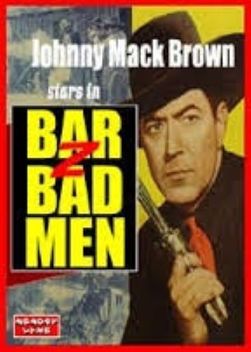
Bar-Z Bad Men (1937, directed by Sam Newfield)


After getting kicked out of town for shooting the place up during a night of friendly fun, cowboy Jim Waters (Johnny Mack Brown) drops in on his old friend, rancher Ed Parks (Jack Rothwell).  Ed has got a strange problem.  There are cattle rustlers about but instead of stealing Ed’s cattle, they’re adding cattle to Ed’s herd.  It’s an obvious scheme to try to create a feud between Ed and his neighbor, rancher Hamp Harvey (Frank LaRue).  Before Jim and Ed can solve the problem, Ed is gunned down.  Harvey is the number one suspect but Jim figures out the truth, that Harvey has been betrayed by one of his own employees and that all of this is a part of a scheme by Sig Bostell (Tom London) to take control of both ranches.

Bar-Z Bad Man is a B-western with a notably twisty plot as Bostell plays both sides against each other for his own benefit.  As usual, Johnny Mack Brown makes for a good and convincing western hero.  Whether he’s chasing someone on his horse or drawing his guns, Brown is always a convincing cowboy.  What makes this film interesting is that it opens with Johnny Mack Brown engaging in the type of behavior that most B-western heroes would never think of doing.  Shooting up the town and then getting exiled for his actions adds an element of redemption to Jim’s efforts to get to the bottom of Bostell’s schemes.  Or it would if Jim ever really seemed to feel bad about shooting the town up.  His excuse is that he was just having a good time.  Try to get away with that in the real old west, Jim!

Bar-Z Bad Men is a good B-western for those who like the genre.  The story is solid and Johnny Mack Brown is as convincing saving the west as he was shooting it up.


Chip of the Flying U (1939, directed by Ralph Staub)


In this B-western, Johnny Mack Brown plays Chip Bennett, the foreman of the Flying U Ranch.  The ranch is owned by J.G. Whitmore (Forrest Taylor) and his daughter (Doris Weston), who has just returned from college and who has eyes for Dusty (Bob Baker), a singing ranchhand.

Ed Duncan (Anthony Warde) and his gang are in the arms smuggling business.  To make their business a success, they need access to the ranch, which sits on the shore of a lake.  Knowing that Chip would never let them take over, Duncan tries to frame Chip for a bank robbery and murder.  Chip responds by kidnapping two of Duncan’s men, leading to a final and explosive shootout.

Chip of the Flying U is a western that doesn’t seem to know what era it’s supposed to be taking place in.  Chip, Duncan, and all of the other ranch hands dress like they’re in the late 1800s.  Doris Weston dresses like she’s just stepped out of a 1930s photoshoot.  Duncan is trying to smuggle hand grenades, which were invented in 1908 but not commonly used until World War I.  The movie’s time period is all over the place but that was frequently the case with the B-westerns of the 30s.  Shot on studio backlots and for a very low budget, these films were not concerned with historical accuracy.  Instead, they were about shootouts and a few songs.  Chip of the Flying U offers up both, along with Fuzzy Knight as the comedic sidekick who turns out to be very good with a rifle.

With lots of horse chases and bloodless shoot-outs and not too much romance, this movie may seem creaky by today’s standards but probably thrilled the kids who caught while spending an afternoon at the movies in 1939.  Today, the appeal of movies like this is that the good guys are unquestionably good and the bad guys are unquestionably bad.  They remind us of a simpler time that may have never existed but we all hope it did.

Texas Panhandle (1945, directed by Ray Nazarro)


Secret Service agent Steve Buckner (Charles Starrett) is told by his boss that his activities as the Durango Kid have led some in the Agency to suspect that Steve is himself an outlaw.  Even after Steve explains that he only takes on the Durango Kid identity when he needs to step outside of the law to protect innocent people, Steve is still suspended pending an investigation.

With nothing better to do, Steve rides off to the Texas panhandle, where he learns that outlaws have been robbing settlers and stealing government gold.  Working as the Durango Kid, Steve discovers that it’s not just outlaws that are targeting the new arrivals but it’s also the corrupt head of the local land office, Ace Gatlin (Forest Taylor).  Helping out Steve are settler Tex Harding and Cannonball (Dub Taylor), who works at the saloon and sings a few songs.

This is a standard Durango Kid film.  It has all the usual gunfights and horse chases but it doesn’t have Smiley Burnette.  Dub Taylor takes Smiley’s place as the comedic sidekick and, while Taylor isn’t bad, he’s still no Smiley Burnette.  Dub Taylor’s characters were usually more buffoonish than the clever helpers played by Smiley Burnette and, as a result, the Durango Kid movies with Taylor feel more juvenile than the ones with Smiley.  That’s the case here.

This installment is interesting because it reveals that Steve’s superiors knew about his Durango Kid side hustle and were as a confused about why he needed it as everyone else was.  Steve reveals he would rather lose his job than give up being Durango.  Luckily, at the end of the movie, he gets a telegram telling him that the investigation is over and he’s been reinstated with the Secret Service.  All’s well that ends well.

Six-Gun Law (1948, directed by Ray Nazarro)


Steve Norris (Charles Starrett) has moved to a new frontier town and is making a good living as a cattle rancher.  The sheriff (Ethan Laidlaw) takes a dislike to Steve and even accuses him of being a cattle rustler.  Steve is so angered that he plays right into the hands of Decker (Hugh Prosser), a corrupt businessman who secretly puts blanks into Steve’s gun and then tricks Steve into thinking that he has shot and killed the sheriff.

Decker appoints Steve as the new sheriff but demands that Steve do exactly what Decker orders him to do.  If Steve actually enforced the law, Decker will turn him in as the first sheriff’s murderer.  Steve may not be able to do anything about Decker’s crimes but his alter ego, The Durango Kid, can!  As always, working with Steve is his loyal sidekick, Smiley Burnette.

The stand-out set piece of this Durango Kid film is an exciting stagecoach chase, which features the Durango Kid (in the form of legendary stuntman Jock Mahoney) making some thrilling moves.  The scene was so exciting and popular that it was used in a dozen other Durango Kid films.  These movies were never shy about reusing good scenes, effective stunts, and plot twists.  (It’s easy to lose track of how many times Steve has been appointed as sheriff of a town.)  This was also neither the first nor the last time that Hugh Prosser and Robert Wilke would play bad guys in a Durango Kid movie.  However, this is the only Durango Kid film to feature the Rodeo Rangers providing musical accompaniment  to Smiley Burnette’s songs.

Six-Gun Law will be best appreciated by fans of the western genre.  Charles Starrett is as tough and authentic a cowboy as always and the storyline has some nice twists and turns.  For once, with Steve being blackmailed by Decker, it makes sense that Steve would put on his disguise and solve his problems as the Durango Kid.