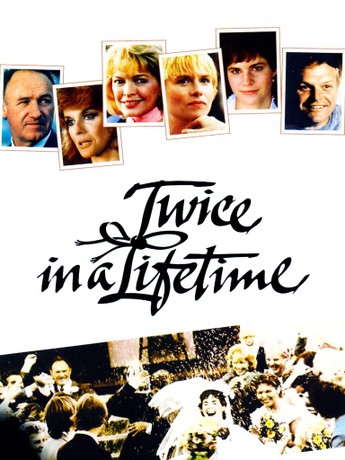
 Today, for obvious and tragic reasons, people everywhere have been thinking about their favorite Gene Hackman performances. Hackman was an actor who always brought his all, even when he was appearing in a lesser film. I think you could ask five different people for their five favorite Hackman performances and they would all give five different answers. His performance as Lex Luthor in Superman and Superman II has always been one of my favorites. Others will undoubtedly cite his award-winning performance as Popeye Doyle in The French Connection or his great work as Norman Dale in Hoosiers or his work in classic neo-noirs like The Conversation and Night Moves. Let’s not forget his most unexpectedly great turn, as the blind man in Young Frankenstein. Hackman gave so many great performances that some of them were for films that are not even remembered today.
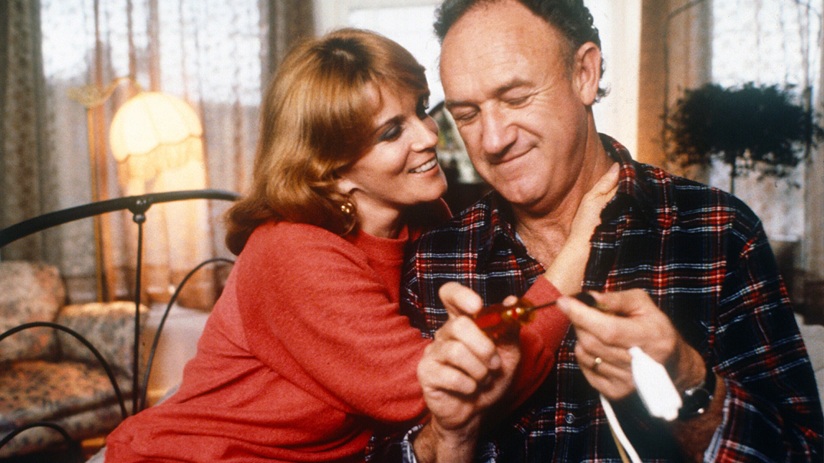
Twice In A Lifetime is one of those forgotten films but I think it features one of Hackman’s best performances. He plays Harry Mackenzie, a steelworker who is married to Kate (Ellen Burstyn, made up to look frumpy) and who has two daughters (Amy Madigan and Ally Sheedy). Harry is the type of everyman that Hackman excelled at playing. He’s a hard worker, a good family man, and a good friend. What no one, not even Harry realizes, is that he’s also having a midlife crisis. On his 50th birthday, he goes out to the neighborhood bar with his buddies and falls for the new barmaid, Audrey (Ann-Margaret). Harry ends up leaving his wife for Audrey, pursuing the spark that his marriage no longer gives him. The movie follows Harry and Kate and their daughters as they adjust to their new lives and they plan for the younger daughter’s wedding.
Twice In A Lifetime was one of many 80s films that dealt with divorce and it has the same flaws that afflicted many of them. These films, which were often made by middle-aged directors who had just gone through their own divorces, rarely played fair when it came to depicting why the marriage failed. Twice In A Lifetime stacks the odds in Harry’s favor just by suggesting that Ann-Margaret would end up working at a bar frequented by steelworkers. Harry has to choose between his plain and boring wife and Ann-Margaret. That’s going to be a difficult choice! The twist that Harry’s decision was ultimately the right thing for Kate doesn’t feel earned.
But damn if Gene Hackman isn’t great in this film. Even though he was one of the most recognizable actors in the movie, Hackman is totally believable as both a steelworker and a man who worries that he’s destroyed his family. It’s not just one moment or scene that makes this a great performance. It’s the entire performance as a whole, with Hackman portraying all of Harry’s conflicted emotions both before and after leaving his family. Hackman gives a performance that is more honest than the film’s script or direction. The movie believes Harry did the right thing but Hackman shows us that Harry himself isn’t so sure. Hackman captures the middle-aged malaise of a man wondering if his life is as good as it gets. When the movie works, it is almost totally due to the emotional authenticity of Hackman’s performance. Twice in a Lifetime may be a forgotten film but it’s also proof of how great an actor Gene Hackman really was. There will never be another one like him.
 Through the Shattered Lens