Horror On The Lens: The Brain Eaters (dir by Bruno VeSota)


For today’s horror on the lens, we have 1958’s The Brain Eaters!

In this noir-influenced tale of science fiction horror, a con-shaped ship crashes near a small town.  Soon, the residents of the town are vanishing, just to return as mind-controlled zombies!  This one clocks in at 61 minutes and it’s an enjoyable little B-movie.  Like many films from the 50s, the main message seems to be that you should never totally trust anyone.  They could be a communist.  They could be an alien.  They could be a Brain Eater!

Keep an eye out for Leonard Nimoy in an early role.  Or actually, it might be better to keep an ear open.  Nimoy isn’t easy to spot but you’ll recognize his voice towards the end of the film.


Horror On The Lens: Attack of the Giant Leeches (dir by Bernard Kowalski)


I love the 1959 film, Attack of the Giant Leeches.

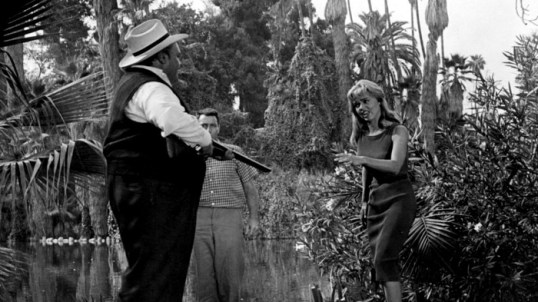
The set up is a classic one.  In the humid bayous, a sweaty and unappealing store owner (Bruno VeSota) discovers that his much younger wife (the great Yvette Vickers) has been cheating on him.  In one scene, he forces his wife and her lover to enter the swamp.  It’s terrifying because the swamp is full of …. GIANT LEECHES!  I’m a Southern girl.  I’ve spent some time in the bayous.  Let me tell you, swamps are creepy enough without the addition of giant leeches.

Full of sultry melodrama and bayou atmosphere, Attack of the Giant Leeches is one of the best of the giant monster films of the 50s.  It’s amazing was radiation can do!

Horror Film Review: The Haunted Palace (dir by Roger Corman)


In the 18th century, the inhabitants of Arkham, Massachusetts yank Joseph Curwen (Vincent Price) out of his mansion and tie him to a tree.  They accuse Curwen of being a warlock who is in league with the devil and who has been bringing young women to his “palace,” and putting them in a trance.  They burn Curwen alive but, before the flames are lit, they also give Curwen a chance to speak and curse both them and their descendants.

You really do have to wonder about the logic behind witch (and warlock) burnings.  They seem counter-productive because they always give the accused just enough time to cast one final curse before being burned to a crisp.  Indeed, you have to wonder why witches and warlock were allowed any final words to begin with.  I mean, at some point, you would think everyone would notice that the final words were always a curse.

Anyway. 110 years later, Joseph Curwen’s descendant, Charles Dexter Ward (Vincent Price, again) rides into town with his wife, Anne (Debra Paget).  He is stunned to see that Arkham has apparently fallen on hard times, with many of the town’s people being horribly disfigured.  It’s explain to him that the disfigurements and the poverty are all a result of his ancestor’s curse.  That’s going to make things a bit awkward, considering that Charles Dexter Ward has not only inherited the Palace but he’s also inherited a copy of Necronomicon and a legacy of messing with Cthulhu.  The townspeople don’t want Ward around but he and Anne decide to spend the night in the Place regardless.

Of course, it doesn’t take long for Curwen’s spirit to possess Charles.  Soon, Charles is trying to resurrect Curwen’s mistress, Hester (Cathie Merchant) and pursuing Curwen’s goals of breeding a race of super humans by forcing the women of the town to mate with the fearsome Yog-Sothoth.  Charles also seeks vengeance on the descendants of those who burned Curwen at the stake, as if all of the poverty and the deformities aren’t punishment enough.  Again, this is why you don’t give warlocks and witches a chance to get out one last curse before being executed.

Though The Haunted Palace is usually considered to be a part of Roger Corman’s Edgar Allan Poe cycle, the story itself is actually based on H.P. Lovecraft’s The Case of Charles Dexter Ward.  (In Lovecraft’s novella, Ward seeks out his evil ancestor whereas, in the film, Ward is more or less an innocent victim.)  The film’s title comes from a Poe poem, which is recited at both the beginning and the end of the film.  But the film itself, with its references to the Cthulhu mythos and its hideous New England setting, is definitely a work of Lovecraftian horror.

Fortunately, it’s an effective work of Lovecraftian horror, one that captures the feeling of people unwisely trying to control a force of evil that they cannot begin to comprehend.  Roger Corman keeps the action moving quickly and creates a gothic atmosphere of impending doom.  Vincent Price, toning down his usual theatrics, is chillingly evil as Curwen and sympathetic as Charles.  The film’s strongest performance, however, comes from Debra Paget, who desperately tries to free her husband from Curwen’s control.  Any woman who has suddenly felt as if she can no longer recognize the man who she once loved will be able to relate to Paget’s performance.

The Haunted Palace is a strong entry in the films of Roger Corman and Vincent Price and one of the better adaptations of the work of H.P. Lovecraft.

Horror On The Lens: Attack of the Giant Leeches (dir. by Bernard Kowalski)


For today’s public domain horror film, I present to you 1959’s Attack of the Giant Leeches. This 60-minute film is a classic Drive-in film.  It features an iconic performance from Yvette Vickers, who is one of my favorites of the strong, confident, unapologetically sexy women who dominated the old B-movies. (Plus, she was only 5’3 and it’s not easy being brave when you’re having to look up at everyone. Trust me, I know.) This short little film is steamier than Louisiana in August and is full of bayou atmosphere.

I have to admit that I’m kinda freaked out by the scenes of people floating underwater in this film. And leeches .… agck! Don’t even get me started on leeches. Especially giant leeches….

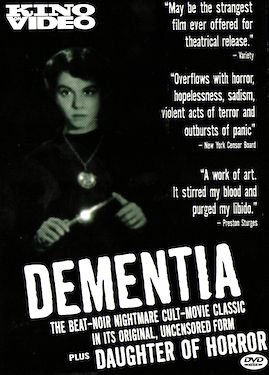
Horror on the Lens: Dementia (dir by John Parker)


Today’s Horror on the Len is 1955’s Dementia, an experimental horror film without dialogue.  The film follows a young woman (Adrienne Barrett) over the course of one surreal and nightmarish night on Los Angeles’s skid row.

Despite an opening endorsement from no less a Hollywood luminary as Preston Sturges, audiences in 1955 were not sure what to make of this dream-like film.  However, it has since been rediscovered and reappreciated by audiences who appreciate the film’s surreal vision.

The TSL’s Horror Grindhouse: Attack of the Giant Leeches (dir by Bernard Kowalski)


It’s time for nonstop drama in the bayous!

Shopkeeper Dave Walker (Bruno VeSota) knows that his wife, Liz (Yvette Vickers), is cheating on him with his best friend, Cal (Michael Emmett)! Dave is determined to catch them in the act and force them to walk out into the middle of the swamp at the end of his shotgun. That would be bad enough but what makes the swamp even more dangerous is the fact that there are two giant leeches living in the water, grabbing whoever they can get and dragging them back to their underground cave! Agck! While Dave plots to get revenge on his cheating wife, game warden Steve Benton (Ken Clark) tries to convince everyone that something really needs to be done about those giant leeches.

Filmed and released in 1959 and produced by Roger Corman, Attack of the Giant Leeches is not a particularly complicated film. The leeches live in the swamp. For various reasons, people keep wandering into the swamp. The leeches keep feeding until eventually, the authorities decide to do something about it. The simplicity of it all is why the film works. Why are there giant leeches in the swamp? How did the leeches become giants in the first place? Who cares? What’s important is that they’re there and they’re hungry for blood. At this point, why doesn’t matter. What matter is what is going to be done about them.

Clocking in at barely an hour and filmed by TV director Bernard L. Kowalski, Attack of the Giant Leeches is an enjoyably overhearted slice of Southern melodrama, full of humid atmosphere and sultry dialogue.  The film does a wonderful job of capturing the overheated feeling of being stuck in the country and not having anything better to do than cause some trouble.  I mean, it’s very easy for people to say what other should or shouldn’t do in their spare time.  But, when you’re actually living in a swamp, you do what you have to do in order to pass the time.  At its best, Attack of the Giant Leeches is like Roger Corman meets Tennessee Williams.  It’s Southern Gothic, with even bigger leeches than usual.  Flannery O’Connor would have been proud.

Yvette Vickers plays the role of Liz with a wonderfully defiant attitude. She’s going to do what she wants when she wants to and if that means running the risk of being forced to walk into the swamp, so be it. If she’s stuck in the bayous, she might as well have a good time.  Liz may be frustrated but can you blame her? Meanwhile, VeSota turns Dave into a rather tragic buffoon. Even when he finally thinks that he’s about get his revenge, it turns out that the universe has other plans in store for him.  In the end, Dave is fortune’s fool.  No wonder stiff but earnest Ken Clark really can’t compete with either of them when it comes to capturing the audience’s attention.

Attack of the Giant Leeches is short but enjoyable and, because the copyright wasn’t renewed, it’s in the public domain and it’s very easy to watch for free. Watch it this Halloween and definitely stay out of the swamp!

Horror On The Lens: Attack of the Giant Leeches (dir. by Bernard Kowalski)


For today’s public domain horror film, I present to you 1959’s Attack of the Giant Leeches. This 60-minute film is a classic Drive-in film. While it has its slow spots, it also features an iconic performance from Yvette Vickers, who is like one of my favorites of the strong, confident, unapologetically sexy women who dominated the old B-movies. (Plus, she was only 5’3 and it’s not easy being brave when you’re having to look up at everyone. Trust me, I know.) This short little film is steamier than Louisiana in August and is full of bayou atmosphere.

I have to admit that I’m kinda freaked out by the scenes of people floating underwater in this film. And leeches … agck! Don’t even get me started on leeches. Especially giant leeches…

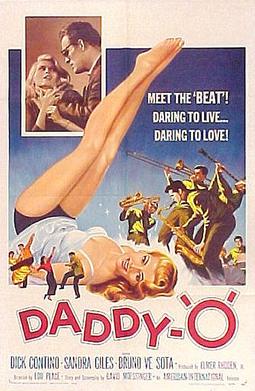
Daddy-O (1958, directed by Lou Place)


Like Elvis before him, Phil Sandifer (Dick Contino, who played a mean accordion back in the day) is a truck driver who wants to be a rock and roll star.  He’s also a street racer who has just fallen in love with Jana (Sandra Giles), the one woman fast enough to run him off the road.  However, before Phil can pursue either Jana or rock and roll fame, he has to investigate the mysterious death of his friend, Sonny.  Someone drove Sonny off the side of the road and the police aren’t willing to investigate.  Instead, they’re more interested in giving Phil a hard time, taking away his license and making it impossible for him to do his thing.

Working with Jana, Phil goes undercover as Daddy-O, the world’s greatest rock and roller.  He gets a job singing at a club owned by the shady Sidney Chillas (Bruno VeSota), the man who Phil believes was responsible for the death of Sonny.  Phil investigates and also finds time to sing a deathless song called Rock Candy Baby.

Today, Daddy-O is probably best known for being featured on Mystery Science Theater 3000.  In fact, I didn’t even mention Phil’s strange habit of hiking his pants nearly halfway up his chest just because Joel and the Bots pretty much said everything that needed to be said about that when they watched the show.  The same can be said of the song Rock Candy Baby, which is both terrible and insanely catchy.

Beyond the pants and Contino’s performance of Rock Candy Baby, Daddy-O is a typical delinquent youth B-movie.  Contino was best known as an accordionist but this film tries to rebrand him as a rock and roller.  He was 28 when he starred in Daddy-O but Contino looked closer to 40 and his discomfort in obvious in every scene.  Far more convincing are Sandra Giles and Bruno VeSota.  Sandra Giles has the right look to be convincing as a 50s bad girl who actually isn’t that bad while Bruno VeSota specialized in playing crooked club owners.

Daddy-O is mostly interesting as an example of how filmmakers tried to reach teenagers in the early days of rock and roll.  Contino was not a rock and roller and he looks plainly uncomfortable trying to be one but it was 1958 and Elvis was everywhere.  Of course, Elvis would have known better than to have called himself Daddy-O.  That’s totally squaresville.

Horror On The Lens: Attack of the Giant Leeches (dir. by Bernard Kowalski)


For today’s public domain horror film, I present to you 1959’s Attack of the Giant Leeches.  This 60-minute film is a classic Drive-in film.  While it has its slow spots, it also features an iconic performance from Yvette Vickers, who is like one of my favorites of the strong, confident, unapologetically sexy women who dominated the old B-movies.  (Plus, she was only 5’3 and it’s not easy being brave when you’re having to look up at everyone.  Trust me, I know.)   This short little film is steamier than Louisiana in August and is full of bayou atmosphere.

I have to admit that I’m kinda freaked out by the scenes of people floating underwater in this film.  And leeches … agck!  Don’t even get me started on leeches.  Especially giant leeches…

Horror Film Review: The Devil’s Hand (dir by William J. Hole, Jr.)


Rick Turner (Robert Alda) has a problem.

Because he’s continually haunted by strange dreams, Rick hasn’t been getting much sleep.  As he explains to his incredibly understanding girlfriend, Donna (Ariadna Welter), the dreams involve a vision of a beautiful woman named Bianca (Linda Christian), who appears to be standing in the clouds while wearing a sheer negligee and calling out to him.

Donna insists that it’s probably nothing but Rick says that, after his last dream, he felt himself being drawn to a doll shop in downtown Los Angeles.  When Rick and Donna go down to the shop, they discover a doll of Bianca sitting in the window.  The owner of the shop, Frank (Neil Hamilton), insists that Rick came in earlier and specifically requested that Frank design the doll so that he could send it as a gift to another woman.  You would think that would upset Donna but she’s more interested in the fact that she’s found a doll that looks exactly like her.

Well, you can probably guess what happens.  Eventually, the doll that looks like Donna ends up pinned to the wall of the shop and Donna ends up in the hospital with a mysterious illness.  Rick manages to track down the real-life Bianca, who greets him in her apartment while wearing the same negligee from Rick’s dreams.  Bianca explains to Rick that she’s been reaching out to him because she wants him to join a cult that worships “Gamba, the Great Devil Dog.”

It turns out that the cult meets in the back of Frank’s doll shop.  Rick attends a meeting with Bianca and discovers that the cult is made up of exclusively of beautiful young women and bland, middle-aged men.  He even gets to witness a near-human sacrifice involving a wheel that’s studded with knives.  As Bianca explains it, Gamba sometimes turns the knives into rubber and then sometimes, he doesn’t.  Gamba’s unpredictable like that.

Bianca explains that Rick can have everything he wants if he just gives his soul over to the Devil Dog.  But what about Donna, who is still in the hospital?

The Devil’s Hand is a low-budget but occasionally effective horror film from 1962.  (Apparently, it was originally filmed in 1959 but it wasn’t released until 3 years later.  Linda Christian later said that she never actually got paid for appearing in this film, as the production company apparently ran out of money during filming.)  Oddly enough, the film opens with extremely cheerful surf music, which leads you to suspect that you’re about to see some sort of weird beach comedy.  Instead, The Devil’s Hand turns out to be a film about a cult operating in the shadows of Los Angeles.

The cult is probably the most interesting thing about the film.  Though the film doesn’t specifically call attention to this fact, it’s hard not to notice that most of the male cult members appear to be either accountants or middle-management types, the type who wear cheap suits and too much cologne.  It’s impossible not to be amused by the idea of a bunch of middle class nobodies gathering in the back of a doll shop so that they can worship the Great Devil Dog.  Neil Hamilton and Linda Christian are both perfectly cast as the leaders of the cult.  Hamilton is properly menacing while Christian seems to be having fun tempting Rick into the darkness.

Unfortunately, Rick’s not a very likable protagonist.  Even though his girlfriend is in the hospital, Rick doesn’t have any problem with going to the horse track and playing the stock market with Bianca.  In short, Rick comes across as being a bit of a jerk and you can’t help but feel that Donna might be better off without him.

Anyway, The Devil’s Hand is an entertaining occult film, one that’s definitely not meant to be taken too seriously.  It’s only 71 minutes long so it really plays more like an extended episode of an old anthology show than anything else.  (It just needs a narrator.)  The story moves quickly and you’ll never forget those accountants in the back of the doll shop.