Retro Television Review: Decoy 1.1 “Stranglehold”


Welcome to Retro Television Reviews, a feature where we review some of our favorite and least favorite shows of the past!  On Thursdays, I will be reviewing Decoy, which aired in Syndication in 1957 and 1958.  The show can be viewed on Tubi!
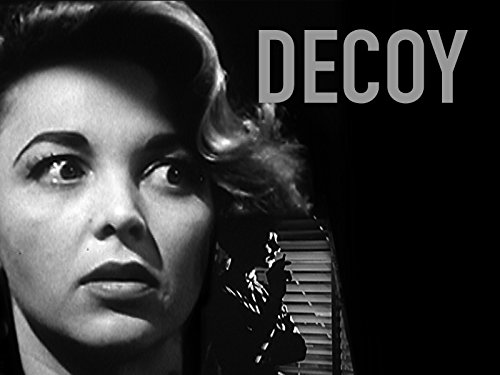
This week, we start a look at Decoy, a show that will hopefully be a considerable improvement on Malibu CA!

Episode 1.1 “Stranglehold”

(Dir by Don Medford, originally aired on October 17th, 1957)

“There are 249 of us in the Department. We carry two things in common wherever we go – the shield, called a “pottsy”, and a .32 revolver. We’re New York’s finest …. we’re police women.”

Those are the words that end the first episode of Decoy and they’re delivered by Casey Jones (Beverly Garland), a former ballet dancer who now works undercover as a member of the NYPD’s Department of Policewomen.  Casey holds up her revolver for the audience to see, leaving them no doubt that she’s telling the truth.  A woman who know how to handle a gun!?  Audiences in 1957 were no doubt stunned.

Of course, the audience had also just spent 25 minutes watching Casey work undercover.  After a merchant seaman is murdered and a woman named Molly Orchid (Joanne Linville) is caught with some of his jewelry, Casey is sent to live across the hall from Molly.  (Casey is also living in the dead man’s apartment.  Casey, a true New Yorker, comments that she’ll do anything to get a good apartment.)  After hiding her gun in a lighting fixture and hiding her badge under her blouse, Casey befriends Molly and tries to meet George, the mysterious boyfriend that Molly says gave her the jewelry.

Molly loves to talk about George but George never seems to be around.  Molly says that George is a musician and that he’s often out of town.  Casey comes to feel sorry for Molly, feeling that the emotionally vulnerable woman is being manipulated by George.  Whereas the male cops would just as soon shoot Molly than try to negotiate with her (this entire show is from the pre-Miranda era), Casey does her best to reason with Molly.  That is the difference between a policewoman and a policeman.

Of course, as you probably already guessed, there is no George.  Casey eventually figures it out after she realizes that Molly has been going to the movies alone as opposed to meeting up with George.  Molly, spotting Casey’s gun, grabs it and finally admits the truth.  The merchant seaman tried to assault her and Molly strangled him in self-defense.  George is a figment of her imagination, someone who she made up as a way to deal with her guilt.  A policeman barges into the apartment and points his gun at Molly but Casey steps in front of him and then manages to talk Molly down.

The first episode of Decoy was distinguished by some on-location shooting in New York City and the performances of Joanne Linville and especially Beverly Garland.  Garland’s empathetic but strong-willed performance dominates the show and it leaves us with little doubt that Casey Jones is the best at what she does.  Meanwhile, Linville, in the role of Molly, may be dangerous but she’s also sympathetic.  Her crime was initially one of self-defense and George was someone she created as her way of surviving in a world where no one was willing to look out for her.

Next week: Casey searches for a missing artist.

Horror Film Review: Piranha (1978, dir by Joe Dante)


At the height of the Vietnam War, the U.S. Government came up with a plan that could have changed the course of the war.

What if the government developed gigantic, super-fast, occasionally jumpy piranha?  And what if they set those killer fish loose in the rivers of Vietnam?  Would those fish swim through North Vietnam and take out the VC?  Sadly, the war ended before the government got a chance to test out Operation Razorteeth.  With the war over, the government was stuck with a bunch of killer fish.  Scientist Robert Hoak (Kevin McCarthy) ignored all orders to destroy his mutant fish because they were his life’s work.  (Awwwwwwwww!)  He kept an eye on them and did everything he could to prevent them from getting into the nearby river.

Unfortunately, Dr. Hoak’s best wasn’t good enough.  Because the piranha have gotten loose and now they’re making their way down to the river!  They start out eating skinny dipping teenagers, fisherman, and Keenan Wynn.  (They’re good enough not to eat Wynn’s adorable dog, which I appreciated.)  Further down the river, there’s a summer camp and a water park!  It’s definitely not safe to get back in the water but sadly, that’s what several people insist on doing throughout this film.  Even when the water is full of blood, people will jump in.  (It’s easy to be judgmental but it is a pretty river.  I don’t swim but I honestly wouldn’t mind living near a river that looked that nice.  Instead, I have to make due with a creek.)

Floating down the river on a raft and trying to warn everyone is the unlikely team of Maggie (Heather Menzies) and Paul (Bradford Dillman).  Maggie is a detective who has come to town to track down the two teenage skinny dippers who were eaten at the start of the film.  Paul is a drunk.  Well, technically, Paul is a wilderness guide and he does spend the entire movie wearing the type of plaid shirt that would only be worn by someone who goes camping every weekend but really, Paul’s main personality trait seems to be that he enjoys his booze.  Paul’s daughter is away at the summer camp.  Yes, that’s the same summer camp that’s about to be visited by a school of piranha.  AGCK!

Produced by Roger Corman and obviously designed to capitalize on the monster success of Jaws, Piranha was an early directorial credit for Joe Dante.  Dante would later go on to direct films like The Howling and GremlinsPiranha was also an early screenwriting credit for the novelist John Sayles, who would use his paycheck to launch his own directing career.  As a director, Sayles specializes in politically-themed ensemble pieces, which is something you might not guess while watching Piranha.  (Piranha does have an anti-military subplot but then again, it’s a film from the 70s so of course it does.)  Like the best of Corman’s film, Piranha works because it sticks to the basics and it delivers exactly what it promises.  Piranha promises killer fish biting away at anyone dumb enough to get in the water and that’s what it gives us.  As an added bonus, we also get some occasionally witty dialogue and Joe Dante’s energetic, self-aware direction.

As is typical with the films of both Corman and Dante, the cast is full of familiar faces.  Along with Kevin McCarthy as the mad scientist and Keenan Wynn as the eccentric fisherman, Dick Miller shows up as the waterpark owner.  Richard Deacon, who made a career of playing bosses and neighbors on various sitcoms in the 50s and 60s, plays the father of a missing teenager.  Director Paul Bartel plays the head of the summer camp, who may be a jerk but who still heroically jumps in the water to save several campers.  (Bartel’s moment of heroism is one of Piranha’s best scenes and, significantly, it’s played without irony.  You’ll want to cheer for the guy.)  Finally, the great Barbara Steele plays the government scientist who shows up to clean up Operation Razorteeth.

Piranha is simple but entertaining.   Dante’s direction is energetic and, despite the film’s self-referential tone, the killer fish are just savage enough to be scary.  It’s a film that tell us not to get back in the water but which understands that the temptation might just be too strong.