Shattered Politics #94: Persecuted (dir by Daniel Lusko)


Persecuted-2014-poster

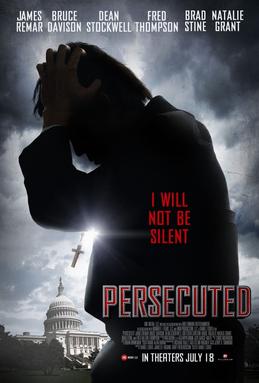
It may seem strange that I would choose to end my series of reviews of films that feature politics and politicians by reviewing Persecuted, an obscure film from 2014.  After all, Shattered Politics started out with D.W. Griffith’s Abraham Lincoln.  Over the past three weeks, I’ve reviewed everything from Mr. Smith Goes To Washington to The Phenix City Story to Dr. Strangelove to The Godfather to Nashville to Once Upon A Time In America to The Aviator.  I have been lucky enough to review some of the greatest films ever made.  And now, at the end of this series, I find myself reviewing Persecuted, a film that has a score of 0% over on Rotten Tomatoes.

Consider that for a moment.

As I sit here typing out this sentence, not a single critic has given Persecuted a good review.  And I will admit right now that I’m not going to be the first.  Persecuted is cheap-looking, heavy-handed, melodramatic, histrionic, foolish, silly, preachy, predictable, strident, and just about every other possible criticism that comes to mind.  If the film is redeemed by anything, it’s that it is full of good actors who do the best that they can with characters that are either seriously underwritten or ludicrously overwritten.

Persecuted takes place in the near future.  Sen. Donald Harrison (Bruce Davison) has written something called the Faith and Fairness Act, which would basically require churches to provide equal time to other religions and would make it illegal to suggest that only one religion has all the answers.  How exactly that would work, I’m not sure.  However, a big part of Harrison’s bill is that, in exchange for giving up any claim to having all the answers, churches will now get money from the federal government.  As a result, a lot of church leaders have sold out and announced their support for the bill.

However, evangelist John Luther (James Remar) refuses to support the bill.  As we’re told when Luther first appears, he’s a recovering alcoholic and drug addict who used to be a professional gambler.  But then he found faith and he’s now the most popular man in the country.  Or, at least, he is until he’s drugged by the government and framed for murdering a prostitute.

So now, Luther is on the run.  He has to evade capture, prove his innocence, and reveal the truth about Harrison and his shadowy backers.  Helping Luther out is his father, an Episcopalian priest who is played by former real-life Presidential candidate Fred Thompson.  (Thompson, incidentally, is a very good actor and brings a lot of conviction and authority to his role.)  Not helping Luther are the former leaders of his church, one of whom is played by character actor Dean Stockwell.

I’ll admit right now that, as familiar and talented as all four of them may be, James Remar, Bruce Davison, Fred Thompson, and Dean Stockwell are hardly big stars and you really can’t blame any of them for presumably taking a job strictly for the money.  That said, it’s still odd to see such good actors appearing in a film like Persecuted and they all deserve at least a little bit of credit for doing their best with the material that they had to work with.  However, my favorite performance came from Brad Stine, who plays glib preacher who betrays Luther.  Stine is just so sleazy and hyperactive that he’s a lot of fun to watch.

Now, while Persecuted is obviously a faith-based film, it’s plot actually has more in common with the paranoia movies of the 70s than it does with Left Behind.  John Luther is a guy who knows the truth and has been framed as a result and he spends nearly the entire film on the run.  If anything, this is a film that will probably appeal more to conspiracy theorists than to Christians.  But, judging from the film, the conspiracy that’s trying to destroy John Luther doesn’t appear to be very competent.  How else do you explain that John Luther — the most famous man in the world — manages to easily evade capture despite the fact that he spends most of the film wandering around in broad daylight with dried blood on his face.  At one point, he even calls his wife and has a conversation with her.  “Ah!” I thought, “this is where we’ll discover that the conspiracy is listening in on the conversation!”  But no, that didn’t happen.  In fact, his wife talked to him while, in the background, two cops searched their house.  “The police are looking for you,” the wife says but neither one of the police officers seems to hear her.  Apparently, it didn’t seem to occur to any of them that John Luther might call his wife.  For a paranoia film to work, you have to feel like the film’s hero is in constant danger and Persecuted never succeeded in doing that.  How can anyone be scared of a conspiracy that can’t even handle the basics?

Persecuted is not a good film but, in its own unfortunate way, it is a relevant one.  Much as how the first film I reviewed for Shattered Politics, D.W. Griffith’s Abraham Lincoln, told us a lot about America in the 1930s, Persecuted tells us a lot about how America is viewed by its citizens in the 21st Century.  Persecuted is a film that insists that our leaders can’t be trusted, that your friends will betray you if ordered to do so by those in authority, and that everything bad will come disguised as something good.  It’s not exactly an optimistic view of politics or America but then again, these are the times that we live in.  It’s been a long time since Billy Jack went to Washington.  It’s been even longer since Mr. Smith first showed up.

Now, instead, all we have is Bruce Davison telling us, “You thought you were bigger than the system and you’re not!”

And, on that note, Shattered Politics comes to an end!  I’ve had a lot of fun writing this series of 94 reviews and I hope that you’ve enjoyed reading them!  If there’s any conclusion that I think can be drawn from these 94 films, it’s that politicians will always betray you and politics will always depress you but movies will always be there to lift you back up.

If I had to choose between voting and watching a movie, I would pick a movie every time.  Fortunately enough, I live in a country where I am allowed to do both.

Back to School #60: Crazy/Beautiful (dir by John Stockwell)


Oh, memories!

I don’t know if I can describe how much my girlfriends and I loved Crazy/Beautiful when it first came out in 2001.  We saw it in the theaters, we rewatched it when it came on cable, and after I bought it on DVD, we watched it at my house.  We loved the movie because we all dreamed of having a sensitive, hot boyfriend like Carlos Nunez (played by Jay Hernandez), who would love us no matter how obnoxious or bratty we may have been.  Even if we sometimes got annoyed with her, we still all related to out-of-control Nicole (Kirsten Dunst), who everyone in the world had given up on but who ultimately just wanted her father to pay as much attention to her as he did to his new wife and his new baby.  We liked the film because we wanted to be both crazy and beautiful.

And, of course, there was all the sex, all of it filmed in beautiful soft-focus with the camera always suggesting that it was showing more than it actually was.  Crazy/Beautiful was one of those films that made you feel grown up while still being very careful not to lose its PG-13 rating.

Yes, back in the day, I loved Crazy/Beautiful.

And you know what?

It may just be the nostalgia talking but I still love it.  I recently rewatched Crazy/Beautiful and, despite the fact that I was now watching as a “critic” as opposed to a 15 year-old with issues, I quickly fell under the film’s spell.  There’s just something about Crazy/Beautiful that I simply cannot resist.

It’s a beautiful film.  Director John Stockwell has made a career out of making movies about pretty people hanging out on pretty beaches and Crazy/Beautiful has a lot of both.  When Carlos, a responsible high school senior who lives in East Los Angeles and who is hoping to attend the U.S. Navy Academy, first meets Nicole, she’s doing community service by picking up trash on the beach.  What Carlos doesn’t find out until later is that Nicole is the daughter of U.S. Rep. Tom Oakley (played, somewhat inevitably, by Bruce Davison).  Nicole is haunted by her mother’s death and feels that her well-meaning but ineffectual father has abandoned her.  At first, her relationship with Carlos seems to be yet another part of her rebellion but soon, both she and Carlos are madly in love.

Can Carlos save Nicole from herself?  Can Nicole love Carlos without leading him down the path of self-destruction?  Will Nicole and her father ever reconnect?  Will … oh, who cares?  You already know the answers.  Crazy/Beautiful is less about the story and more about how the story is told.  Stockwell keeps the story moving along and fills the screen with colorful and romantic images that make Crazy/Beautiful into the perfect teenage daydream.  He also makes perfect use of the undeniable chemistry between Jay Hernandez and Kirsten Dunst.  Both of the stars give such good performances that you really do come to care about the characters that they are playing and hope that things work out for them.  Kirsten Dunst, in particular, gives a brave performance and doesn’t shy away from playing up Nicole’s abrasiveness.  It takes courage to play a character who can be unlikable.  It takes talent to make that unlikable character sympathetic and, fortunately, Kirsten Dunst shows a lot of both in Crazy/Beautiful.

CrazyBeautiful


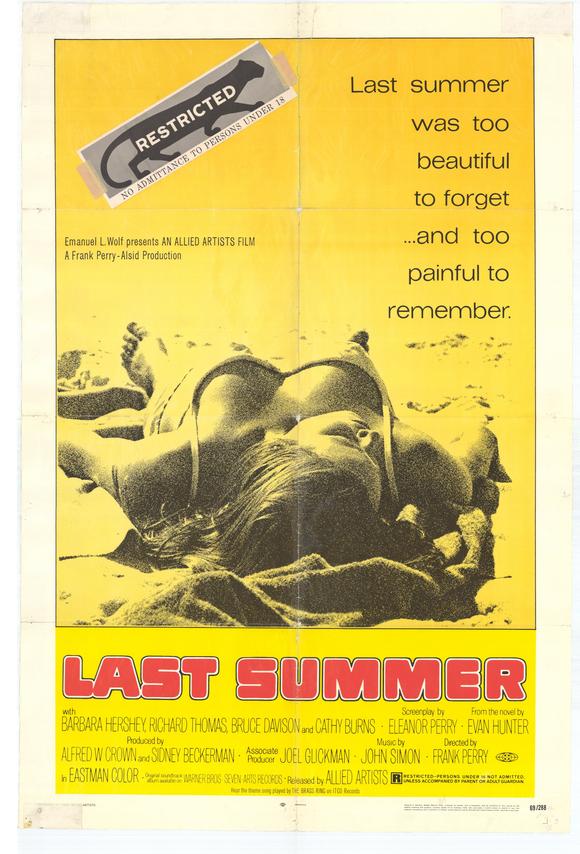
Embracing the Melodrama #24: Last Summer (dir by Frank Perry)


last-summer-movie-poster-1969-1020204164

Let’s close out today’s series of melodrama reviews by taking a look at an unfairly obscure film from 1969, Last Summer.  Directed by Frank Perry (who also directed at least part of The Swimmer before getting into an argument with Burt Lancaster), Last Summer is a film about four teenagers who make the mistake of hanging out with each other during one fateful summer.

Peter (Richard Thomas) and his best friend Dan (Bruce Davison) meet Sandy (Barbara Hershey) on the beach.  Sandy recruits them into helping her take care of a seagull with a broken wing and soon, the three of them are inseparable.  The sexually inexperienced Peter and Dan are both attracted to Sandy while Sandy shown proves herself to have a casually destructive streak.  The two boys are so infatuated with Sandy that they even forgive her after she gets bored with the seagull and kills it.

Eventually, Rhoda (Catherine Burns, who was Oscar-nominated for her performance) starts to hang out with the three of them.  Overweight and shy, Rhoda is, at first, an awkward addition to the group but soon, she and Peter start to grow close.  Sandy, who was previously more interested in Dan until she realized that Peter was losing interest in her, reacts by looking for more and more ways to humiliate the insecure Rhoda.  Eventually, they set Rhoda up on a blind date with a shy Puerto Rican man, a cruel prank which quickly goes wrong.

When Rhoda eventually stands up to her three new “friends,” it leads to a disturbing finale that it is all the more effective specifically because it is so inevitable.

I have to admit that I have a weakness for out-of-control youth films, largely because — while I never went as crazy as Sandy or made as many mistakes as Rhoda — I still had my moments back when I was in high school.  In ways both good and bad, I could relate to the two female leads of Last Summer.  There have been times in my life when I’ve felt like the intellectual and naive Rhoda and then there’s been other times when I’ve felt like the beautiful and self-assured Sandy.  For the most part, I’m usually prouder of myself when I feel like Rhoda but I have a lot more fun when I feel like Sandy.  While the two boys largely remain ciphers, Last Summer is worth seeing for the outstanding performances of Barbara Hershey and Catherine Burns.  Combined with Frank Perry’s atmospheric direction (you can literally see the layers of ennui and humidity clinging to some of the scenes), the end result is an effectively creepy coming-of-age film.

For some unknown reason, Last Summer appears to one of those rare Oscar-nominated films that has never been released on DVD or Blu-ray.  However, it does occasionally show up on TCM and I would suggest keeping an eye out for it.

Last Summer 1969 Thomas Hershey Davidson

(Incidentally, California Scheming — was was released earlier this year — is pretty much an unacknowledged remake of Last Summer, right down to the bit with the seagull.  California Scheming is actually not a bad film.  It’s certainly deserves better than some of the online reviews that it’s received.)