 Ving Rhames plays Sonny Liston, one of the greatest heavyweights who ever boxed but whose legacy will forever be overshadowed by the man who defeated him twice, Muhammad Ali.
Phantom Punch hits all of the well-known notes of Liston’s life. He grows up dealing with poverty and racism. He goes to prison as a young man and it is there that a sympathetic priest (Rick Roberts) helps him discover that his talent for fighting can be transformed into the skills needed to be a heavyweight contender. Sonny turns pro after he’s released but, even as he angles for a championship fight, he’s still collecting debts for mobsters like Savino (David Proval). Sonny becomes the champ after defeating Floyd Patterson but is hated by white boxing fans who resent that, unlike previous black champs, he doesn’t seem to care about their approval. Both of his losses to Ali lead to accusations that he threw the fights. With the help of his manager (Nichols Turturro), he works his way back up the rankings and is poised for another shot at the title but the Mafia now wants him to throw his fights for real. In 1971, Liston dies of what the police claim was a heroin overdose even though everyone knew that Liston hated needles. There’s not much new to be found in Robert Townsend’s biopic of Liston but Ving Rhames is convincing as Sonny and even brings some humanity to one of boxing’s most fearsome champs. It was a movie made for boxing fans and Rhames looks credible throwing a punch.
As I watched the movie, I wondered whether Liston really did throw his fights against Ali. I don’t think he did, even though both fights were strange. In the first fight, Sonny put something on his gloves that irritated Ali’s eyes. When that didn’t stop Ali, Sonny retired to his corner and didn’t come out for the seventh round. That led to rumors that the Mob ordered him to throw the fight but if you watch the match, it’s obvious that Sonny was trying to win and he just wasn’t prepared for Ali’s quickness. Liston knew he was losing and, with an aggravated shoulder injury making it difficult for him to throw his heavy punches, Liston bowed to the inevitable and refused to give Ali the chance to knock him out. The second fight was the one where the phantom punch occurred. Liston fell so quickly that, when I first saw it, I thought he had thrown the fight. It wasn’t until I watched the fight in slow motion that I saw that Ali did make contact with Liston before he fell. Liston may have been many things but but he wasn’t a chump. The so-called phantom punch was fast but it was real.
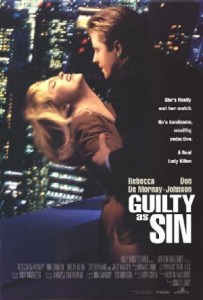 When wealthy playboy David Greenhill (Don Johnson, doing a one-note Michael Douglas impersonation) is accused of throwing his wife out of a window, there’s only one lawyer who he wants to defend him. Jennifer Haines (Rebecca De Mornay) may have just won a huge case but it is obvious that the only reason that David wants her on his team is because she’s sexy as Hell and David has an obsessive streak. Still, despite the misgivings of her boyfriend (Stephen Lang) and her mentor (Jack Warden), she takes the case, convinced that she is the only attorney smart enough to be able to get David acquitted.
 Through the Shattered Lens