Brad reviews LIONHEART (1990), starring Jean-Claude Van Damme!


As a teenager of the late 80’s, I became a huge fan of Jean-Claude Van Damme when I watched movies like BLOODSPORT (1988), CYBORG (1989), KICKBOXER (1989), and DEATH WARRANT (1990). He really seemed to be going big-time with movies like UNIVERSAL SOLDIER (1992), HARD TARGET (1993) and especially TIMECOP (1994). Unfortunately, through a variety of problems, including a reportedly uncontrollable ego, a seemingly never ending supply of gratuitous butt shots for the ladies, and potential drug issues, his star would begin to wane in the mid-1990’s and he’d soon find his career heading the wrong direction. Through it all though, I’ve always loved Van Damme, and I still like to watch his movies (both new and old) to this day. One of the films that he made in his prime was LIONHEART (1990). I remember renting the movie as soon as it became available at our local video store, and even though I don’t hear it spoken of often these days, it’s always been one of my favorite films of the so-called “Muscles from Brussels!”

LIONHEART stars Van Damme as Lyon Gaultier, a French Foreign Legionnaire who deserts his post in North Africa after finding out that his drug addict brother, who lives in Los Angeles, has been set on fire and is barely clinging to life. Determined to help his brother’s family, Lyon goes AWOL and hops a boat to the United States of America. Unfortunately, Lyon finds himself stranded in New York with no money, until he stumbles across an underground street fight. With the connections of a hustler named Joshua (Harrison Page) and a sexy fight organizer named Cynthia (Deborah Rennard), Lyon’s talent in the ring allows him to make the money he needs to go to L.A. When he finally makes it to the west coast, his brother has passed away, leaving huge medical bills for his wife Helene (Lisa Pelikan) and young daughter, Nicole (Ashley Johnson). Continuing to fight in the underground market in L.A. to provide funds for his sister-in-law, Lyon takes on increasingly dangerous opponents, including the savage Attila (Abdel Qissi) in a high-stakes fight that could settle his family’s financial problems for good… if it doesn’t kill him. 

I mentioned earlier that I’m a big fan of LIONHEART. With that said, I can certainly see some flaws in the film. The performances aren’t all great. For example, Deborah Rennard is somewhat ridiculous as the sexy, duplicitous Cynthia. Her character is as cliched as it gets, even if she does look good in her see-through stockings. It’s also too long. Clocking in at almost an hour and fifty minutes, the film is at least twenty minutes too long. There are definitely scenes that could have been trimmed down to make for a more efficient movie. Flaws acknowledged, I watched it again today, and I still love the movie. Directed by Sheldon Lettich (DOUBLE IMPACT), LIONHEART delivers the goods as a badass, fight film with a heart. The action sequences drew me in with Van Damme’s athletic spins and kicks, but it also reminded me of my favorite film of all time, HARD TIMES (1975) starring Charles Bronson. In HARD TIMES, Bronson takes out a cocky bastard with one punch to the face. In LIONHEART, Van Damme takes out a cocky bastard with one punch to the nuts. Both films deliver final showdowns against awesome opponents that deliver brutal and satisfying climaxes to the action. And both films go for real emotion. In HARD TIMES, those relationships are limited to the men in Bronson’s life, but in LIONHEART, Lyon’s relationships with his friend Joshua, as well as his love for his niece and widowed sister-in-law really set the film apart. Van Damme isn’t a great actor at this point in his career, but there’s just something really appealing about his unconditional love for his family. He won me over with his earnest performance, and I was all in when everything comes to a head at the end. It was also fun seeing producer Lawrence Bender (PULP FICTION, ANNA AND THE KING, KILL BILL) cameo in an early fight scene as a doofus with a pony tail who gets his ass handed to him by Van Damme. That’s just fun movie stuff. 

Playing on Amazon Prime as I type, I easily recommend LIONHEART to any person who likes Van Damme or action films of the 80’s and 90’s. It may be as cheesy as hell, but in my opinion, it’s one of the star’s best films. 

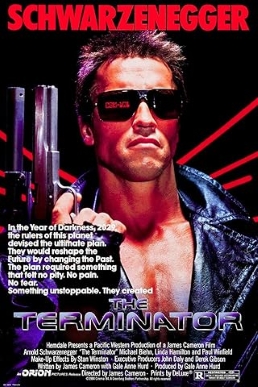
The Unnominated #19: The Terminator (dir by James Cameron)


Though the Academy of Motion Picture Arts and Sciences claim that the Oscars honor the best of the year, we all know that there are always worthy films and performances that end up getting overlooked.  Sometimes, it’s because the competition too fierce.  Sometimes, it’s because the film itself was too controversial.  Often, it’s just a case of a film’s quality not being fully recognized until years after its initial released.  This series of reviews takes a look at the films and performances that should have been nominated but were, for whatever reason, overlooked.  These are the Unnominated.

First released in 1984, The Terminator was the one of the top box office hits of the year.  It’s the film that established James Cameron as a filmmaker.  It’s the film that made a bona-fide star out of Arnold Schwarzenegger.  It’s a film that was imitated a thousand times before it even got its first official sequel.  It’s a film that’s still celebrated today.  41 years later, people are still saying, “I’ll be back.”  Would Arnold Schwarzenegger ever have become governor of California if he hadn’t first played a killing machine?  There’s a reason why his political nickname was the Governator.

And yet, The Terminator was not nominated for a single Oscar.  For all of the explosions and the gunfire and the screaming, it wasn’t even nominated for Best Sound.  Some of the special effects may now seem a bit hokey in this age of rampant CGI but it’s still a surprise that The Terminator was not nominated for Best Visual Effects.  The breath-taking action scenes did not result in a nomination for Best Editing.  Linda Hamilton was not nominated for her fantastic performance as Sarah Connor, a young woman who finds herself being pursued by a killer cyborg from the future.  Arnold Schwarzenegger was not nominated for playing one of the most memorable villains of the past 40 years.  Those who claim that Schwarzenegger was just playing himself are being overly glib.  Anyone could have said, “I’ll be back.”  It took Schwarzenegger’s delivery to make it a great line.

The lack of nominations aren’t really not a surprise, of course.  The Academy has only recently started to show an openness to nominating genre films for major awards and, even now, a genre film has to be considered a “cultural event” to even get a nomination.  Black Panther, Get Out, and even Mad Max: Fury Road and Dune were all nominated because it was felt that they had transcended their genre origins.  The Terminator is a sci-fi action movie and it’s proud to be a sci-fi action movie.  (Terminator 2: Judgment Day, it could be argued, transcended its genre origins but it was released in 1991 and Silence of the Lambs was destined to be the genre nominee that year.)  It’s also so relentlessly paced and intelligently written and directed that it’s a film that, even after all these years, it can still leave you breathless.  Nominated or not, The Terminator is a film that grabs your attention and holds it for a full 107 minutes.  There’s not many films that can make that claim.

The Terminator is a film that has held up surprisingly well.  (It’s certainly held up better than some of its more recent sequels.)  The performances of Linda Hamilton, Michael Biehn, and Arnold Schwarzenegger still work.  It’s still terrifying to watch as The Terminator relentlessly kills everyone that he comes into contact with.  (One thing that always gets me about the Terminator is that, even though he’s huge and superstrong and could probably physically rip anyone he wanted to apart, he still carries and uses a gun.  This makes him seem like even more of a bully.)  The Terminator is a machine and what makes him especially intimidating is that he doesn’t care if people see him coming or if they witness his crimes.  He has one function and that’s all he worries about.  When Michael Biehn first shows up, you can’t help but wonder why this guy, with his slight build and his somewhat nervous mannerisms, would be sent to try to stop the Terminator.  Of course, by the end of the movie, you understand.

(And what an ending!  The sight of those clouds, Linda Hamilton’s delivery of her final line, and the feeling that the future has already been determined, it all definitely makes an impression that has managed to survive every sequel after Judgment Day.  There’s a reason why Skynet — much like “I’ll be back” — has taken on a cultural life of its own.)

There were a lot of very good films that were nominated for Oscars in 1984.  The Terminator, much like Once Upon A Time In America, was not one of them but it will still never be forgotten.

Previous Entries In The Unnominated:

  1. Auto Focus 
  2. Star 80
  3. Monty Python and The Holy Grail
  4. Johnny Got His Gun
  5. Saint Jack
  6. Office Space
  7. Play Misty For Me
  8. The Long Riders
  9. Mean Streets
  10. The Long Goodbye
  11. The General
  12. Tombstone
  13. Heat
  14. Kansas City Bomber
  15. Touch of Evil
  16. The Mortal Storm
  17. Honky Tonk Man
  18. Two-Lane Blacktop

Life Stinks (1991, directed by Mel Brooks)


Goddard Bolt (Mel Brooks), the massively wealthy CEO of Bolt Enterprises, wants to buy up a huge area of Los Angeles’s slums and tear them down, transforming the area into a chic neighborhood and moving all of the poor residents and street people out.  Rival businessman Vaughn Craswell (Jeffrey Tambor), who grew up in the slum and dreams of destroying it himself, has the same plan.  He and Bolt make a bet.  If Bolt can survive for 30 days on the streets, Craswell will allow Bolt to have the property.  Bolt agrees and soon, he is penniless and sleeping in alleys.  While Bolt befriends Sailor (Howard Morris) and Fumes (Theodore Wilson) and falls in love with a former dancer named Molly (Lesley Ann Warren), Craswell schemes to take over Bolt’s company and keep Bolt on the streets permanently.

Life Stinks was one of Mel Brooks’s attempts to make a straight comedy that wasn’t a parody and which had a serious message underneath the laughs.  The mix of comedy and drama doesn’t really gel,  because the drama is too dark and the comedy is too cartoonish.  Life Stinks is often guilty of romanticizing living on the streets.  With the exception of two muggers, everyone whom Bolt meets is a saint.  It is still interesting to see Brooks creatively at his most heartfelt and humanistic.

Life Stinks does feature some of Mel Brooks’s best work as an actor and it’s also features an excellent turn from Lesley Anne Warren.  At first, I thought Warren would be miscast as a woman who spent her days in a soup kitchen and her nights sleeping in an alley.  But she actually gives a very sweet and believable performance.

No matter what else, Mel Brooks is a true mensch.


Flight of the Living Dead: Outbreak On A Plane (2007, directed by Scott Thomas)


Bad news!  There’s a zombie outbreak on a 747 jumbo jet!  That’s what you get for trying to transport a scientist who has been infected with a “super warrior” virus on a commercial flight.  It’s fine as long as she’s in her container but it just takes a little turbulence for her to get free and start infecting everyone.

This movie was advertised as being the first movie about a zombie outbreak on a plane and yes, it came out the same time as Snakes on a PlaneFlight of the Living Dead makes good use of its limited setting.  Not only do the handful of uninfected passengers have to maneuver around the undead in a tight space but they have to figure out how to get off the plane before it either runs out of fuel or gets blown up by the fighter jets that are following it.  The plane setting also reveals a new way to dispose of zombies, though it also means disposing of many of the living as well.

Flight of the Living Dead was better than I expected.  The characters are all cardboard but the action is fast and furious and that it was all happening the air did bring a new element of suspense to the familiar story.  Zombie movies are dime a dozen but this one’s not bad.  The next time I have to fly anywhere, I’m going to make sure I’m seated as far to the back of the plane as possible.

Guilty Pleasure No. 51: Rage and Honor (dir by Terence Winkless)


The 1992 film, Rage and Honor, tells the story of two people from different worlds, who come together to kick ass and save a declining American city.

Preston Michaels (Richard Norton) is a cop from Australia who has come to America as a part of an exchange program.  When he’s not working undercover, he’s supplementing his income by working as a bodyguard for what appears to be an 80s cover band.

Kris Fairfield (Cynthia Rothrock) is a teacher at the local high school who also moonlights as a karate instructor.  She’s haunted by the death of her parents and the subsequent disappearance of her brother.  She cares about her students, even though hardly any of them actually appear in the film.  In fact, the whole high school teacher thing never really matters much in the grand scheme of things.

Preston and Kris are teaming up to take down spacey drug lord Conrad Drago (Brian Thompson).  Conrad has a fierce mullet, a cocaine addiction, and a knowledge of all of the body’s pressure points.  His girlfriend is Rita (Terri Treas) and the only thing that could possibly prevent Drago and Rita from taking over the city is a tape that reveals Rita and a bunch of crooked cops killing someone.  Kris and Preston are trying to find the tape before Drago and Rita find it.  Somehow, it all eventually leads to a homeless stock broker named Baby (Stephen Davies) and a weird fight club that’s run by Hannah the Hun (Alex Datcher).

It’s an incredibly silly film, to be honest.  It’s the type of film where Preston gets shot once in the side and once in the leg and neither time does it slow him down.  (He does mention that his leg hurts at one point but he never starts to limp or anything like that.)  Kris, meanwhile, is given a tragic backstory that is explained to us in-between scenes of awkward comedic relief.  Hannah goes from being a calculating villainous to a heroic ally, without the film attempting any explanation as to why.  Meanwhile, despite Brian Thompson’s best efforts to be menacing, Conrad is written as being some sort of flakey, New Age drug dealer.  He’s about as intimidating as the biggest guy in a drum circle.  There’s really not much rage or honor to be found in Rage and Honor.

And yet, it was impossible for me to dislike the film.  Every time Cynthia Rothrock did a flying kick and sent some jerk flying, the film won me back.  Unfortunately, she didn’t really get to do as much fighting as she should have.  She had to share the screen with Brian Thompson and Richard Norton, who both received fight scenes of their own.  All three of them looked good fighting but Cynthia was the clear star.  What she lacked in actual acting ability, she made up for with pure enthusiasm.  Watching her, you realized that she was not only good at fighting but she enjoyed it as well.  For all the film’s flaws, Cynthia kicked everyone’s ass and that’s really all that mattered.  It was empowering and, even more importantly, it was a lot of fun to watch.

Go, Cynthia, go!

Previous Guilty Pleasures

  1. Half-Baked
  2. Save The Last Dance
  3. Every Rose Has Its Thorns
  4. The Jeremy Kyle Show
  5. Invasion USA
  6. The Golden Child
  7. Final Destination 2
  8. Paparazzi
  9. The Principal
  10. The Substitute
  11. Terror In The Family
  12. Pandorum
  13. Lambada
  14. Fear
  15. Cocktail
  16. Keep Off The Grass
  17. Girls, Girls, Girls
  18. Class
  19. Tart
  20. King Kong vs. Godzilla
  21. Hawk the Slayer
  22. Battle Beyond the Stars
  23. Meridian
  24. Walk of Shame
  25. From Justin To Kelly
  26. Project Greenlight
  27. Sex Decoy: Love Stings
  28. Swimfan
  29. On the Line
  30. Wolfen
  31. Hail Caesar!
  32. It’s So Cold In The D
  33. In the Mix
  34. Healed By Grace
  35. Valley of the Dolls
  36. The Legend of Billie Jean
  37. Death Wish
  38. Shipping Wars
  39. Ghost Whisperer
  40. Parking Wars
  41. The Dead Are After Me
  42. Harper’s Island
  43. The Resurrection of Gavin Stone
  44. Paranormal State
  45. Utopia
  46. Bar Rescue
  47. The Powers of Matthew Star
  48. Spiker
  49. Heavenly Bodies
  50. Maid in Manhattan

Film Review: Miracle Mile (dir by Steve De Jarnatt)


Last night, as I was watching the 1988 film, Miracle Mile, I found myself thinking about the fact that this film literally could not be made today.

No, it’s not because the film itself is about the treat of nuclear war.  Though nuclear war may no longer be as much of a cultural obsession as it apparently was back in the 80s, the fact of the matter is that the U.S., Russia, the UK, France, and China all still have nuclear weapons.  Pakistan, India, and North Korea all claim to have nuclear weapons.  It’s believed that Israel also has a few.  Iran is apparently working on developing an arsenal.  It’s estimated that there are currently 13,865 nuclear weapons in existence, 90% of which are divided between the U.S. and Russia.  That’s not even counting the threat of a terrorist group setting off a nuclear device.  In short, the threat of nuclear war is still very much a real one.

Instead, what truly makes Miracle Mile stand out as a film of its time, is the fact that almost the entire plot revolves around the character of Harry (played by Anthony Edwards) answering a Los Angeles pay phone at four in the morning.

Why is Harry answering a pay phone at 4 in the morning?  It’s because, earlier, he met Julie (Mare Winningham) at the La Brea Tar Pits and they fell instantly in love.  After spending most of the afternoon together, they made a date to meet at the local diner where Julie worked as a waitress.  Julie’s shift ended at midnight.  Harry went home to get a quick nap before picking her up.  Unfortunately, a power failure — one that was largely caused by Harry carelessly tossing away a cigarette — resulted in Harry’s alarm not going off.  At midnight, while Julie was standing outside the diner, Harry was asleep.

Harry doesn’t wake up until well-past 3 a.m.  After hastily getting dressed, Harry drives down to the diner.  When he arrives, he bumps into a tree and three rats fall off the branches and land on his car, which is a bit of an ominous omen.  (After watching the movie, I did a Google search and discovered that it’s actually not uncommon for rats to hang out in palm trees after dark.  I had no idea.  I’m glad I don’t live near any palm trees.)

By the time Harry arrives, Julie’s already gone.  From the payphone outside the diner, Harry calls Julie and leaves an apologetic message on her answering machine.  (Julie sleeps through it.)  Within minutes of Harry hanging up, the pay phone rings again.  Harry answers it, expecting to speak to Julie.  Instead, he finds himself talking to a panicked soldier who was trying to call his father but who dialed the wrong area code.  The soldier says that a war is about to break out and that everyone is going to die.  Suddenly, Harry hears what sounds like a gunshot.  Another voice gets on the phone and tells Harry to go back to sleep and forget about the call.

Of course, the reason why this story couldn’t take place in 2020 is pretty obvious to see.  No one uses pay phones anymore.  If the movie were made today. Harry would have just Julie on his own phone and then waited for her to call him back.  The soldier would never have misdialed his father’s area code.  Harry never would have gotten the message that the world was about to end and most of the subsequent events in Miracle Mile never would have happened.  Harry would have just sat in the diner and had a cup of coffee and waited for Julie to call until the inevitable happened.  In 2020, that would have been the movie.

So, let’s be happy that this film was made in 1988. during the time when pay phones were everywhere, because Miracle Mile is an excellent film.  Miracle Mile starts out as a romantic comedy, with Anthony Edwards and Mare Winningham making for an incredibly adorable couple.  Then, after Harry answers that pay phone, the movie grows increasingly grim as Harry desperately tries to make his way to Julie and arrange for the two of them to board a plane that a mysterious woman (Denise Crosby) has charted for Antarctica.  The problem, of course, is that in order to reach Julie, Harry is going to need the help of the type of people who are typically up and wandering around at 4 in the morning in Los Angeles.  Several people die as Harry tries to make it to Julie and, smartly, the film doesn’t just shrug off their deaths.  For the majority of the film, Harry isn’t even sure if there’s actually going to be an attack and it’s possible that he’s not only panicking over nothing but that he’s causing others to panic as well.  People are dying because of that phone call and Harry doesn’t even know whether it was real or not.  Even when full scale rioting breaks out, Harry doesn’t know if it’s because the world’s ending or because of a bad joke that he took seriously.  Transitioning from romantic comedy to dark comedy, Miracle Mile eventually becomes a nightmare as it becomes obvious that, even if Harry does reach Julie, escaping the city is not going to be easy.  The sun is rising and the truth is about that phone call is about to revealed….

Miracle Mile is a film that will get your heart racing.  On the one hand, Anthony Edwards and Mare Winningham have such a wonderful chemistry and they’re both just so damn likable that you want them to find each other and stay together.  Even if it means running the risk of being incinerated in a nuclear explosion, you want Harry and Julie to be with each other.  At the same time, you watch the movie with the knowledge that, even if they do manage to reunite, it might not matter because the world’s going to end.  Remarkably, almost everyone who Harry talks to about the phone call believes him when he says that a war is about break out.  Almost all of them have a plan to escape and, as a viewer, you get so wrapped up in the film that it’s only later that you realize that none of their plans made any sense.  Hiding out in Antarctica?  How exactly is that going to work?  Antarctica’s not exactly a place to which you impulsively move.  If there is truly no way to escape the inevitable, perhaps we should just be happy that Julie and Harry found love, even if it was right before the apocalypse.

Favorite Son (1988, directed by Jeff Bleckner)


During a reception on the steps of U.S. Capitol, an assassin kills Contra leader Col. Martinez (Geno Silva) and seriously wounds Sen. Terry Fallon (Harry Hamlin), an up-and-coming politician from Texas.  An eager media catapults Fallon to national stardom and the beleagued President (James Whitmore), who is facing a tough reelection bid, is pressured to replace the current vice president (Mitchell Ryan) with Fallon.

The FBI only assigns two of their agents to investigate the assassination, a sure sign that someone wants the investigation to just go away.  Nick Mancuso (Robert Loggia) is a crusty, hard-drinking veteran agent whose career is nearly at an end.  David Ross (Lance Guest) is his young and idealistic partner.  When Mancuso and Ross discover that Martinez was injected with the HIV virus just two days before the assassination, it becomes obvious that there is a bigger conspiracy afoot.  It all links back to Sally Crain (Linda Kozlowski), who is Fallon’s legislative aide and also his lover.  (Fallon has a wife but she’s locked away in a hospital.)  Sally has an interest in bondage, as Ross soon finds out.

Favorite Son was originally aired as a 3-night, 4 and a half-hour miniseries.  It was later reedited and, with a running time of less than two hours, released theatrically overseas as Target: Favorite Son.  As a miniseries, Favorite Son is an exciting conspiracy-themed film that is full of scheming, plotting, interesting performances, and pungent dialogue.  Target: Favorite Son, on the other hand, is disjointed and, unless you know the original’s plot, almost impossible to follow.  If you’re going to watch Favorite Son, make sure you see the original miniseries.  My mom taped it off of NBC when it originally aired.  That was the only way that I was able to originally see the film the way that it meant to be seen.  The entire miniseries has also been uploaded, in three parts, to YouTube.

Hopefully, the original miniseries will get an official release someday because it’s pretty damn entertaining.  Harry Hamlin isn’t really dynamic enough for the role of Fallon but otherwise, the movie is perfectly cast.  Robert Loggia is so perfect for the role of Nick Mancuso that it almost seems as if the character was written for him.  (Loggia did later star in a one-season drama called Mancuso, FBI.)  Linda Kozlowski seems to be destined to be forever known as Crocodile Dundee’s wife but her performance as Sally shows that she was a better actress than she was given credit for.  The supporting cast also features good performances from Jason Alexander, Ronny Cox, Tony Goldwyn, John Mahoney, Kenneth McMillian, Richard Bradford, and Jon Cypher.

Favorite Son may be over 30 years old but it’s still relevant today.  In the third part, John Mahoney gives a speech about how American voters are often willfully ignorant when it comes to what’s going on behind the scenes in Washington and it’s a killer moment.  Melodramatic as Favorite Son may be, with its portrayal of political chicanery and an exploitative national media, it’s still got something to say that’s worth hearing.


Cobra (1986, directed by George Pan Cosmatos)


“You’re the disease.  I’m the cure.”

When a madman pulls out a gun in the middle of a supermarket, he starts out by firing at the produce department.  He doesn’t shoot at anyone who works in the produce department.  Instead, in slow motion, he blows away cabbages and apples.  Then he shoots a shopping cart.  He finally gets around to shooting one innocent bystander after telling him to walk down an aisle.

Outside the supermarket, a 1950 Mercury Monterey Coupe pulls up.  The personalized license plate reads Awsum 50.  The car’s driver (Sylvester Stallone) steps out of the car.  His name is Lt. Cobretti but everyone calls him Cobra.  Detective Monte (Andy Robinson, who played the killer in Dirty Harry) tells Cobra to stay out of it.  Cobra ignores him and goes into the store.

The guman raves that he’s a part of the “new world.”

“You wasted a kid for nothing,” Cobra says.  “Now, I think it’s time to waste you.”

And then Cobra does just that.

After getting yelled at by his superiors, Cobra drives back to his apartment, throws away his mail, and uses a pair of scissors as an eating utensil.  Just another day in the life of Cobra.

If you hadn’t already guessed, Cobra is the ultimate Sylvester Stallone-in-the-80s Cannon film.  In 1985, Stallone could do any film that he wanted to and, even if he wasn’t the director, the job was usually given to someone who wouldn’t stand in the way of letting Sly achieve his vision.  (That vision usually involved Stallone getting all of the good shots while everyone else dove for cover.)  Stallone is credited as the writer of Cobra and whatever else you can say about the man and his films, Stallone the screenwriter knew exactly what Stallone the actor was good at.  There’s not much meaningful dialogue in Cobra and most of it is made up of either Stallone threatening to shoot people or characters like the Night Slasher (Brian Thompson) bragging about how Cobra can’t touch him because of the constitution.  There is more intentional humor in Cobra than I think most people realize and there are a few scenes that only make sense if you accept that Stallone was poking fun of his own monosyllabic image.  For the most part, though, Cobra is nonstop violence from beginning to end.

Amazingly, Cobra started out as Beverly Hills Cops.  Before Eddie Murphy was cast as Axel Foley, Beverly Hills Cop was briefly meant to be a Sylvester Stalllone film.  Stallone, however, rewrote the script and took out most of the humor.  After the film’s producers reminded Stallone that they were trying to make a comedy, Stallone left the project and most of his ideas ended up in the script for Cobra.  The film features a murderous cult, led by the knife-wielding Night Slasher, that is determined to destroy anyone who they think is standing in the way of the “new world.”  Only Cobra can both stop them and also protect the life of their latest target, a model named Ingrid Knudsen (Brigitte Nielsen).  It’s hard to imagine Eddie Murphy dealing with any of this but it’s perfect for Stallone.

Cobra is a live-action cartoon and Cobra’s battle with the Night Slasher should be taken as seriously as He-Man’s battles with Skeletor.  The Night Slasher has no motivation beyond just being evil, Cobra never runs out of bullets or takes even a piece of shrapnel despite having hundreds of cultists shooting at him, and there’s an extended sequence where Ingrid poses with life-size robots.  Cobra chews on a toothpick and wears dark glasses and that’s all the personality he needs.  After all, crime is the disease and he’s the cure.


Missed Opportunities: Alien Nation (1988, directed by Graham Baker)


Alien Nation starts out with an intriguing premise but sadly doesn’t do enough with it.

In 1988, a spaceship lands in Mojave Desert.  Inside are 300,000 humanoid aliens, known as the Newcomers.  Intended to serve as intergalactic slaves, the Newcomers are now stuck on Earth.  (Of course, in the view of many humans, it’s Earth that’s stuck with them.)  Three years later, the Newcomers have settled in Los Angeles and they have adopted human names.  Some of them, like businessman William Harcourt (Terrence Stamp), have become successful and have been accepted by the human establishment.  The majority remain second-class citizens, facing discrimination and feeling alone in a world that doesn’t seem to want them.

Detective Matthew Sykes (James Caan) does not like the Newcomers but, after his partner is killed by one of the aliens, he ends up working with one.  Sam Francisco (Mandy Patinkin) is the first Newcomer to have been promoted to the rank of detective and is eager to prove himself.  Sykes renames him George and enlists him to investigate a series of recent Newcomer deaths.  Sykes’s real goal is to use Francisco’s Newcomer connections to investigate the death of his partner.  What the two of them discover is that the deaths are linked to a drug called Jabroka, which has no effect on human but was previously used to keep the Newcomers enslaved.

Alien Nation starts out with an intriguing premise.  I love the early scenes of Sykes driving down the streets of Los Angeles and seeing Newcomer prostitutes, Newcomer families, and even a Newcomer dance studio.  There is a lot promise in those scenes and they capture the feeling of a familiar world that has been irrevocably changed.  Both Caan and Patinkin give good performances and the alien makeup is still impressive.  Unfortunately, once Sykes and George start their investigation, the movie becomes a standard-issue police movie with a plot that could easily have been lifted from a Lethal Weapon rip-off.  So many interesting ideas are left unexplored, making Alien Nation an intriguing missed opportunity.  (There was later a television series based on the movie, which explored the Newcomer culture in greater detail.)

Alien Nation still has a strong cult following and I wouldn’t be surprised if it influenced District 9.  In 2016, it was announced that Jeff Nichols would be writing and directing a remake.  Nichols seems like the ideal director for a film like this and this is the rare case of a remake that I’m actually looking forward to.

A Movie A Day #323: Ted & Venus (1991, directed by Bud Cort)


Strange movie, Ted & Venus.

Actor Bud Cort (you remember him from Harold and Maude) both directs and stars as Ted.  Ted is a homeless poet who lives on the beach and only has one friend, a mellow beach bum named Max (Josh Brolin).  Kim Adams plays Linda, who is the Venus of the title, a social worker who has a bodybuilder jerk for a boyfriend (Brian Thompson, who you might remember as the main villain in Cobra).  When Ted sees Linda, it is love at first sight and at first, the movie seems like it is going to be a quirky romantic comedy where Ted eventually wins Linda over.  When Linda turns down Ted’s advances, Ted does not give up.  Instead, Ted starts following her everywhere and making harassing phone calls.  Ted starts out as a nuisance and goes on to become a full-out stalker.  Everyone, even Max, tells Ted to stop bothering Linda but he is convinced that he can make her fall in love him.  He’s wrong.

Because of the presence of Cort both in front of and behind the camera, Ted & Venus sometimes seems like Harold and Maude: The Later Years.  Harold, the iconoclast that everyone loved, has grown up and become Ted, the unemployable stalker.  It’s an interesting idea and Cort pulls it off as an actor but not as a director.  You have to admire Cort’s devotion to his vision but it’s impossible to be certain what that vision was because the film’s tone is all over the place.  Cort gets a far better performance from himself than he does from the rest of the cast.

Speaking of the cast, the movie is full of familiar faces.  In fact, there are almost too many familiar faces.  It’s hard not to get distracted by all of the cameos.  If you somehow see this obscure movie, keep an eye out for: Woody Harrelson (who gets two lines and five seconds of screen time), Rhea Pearlman, Carol Kane, Martin Mull, Gena Rowlands, Pat McCormick, Vincent Schiavelli, Cassandra Peterson, and Andrea Martin.  When Ted is hauled into court, charged with stalking, the judge is played by LSD guru Timothy Leary.  I am not sure what Ted & Venus was trying to say but Bud Cort assembled an impressive cast to say it.