Review: Conspiracy (dir. by Frank Pierson)


“We will not sterilize every Jew and wait for them to die. We will not sterilize every Jew and then exterminate the race. That’s farcical.” — Reinhardt Heydrich

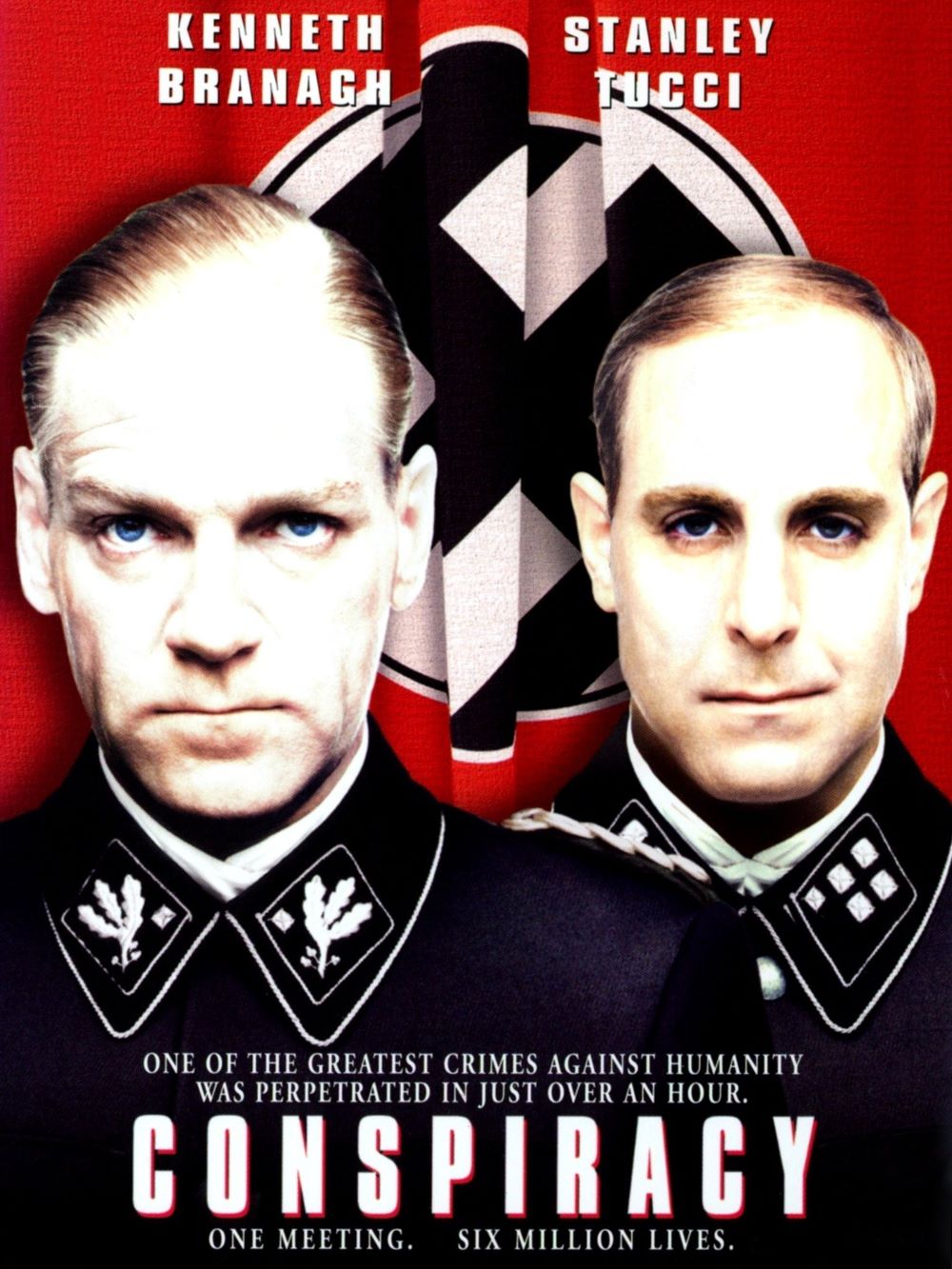
HBO’s Conspiracy (2001) masterfully dramatizes the infamous Wannsee Conference, held on January 20, 1942, where high-ranking Nazi officials orchestrated the Final Solution. The film’s running time mirrors the historical meeting itself, distilling one of the darkest moments in history into a single, chilling sitting that balances historical fidelity, psychological insight, and dramatic restraint. The premise is stark and deceptively simple: a group of men, most of whom had never previously met, gather in a sun-drenched villa outside Berlin to discuss systematic mass murder while enjoying fine food and polite conversation. This contrasting setting, rendered with careful attention to period detail, powerfully underscores what Hannah Arendt called the “banality of evil.” In Conspiracy, evil is not the property of villainous caricatures, but of functionaries and technocrats—chillingly rational and disturbingly mundane.

Much of the film unfolds in real time, utilizing dialogue taken from the sole surviving minutes of the Wannsee Conference. Screenwriter Loring Mandel and director Frank Pierson avoid unnecessary embellishments, allowing the facts and the conversations themselves to carry the full, horrifying weight. Kenneth Branagh gives an Emmy-winning performance as Reinhard Heydrich, the orchestrator and presiding presence at the conference. Branagh’s portrayal is both urbane and authoritative, presenting Heydrich as a figure whose affable composure thinly veils his unwavering commitment to genocide. There is no soaring rhetoric or overt menace; Heydrich’s evil is presented with administrative casualness, making it all the more chilling.

Stanley Tucci is equally compelling as Adolf Eichmann, Heydrich’s logistical right hand and the architect of the machinery of death. Tucci infuses Eichmann with a quiet efficiency and bureaucratic pride—a portrait of a man more attached to process than morality, disturbingly bland in his demeanor. The supporting cast is no less impressive. Colin Firth, as Dr. Wilhelm Stuckart, portrays a legal architect of Nazi race law who appears increasingly unsettled as the agenda shifts from disenfranchisement to extermination. Each attendee is rendered with psychological nuance. Some are disturbingly enthusiastic about their roles, while others are quietly apprehensive, yet ultimately complicit. These subtle gradations of doubt, ambition, and opportunism animate the film’s psychological landscape.

The dialogue, rooted in the actual transcript and skillful dramatic writing, eschews melodrama. The horror emerges not through spectacle, but in analytic exchanges about logistics, quotas, and definitions—the cold calculus of genocide. The men’s debates around how to classify mixed-race Jews, whether sterilization is preferable to extermination, and who should be spared create a bureaucratic puzzle as vile as its intent. Their discussions are delivered in a neutral, even mundane tone, which heightens the chilling reality of what they are planning. Pierson’s direction is restrained; the film never leaves its confined setting, emphasizing the claustrophobic mood of collective complicity. The camera lingers on faces rather than violence, building tension through small gestures—a glance, a pause, the clinking of glassware. The impact of what is said is matched only by the weight of what goes unsaid, until Heydrich, in a quietly devastating moment, makes the true purpose explicit.

More than a simple history lesson, Conspiracy meditates on themes of collective guilt, moral responsibility, and the terrifying ease with which ordinary people become accessories to atrocity. The film is haunted by bureaucracy; if everyone is “just following orders” or “simply doing their job,” the boundaries of blame blur and diffuse. The characters’ debates skillfully skirt the language of murder, favoring euphemisms such as “evacuation” or “resettlement.” This allows viewers to witness, in real time, the kind of moral erosion that enables atrocity on a massive scale. The dry, matter-of-fact tone of the film deepens its emotional impact, forcing the audience to comprehend that such horrors were conjured not in a frenzy, but in calm administrative exchanges over lunch.

For both historians and general audiences, Conspiracy earns praise for its meticulous adherence to historical detail. The screenplay closely follows the Wannsee minutes, and the film’s design choices—muted score, period-accurate costumes, and careful pacing—all serve to render bureaucratic evil as mundane and unremarkable. This unwavering restraint, however, does impose certain limits. The film’s dramatic arc is inherently subdued; the absence of conventional action or narrative tension makes it unfold like an extended negotiation rather than a traditional drama. Some viewers may find this lack of overt conflict stifling or static, resulting in a work that feels more “important” than “entertaining,” but this is clearly by design.

Conspiracy received widespread acclaim for both its historical gravity and psychological depth. Branagh and Tucci, in particular, were celebrated for their nuanced performances. The film is often cited as a model example of how the “banality of evil” operates—not through monsters, but through functionaries in tailored uniforms, sipping wine and rationalizing extermination. For those unfamiliar with the events, the manner in which these men discuss matters of life and death with casual detachment is shocking. As one critic noted, “Most people believe they know what evil looks like… But in Conspiracy, men of true evil met in pristine, gorgeous surroundings… and go about their business leisurely… with a smile and barely a hint of remorse.”

Within the canon of Holocaust cinema, Conspiracy stands apart from films like Schindler’s List or The Pianist, which focus on the suffering and survival of victims. Instead, it occupies a space similar to Downfall and the earlier Die Wannseekonferenz, dramatizing not the machinery of genocide but the mindsets of its architects. By confining itself to dialogue and implication, the film compels viewers to reflect on how civilization’s facades both enable and obscure horror.

The film’s lingering effect is not found in dramatic catharsis or tears, but in an enduring sense of discomfort. Conspiracy dramatizes not just a choice among evil options, but the ease with which those choices become rote procedure and social negotiation. The silence in the final act, as the men calmly disperse after codifying genocide, lands with a cold, almost procedural finality. The closing captions, briefly summarizing the fates of those present, deliver a sobering message: accountability was sporadic, often delayed, and never guaranteed.

Conspiracy is not casual entertainment, nor is it meant to be. Instead, it is essential viewing for anyone interested in the psychology of atrocity, the peril of bureaucratic amorality, and the enduring question of how ordinary people become complicit in extraordinary evil. With a screenplay of surgical precision, outstanding ensemble cast (especially Branagh and Tucci), and a director committed to understatement, HBO’s film demonstrates how history’s darkest decisions are forged not in chaos, but in chilling consensus. To those seeking to understand not only what happened at Wannsee, but how, Conspiracy offers an unblinking and quietly devastating answer.

Film Review: Conspiracy (dir by Frank Pierson)


The 2001 film, Conspiracy, takes place at a villa on the outskirts of Berlin.  It’s a lovely villa and, as we can see during the film’s opening moments, it’s about to play host to a meeting of very important people.

The date is January 20th and the year is 1942.  Having conquered much of Europe, Nazi Germany is now at war with the Allies.  Reinhard Heydrich (Kenneth Branagh), the young chief of the Reich Security Main Office and the man who many feel will eventually succeed Adolf Hitler as the leader of the Third Reich, has been directed to call a conference so that he and his deputy, Adolf Eichmann (Stanley Tucci), can “discuss” ways to solve “the Jewish question.”  One-by-one, representatives of the Reich’s bureaucracy show up at the villa.

At the start of the meeting, the men discuss various ways to force the Jews out of Germany and all of the occupied territories.  The men chose their words carefully, speaking in euphemisms and doing their best to sound like concerned government officials.  The men know what they’re talking about but they still seem to feel the need to avoid coming right and saying it.  As they talk, it becomes clear that everyone is trying to stay in Heydrich’s good graces while, at the same time, avoiding the fact that they understand the truth about what Germany is doing.  It’s not until halfway through the meeting that Heydrich and Eichmann reveal that Germany’s policy has already been determined and that concentration camps with gas chambers have already been designed and built.  The meeting is less about discussing the policy and more about getting each man at the meeting to sign off on it.  The unspoken subtext is that each man is being tested to determine who will support (and, if need be, help to cover up) the Final Solution and who will have to be otherwise dealt with.

Based on the actual minutes of the meeting, Conspiracy is film that is perhaps even more important now than when it was first released.  It’s a film that explores not only the banality of evil but also seeks to answer the question of why no one in Hitler’s government forcefully objected to the Final Solution.  (Many, of course, claimed not to know what was going on.  This film reveals just how little credibility that claim had.)  Some of the men go along because they understand not going along would mean the end of their careers and maybe their lives.  Some of the men agree because, as members of the military, they believe in supporting their country’s leadership, regardless of what that leadership represents.  Some of the men agree because they want to stay in Heydrich’s good graces.  These men represent a society where anti-Semitism is so normalized that it is accepted as a given and, while some of the men are not as outspoken in their prejudice as the others, it’s clear that all of them view the Jewish people as being a unique problem.  Those who do raise concerns do so only out of worry of what will happen to them if the rest of the world discovers what Germany is planning.  Heydrich insists that there is no need to worry because Germany will win the war.  Some of the men at the Conference are clearly not convinced of Germany’s pre-destined victory but not a single one has either the morality or the courage to refuse to endorse the Final Solution.  The film ends with a series of title cards, letting us know what became of the men who attended the Wannsee Conference.  Heydrich was assassinated during the war.  Eichmann fled to South America and hid there until he was captured by Israel in 1960.  Many of the men were executed for war crimes but a surprising number of them were either acquitted or never put on trial and went to live peacefully after the war.

Well-directed by Frank Pierson, Conspiracy has a distinguished cast who brings the historical characters to terrible life.  It’s one thing to read about what was said and planned at the Conference.  It’s another thing to actually hear those words spoken aloud and it’s a reminder that the evil of the Holocaust was not an accident nor was it something that took its perpetrators by surprise.  It was something that meticulously planned by human beings who were fully aware of what they were doing.  Kenneth Branagh makes for an arrogant and intimidating Heydrich while Stanley Tucci plays Eichmann as being the type of bureaucratic robot who is incapable of seeing human beings as anything more than just dwindling numbers on a report.  Colin Firth and David Threlfall make strong impressions as two of the more weary members of the Conference, as does Ian McNeice in the role of the type of crude, career-driven government functionary who has survived by pretending to be dumb.

At a time when anti-Semitism is on the upswing and Holocaust denialism is being mainstreamed, Conspiracy is an important film.  When others say that the Holocaust didn’t happen or that it doesn’t matter, Conspiracy defiantly says, “Yes, it did and yes, it does.”

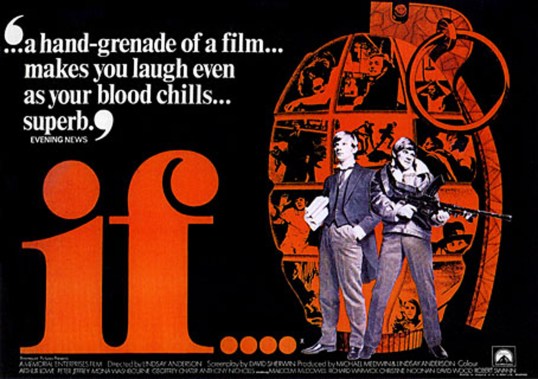
Back to School #7: if… (dir by Lindsay Anderson)


For today’s final entry in our series of Back to School reviews, let’s close out the 60s by taking a look at a 1968 British film.  Directed by Lindsay Anderson, if… not only won the Grand Prix du Festival International du Film (now known as the Palme d’Or) at the 1969 Cannes Film Festival but it also featured the film debut of future icon Malcolm McDowell.

if… takes place at a British public school (or, as we would call it here in the States, a private school) that is mired in a long tradition of conformity and oppression.  For roughly the first half of the film, we see how the school works.  The teachers are stern and out-of-touch.  The headmaster (Peter Jeffrey) considers himself to be something of a reformer and is clueless as to just how little respect the students have for him.  Discipline is maintained by the Whips,sadistic upperclassmen who revel in their power and who spend most of their time speculating about which one of them will claim 13 year-old Bobby Phillips (Rupert Webster) as his own.  Three students — Mick Travis (Malcolm McDowell), Johnny (David Wood), and Wallace (Richard Warwick) — are considered to be nonconformists and soon find themselves being targeted by both the school’s faculty and the Whips.  During this first half, the film plays out as harsh but relatively realistic.

And then something happens.

If2

About 45 minutes into the film, if… starts to grow increasingly more and more surreal.  In a scene that plays out in languid, sensual slow motion, the otherwise dim-witted Wallace gracefully exercises on a high bar while an entranced Bobby Phillips watches.  When Rowntree and his fellow whips decide to punish Mick, Johnny, and Wallace with a particularly brutal caning, the disturbing sound of it echoes throughout the entire school.  During a war game, Mick fires an automatic rifle full of blanks at the chaplain and is subsequently forced to apologize while the chaplain sits up in a drawer kept in the headmaster’s office.  Mrs. Kemp, the wife of the housemaster, wanders naked through the dormitory.  Perhaps most famously, the film goes from randomly being in color to black-and-white and then back again, all adding to the movie’s dreamlike feel.

Perhaps most importantly, Johnny and Mick manage to sneak off campus and spend a day roaming around the city.  After they steal a motorcycle from a showroom, they stop at a cafe where they are served coffee by a character known only as the Girl (Christine Noonan).  The Girl tells Mick that sometimes she’s a tiger and soon, they are wrestling naked on the floor while Johnny sits in a corner booth and drinks his coffee.  Later, when Mick returns to the school, he looks through a telescope and sees the Girl staring back at him and waving.

Johnny, the Girl, and Mick

And finally, the Girl shows up while Mick, Johnny, Wallace, and Bobby are cleaning out a storeroom as a part of their punishment for scaring the chaplain.  Among the dusty shelves, they find not only a jar containing a fetus but a cache of weapons as well.  This leads to the film’s famous conclusion, a shocking act of violence that, in the 60s, was probably viewed as a show of solidarity with rebellious youth everywhere but, when seen in this time and age, draws disturbing parallels with the American tradition of school shootings.

Seen today, if… remains a surprisingly potent celebration of rebellion and a harsh condemnation of conformist society.  Occasionally pretentious in that wonderful way that only a British film made in 1968 could be, if… is also a surprisingly stinging satire that doesn’t leave anyone — even the film’s heroes — untouched.  Perhaps best of all, if… is also the film debut of Malcolm McDowell and he gives a strong performance here.  It’s easy to understand why, after seeing if…, Stanley Kubrick cast McDowell in A Clockwork Orange.  Interestingly enough, despite if’s apocalyptic ending, McDowell would play Mick Travis twice more, in Anderson’s O Lucky Man, a film that is even more surreal than if…, and in Britannia Hospital.

Tomorrow, we’ll continue our journey back to school by taking a trip to the 70s!

If