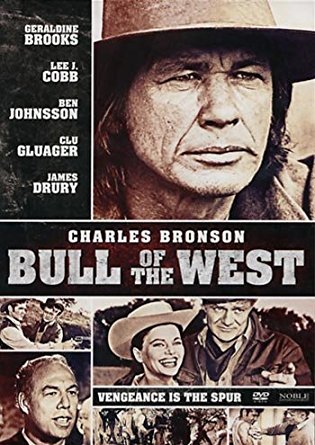
Welcome to the American frontier. The time is the 1880s and men and women everywhere are heading out west in search of their fortune. While stowing away on a train, veteran cowboy Johnny Wade (Brian Keith) meets the naive Steve Hill (Gary Clarke) and becomes a mentor to the younger man. Johnny teaches Steve how to shoot a gun and, when they get off the train at Medicine Bow, Wyoming, they get jobs working on the ranch of Georgia Price (Geraldine Brooks). When Georgia and Johnny plot to overgraze the land, Steve must decide whether he’s with them or with a rival rancher, Judge Garth (Lee J. Cobb).
At the same time, Ben Justin (Charles Bronson) has arrived in town with his son, Will (Robert Random), and his new wife (Lois Nettleton). Ben is determined to start his own ranch but, because of his taciturn and stubborn personality, he alienates the Cattleman’s Association, which led by Judge Garth and Bear Suchette (George Kennedy). Will wants to help his father but Ben keeps pushing him away. It’s up to Judge Garth’s foreman, the Virginian (James Drury), to bring the family together.
Just like The Meanest Men In The West,The Bull of the West was created by editing together footage from two unrelated episodes of The Virginian. It works better for the Bull of the West because the two episodes had similar themes and the footage mixes together less awkwardly than it did in The Meanest Men In The West. But Bull of the West is still just a TV show edited into a movie. The main reason to see it is because of all the familiar western faces in the cast. Along with Bronson, Keith, Cobb, and Kennedy, keep an eye out for Ben Johnson, DeForest Kelley, and Clu Gulager.
Earlier tonight, I watched a 1966 film called The Russians Are Coming, The Russians Are Coming.
It’s a cheerful comedy about what happens when the captain (played by Theodore Bikel) of a Russian submarine decides that he wants to take a look at the United States. Though he was only planning to look at America through a periscope, he accidentally runs the submarine into a sandbar sitting near Gloucester Island, which itself sits off the coast of Massachusetts. The captain sends a nine man landing party, led by Lt. Yuri Rozanov (a youngish Alan Arkin, making his film debut and receiving an Oscar nomination for his efforts), to the island. Their orders are simple. Yuri and his men are too either borrow or steal a boat that can be used to push the submarine off the sandbar. If they run into any locals, they are to claim to be Norwegian fisherman.
Needless to say, things that don’t quite go as planned. The first Americans that Yuri and his men meet are the family of Walt Whitaker (Carl Reiner), a vacationing playwright. Walt’s youngest son immediately identifies the Norwegian fisherman as being “Russians with submachine guns.” When Walt laughingly asks Yuri if he’s a “Russian with a submachine gun,” Yuri produces a submachine gun and promptly takes Walt, his wife (Eva Marie Saint), and his children hostage.
Yuri may be a Russian. He may officially be an enemy of America. But he’s actually a pretty nice guy. All he wants to do is find a boat, keep his men safe, and leave the island with as little drama as possible. However, the inhabitants of the island have other plans. As rumors spread that the Russians have landed, the eccentric and largely elderly population of Gloucester Island prepares for war. Even as Police Chief Mattocks (Brian Keith) and his bumbling assistant, Norman Jonas (Jonathan Winters), attempt to keep everyone calm, Fendall Hawkins (Paul Ford) is organizing a militia and trying to contact the U.S. Air Force.
Meanwhile, Walt’s babysitter, Allison (Andrea Dromm) finds herself falling in love with one of the Russians, the gentle Alexei Kolchin (John Phillip Law).
As I said at the start of this review, The Russians Are Coming, The Russians Are Coming is a cheerful comedy, one with a rather gentle political subtext, suggesting that the majority of international conflicts could be avoided if people got to know each other as people as opposed to judging them based on nationality or ideology. There’s a rather old-fashioned liberalism to it that probably seemed quite daring in 1966 but which feels rather quaint today. Sometimes, the comedy gets a bit broad and there were a few times that I found myself surprised that the film didn’t come with a laugh track. But overall, this is a well-acted and likable little movie.
As I watched The Russians Are Coming, The Russians Are Coming (and, as someone who is contractually obligated to use a certain number of words per review, allow me to say how much I enjoyed the length of that title), I found myself considering that the film would have seemed dated in 2013 but, with all the talk of Russian hacking in the election and everything else, it now feels a little bit more relevant. Not a day goes by when I don’t see someone on twitter announcing that the Russians are coming. Of course, if the film were released today, its optimistic ending would probably be denounced as an unacceptable compromise. Peaceful co-existence is no longer as trendy as it once was.
Another interesting thing to note about The Russians Are Coming, The Russians are Coming: though the film was written by William Rose (who also wrote another example of mild 1960s feelgood liberalism, Guess Who’s Coming To Dinner), it was based on a novel by Nathaniel Benchley. Benchley was the father of Peter Benchley, the author of Jaws. It’s easy to see the eccentrics of Gloucester Island as distant cousins of the inhabitants of Amity Island.
As previously stated, The Russians Are Coming, The Russians Are Coming was nominated for best picture but it lost to the far more weighty A Man For All Seasons.
After a drug bust goes wrong, Atlanta police detective Tom Sharky (Burt Reynolds, who also directed) is transferred from narcotics to the vice squad, the least desirable assignment in the Atlanta police department. Despite all of his honors and commendations, Sharky finds himself reduced to busting hookers with Papa (Brian Keith) and Arch (Bernie Casey). But then Sharky discovers evidence of a prostitution ring being run by Victor D’Anton (Vittorio Gassman), one that services the wealthiest and most powerful men in Georgia.
Working with Papa, Arch, and a burned-out bugging expert named Nosh (Richard Libertini), Sharky begins a surveillance of Domino (Rachel Ward), one of Victor’s girls. As the days turns into weeks, Sharky falls in love with Domino, who doesn’t even know that she’s being watched. Sharky also discovers that Domino is sleeping with Hotckins (Earl Holliman), who is about to be elected governor of Georgia. At the same time, a heroin-addicted assassin named Billy Score (Henry Silva) is assassinating anyone who could reveal Victor’s crimes.
There are two great sequences in Sharky’s Machine. One is the opening credits scene, in which a bearded Burt Reynolds walks through the roughest parts of Atlanta while Randy Crawford sings Street Life. This scene lets everyone know from the start that this is not another Burt Reynolds good ol’ boy comedy. The other is a cat-and-mouse chase through an Atlanta skyscraper, as Sharky and his partners try to track down Billy Score, who is so doped up on painkillers that he barely flinches whenever he’s shot. Billy Score is one of the most frightening movie villains of all time, seemingly indestructible and capable of moving like a ghost.
With the exception of maybe Deliverance, Sharky’s Machine is Burt Reynolds’s darkest movie. There are moments of humor and appearances by the usual members of the Burt Reynolds stock company, like John Fiedler and Charles Durning. But overall, this is one dark movie. Likable characters die. Sharky cries and loses two fingers when they are graphically chopped off by the bad guys. A woman’s face is literally blown off. Even when Sharky starts to talk about his childhood, a sentimental moment the occurred in almost every Burt Reynolds film, Domino tells him that she doesn’t care.
In other words, this ain’t The Cannonball Run.
Burt Reynolds’s first cut of Sharky’s Machine reportedly ran for 140 minutes. Twenty minutes were cut before it was released into theaters and, as a result, Sharky’s Machine sometimes seems to be rough around the edges. (One important supporting character is killed off-screen and if you don’t pay close attention to the dialogue, you might never know what happened to him.) Still, this violent film noir, which Reynolds once called “Dirty Harry in Atlanta,” is one of Burt’s best.
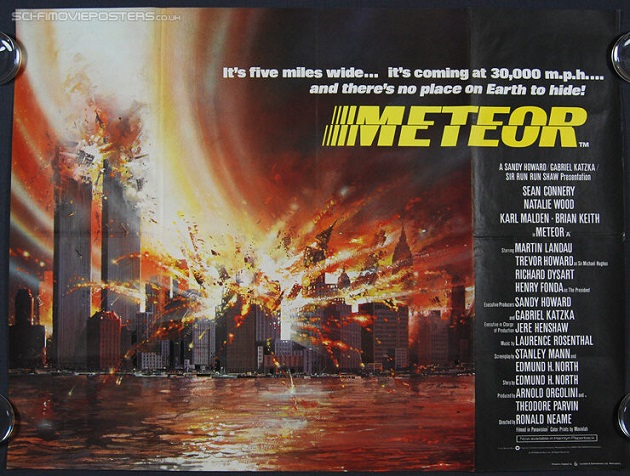
American-International Pictures had gotten pretty fancy-schmancy by the late 70’s. The studio was leaving their exploitation roots behind and branching out to bigger budgeted films like FORCE TEN FROM NAVARONE, LOVE AT FIRST BITE, and THE AMITYVILLE HORROR, with bigger name stars for marquee allure. Toward the end of 1979 they released METEOR, a $16 million dollar, star-studded, special-effects laden, sci-fi/ disaster film spectacle that bombed at the box-office and contributed to the company’s demise.
Coming at the tail end of the disaster cycle, METEOR is formulaic as hell. Take a group of well-known stars (Sean Connery, Natalie Wood , Karl Malden , Brian Keith , Martin Landau, Henry Fonda ), give them a disastrous menace to combat (in this case a five-mile wide meteor hurtling toward Earth), add some conflict (US/USSR Cold War relations), and some scenes of destruction, and voila! instant disaster movie! Unfortunately, by 1979 audiences had already grown tired…
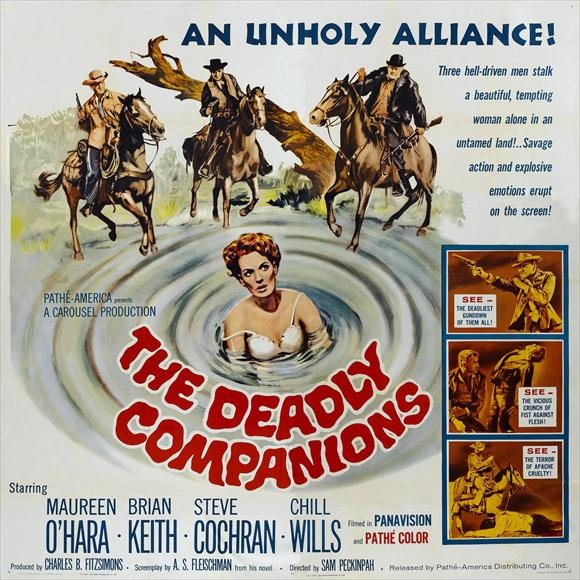
Maverick filmmaker Sam Peckinpah got his start in television, writing and directing for Westerns such as GUNSMOKE, THE RIFLEMAN, and HAVE GUN- WILL TRAVEL. In 1959, he created the series THE WESTERNER, starring Brian Keith as a drifter named Dave Blassingame, noted for its extreme (for the time) violence. When Keith was cast as the lead in THE DEADLY COMPANIONS, he suggested his friend Peckinpah as director. This was Peckinpah’s first feature film, and the result is a flawed but interesting film which has brief flourishes of the style he later perfected in THE WILD BUNCH and PAT GARRETT AND BILLY THE KID.
Keith is again a drifter, this time an ex-Union soldier known only as Yellowleg. He hooks up with a pair of Southern outlaws and they ride to Hila City to rob the bank. They get sidetracked at the saloon when it converts into a church service. Next thing you know…
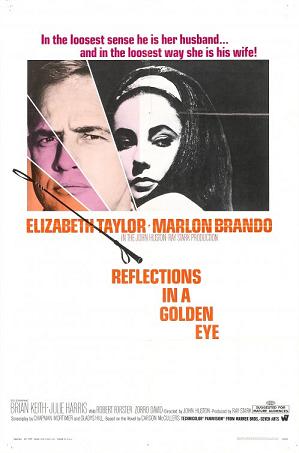
For the past two weeks, I’ve been reviewing, in chronological order, 126 cinematic melodramas. I started in the 1920s with Sunrise and Wings and now, 33 reviews later, we have finally reached the end of the 1960s. And what better way to end the 60s than by taking a mercifully brief look at the 1969 film, Reflections in a Golden Eye.
Now, before I get too critical of this film, I should acknowledge that there are some critics who absolutely love Reflections in a Golden Eye. They think very highly of Marlon Brando’s performance as Maj. Weldon Penderton, a closeted homosexual who is stationed at a military base in the South. They think that Elizabeth Taylor’s performance as Brando’s wife isn’t somewhat embarrassing. And they think that the script isn’t overwritten and that director John Huston doesn’t try way too hard to prove himself worthy of the title auteur. They feel that Reflections in a Golden Eye is a secret masterpiece that does not deserve to be known as an infamous flop.
I’m definitely not one of those people but they do exist. There are some very respectable and intelligent critics who happen to love Reflections in a Golden Eye.
Well — vive la différence!
Earlier in this series, I pointed out that the 60s were not a great time for old school Hollywood directors trying to compete with both American television and European film. It was a time when talented directors found themselves trying to keep up with the times and appeal to new audiences. As a result, Joseph L. Mankiewicz ended up making Cleopatra. Edward Dmytryk did The Carpetbaggers. Elia Kazan directed The Arrangement. William Wyler did The Liberation of L.B. Jones. Stanley Kramer made RPM.
And John Huston made Reflections in a Golden Eye.
This painfully slow film follows the affairs of six people on that Southern army base. Brando is emotionally repressed and spend most of the movie mumbling in one of the worst Southern accents ever. Taylor is obsessed with horses and spends most of the movie yelling in one of the worst Southern accents ever. Robert Forster is the object of Brando’s repressed desire, a soldier who likes to ride horses while naked and who is obsessed with sniffing Elizabeth Taylor’s underwear. Brian Keith is in charge of the army base and is having an affair with Taylor. Julie Harris is Keith’s suicidal wife. Zorro David is Harris’s houseboy who, at one point, is nice enough to give this film a title by mentioning something about a golden eye.
What’s particularly insane is that Huston took the idea of making this film a reflection in a golden eye literally. The entire film is tinted a sickly gold color. Whenever the characters step outside, the sky looks like the sun has just exploded. Whenever the characters are inside, they all look like they have jaundice. On the one hand, you have to respect the fact that Huston so committed himself to potentially alienating the audience. On the other hand, the yellow-tinting renders almost every image so grotesque that I actually found myself growing physically ill as I watched the film.
Watching Reflections in a Golden Eye, I could understand why The Godfather was such a huge comeback for Marlon Brando. I wouldn’t necessarily say that Brando gives a bad performance here. He’s watchable throughout the entire film. But it’s still a performance that’s so strangely modulated (and which features a Southern accent that is just amazingly bad) that it ultimately distracts from the film itself. If anything, Brando gives a performance that suggests what happens when a talented and eccentric man gets bored with what he’s doing.
(If you want to see a good Brando performance from 1969, see Burn.)
Reflections in a Golden Eye is a pretentious mess but fortunately, both Huston and American film would make a comeback in the 1970s. We’ll start on that decade tomorrow.
(Yes, this video is a spoiler but it’ll allow you to see the gold tinting.)
(The film was also released in an untinted version.)
 Welcome to the American frontier. The time is the 1880s and men and women everywhere are heading out west in search of their fortune. While stowing away on a train, veteran cowboy Johnny Wade (Brian Keith) meets the naive Steve Hill (Gary Clarke) and becomes a mentor to the younger man. Johnny teaches Steve how to shoot a gun and, when they get off the train at Medicine Bow, Wyoming, they get jobs working on the ranch of Georgia Price (Geraldine Brooks). When Georgia and Johnny plot to overgraze the land, Steve must decide whether he’s with them or with a rival rancher, Judge Garth (Lee J. Cobb).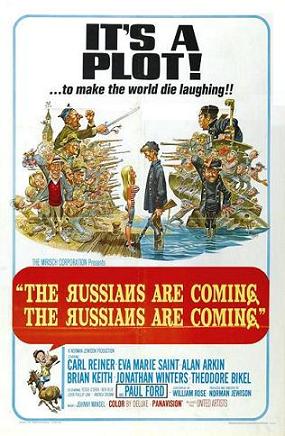




 Through the Shattered Lens