The 1990 film Jacob’s Ladder asks the question, “Who is Jacob Singer?”
Is Jacob (played by Tim Robbins), a soldier serving in Vietnam who has just been severely wounded in an enemy attack and who is now barely clinging to life in a helicopter?
Is Jacob a withdrawn postal worker who lives in 1970s New York with his girlfriend, Jezzie (Elizabeth Pena), and who is haunted by horrifying visions of faceless, vibrating figures and viscous demons? This Jacob is haunted by ill-defined past incidents. Whenever he gets depressed, Jezzie is quick to demand that he snap out of it and that he stop thinking about anything other than the present day. This Jacob can only watch as all of his old friends either sink into paranoia or die. He hears rumors that they all may have been part of some sort of experiment involving LSD. He’s sure that he served in the army but when he attempts to hire an attorney, he’s informed that the army has no record of him ever having served in combat and that they say he was discharged for psychological reasons.
Or is Jacob the husband of Sarah (Patricia Kalember) and the father of Gabe (Macaulay Culkin — yes, that Culkin)? This is the Jacob who occasionally wakes up in bed with his wife and tells her that he’s been having the weirdest dream, one where he was living with “that crazy woman” from the post office, Jezebel?
Which one of these three realities is the truth for Jacob? At times, Jacob himself doesn’t even seem to be sure. Perhaps the one thing that you can be sure about in this movie is that whenever Jacob closes his eyes, he’s going to reopen them and discover that he’s in a different time and place. Jacob spends almost the entire film trying to work out what’s happening in the present, what’s happening in the past, and what’s just happening in his head.
And, to be honest, it all gets a bit pretentious at times. The film’s script has a lot on its mind. In fact, it might have a little bit too much going on. No sooner have you soaked in what the film has to say about denial and acceptance than you’re suddenly getting a crash course in MK-ULTRA and other mind-control conspiracy theories. Whenever Jacob isn’t seeing demons and faceless apparitions, he’s being kidnapped by government agents. There’s so much going on that this film can get a bit exhausting.
Fortunately, the film itself is such a triumph of style that it doesn’t matter that the script is a bit of a mess. Director Adrian Lyne does a great job bringing Jacob’s nightmarish world to life. Jacob seems to live in a world where the skies are permanently overcast and the streets are always wet after a recent storm. When Jacob makes the mistake of walking down a subway tunnel, Lyne frames it as if Jacob is literally following a tunnel into Hell. When a subway train rushes by Jacob, we catch disturbing glimpses of featureless faces facing the windows. When Jacob sees a demon at a party, Lynne films the moment so that, just like Jacob, it takes us a few minutes to realize what we’re seeing. And when Jacob is kidnapped and taken to a Hellish hospital, the scene is nightmarish in its intensity.
Tim Robbins gives a great performance as the emotionally withdrawn and haunted Jacob. (In fact, he’s so good that it makes it all the more sad that he really hasn’t had a decent role since he won an Oscar for 2003’s Mystic River.) He’s matched by Elizabeth Pena, who constantly keeps you wondering if Jezzie truly cares about Jacob or if she’s just another part of the conspiracy that seems to have taken over his life.
Jacob’s Ladder is an intensely effective, if somewhat messy, horror film. Apparently, like almost every other horror film released in the 20th century, it’s currently being remade, with the remake due to released on February 9th. Just in time for Valentine’s Day!
From start to end, the 1994 film Ed Wood is a nearly perfect film.
Consider the opening sequence. In glorious black-and-white, we are presented with a house sitting in the middle of a storm. As Howard Shore’s melodramatic and spooky score plays in the background, the camera zooms towards the house. A window flies open to reveal a coffin sitting in the middle of a dark room. A man dressed in a tuxedo (played to snarky and eccentric perfection by Jeffrey Jones) sits up in the coffin. Later, we learn that the man is an infamously inaccurate psychic named Criswell. Criswell greets us and says that we are interested in the unknown. “Can your heart handle the shocking facts of the true story of Edward D. Wood, Jr!?”
As streaks of lightning flash across the sky, the opening credits appear and disappear on the screen. The camera zooms by tombstones featuring the names of the cast. Cheap-looking flying saucers, dangling on string, fly through the night sky. The camera even goes underwater, revealing a giant octopus…
It’s a brilliant opening, especially if you’re already a fan of Ed Wood’s. If you’re familiar with Wood’sfilms, you know that Criswell’s appearance in the coffin is a reference to Orgy of the Dead and that his opening monologue was a tribute to his opening lines fromPlan 9 From Outer Space. If you’re already a fan of Ed Wood then you’ll immediately recognize the flying saucers. You’ll look at that octopus and you’ll say, “Bride of the Monster!”
And if you’re not an Ed Wood fan, fear not. The opening credits will pull you in, even if you don’t know the difference between Plan 9 and Plan 10. Between the music and the gorgeous black-and-white, Ed Wood is irresistible from the start.
Those opening credits also announce that we’re about to see an extremely stylized biopic. In the real world, Ed Wood was a screenwriter and director who spent most of his life on the fringes of Hollywood, occasionally working with reputable or, at the very least, well-known actors like Lyle Talbot and Bela Lugosi. He directed a few TV shows. He wrote several scripts and directed a handful of low-budget exploitation films. He also wrote a lot of paperbacks, some of which were semi-pornographic. Most famously, he was a cross-dresser, who served in the army in World War II and was wearing a bra under his uniform when he charged the beaches of Normandy. Apparently, the stories of his love for angora were not exaggerated. Sadly, Wood was also an alcoholic who drank himself to death at the age of 54.
Every fan of Ed Wood has seen this picture of him, taken when he first arrived in Hollywood and looked like he had the potential to be a dashing leading man:
What people are less familiar with is how Ed looked after spending two decades on the fringes of the film business:
My point is that the true story of Ed Wood was not necessarily a happy one. However, one wouldn’t know that from watching the film based on his life. As directed by Tim Burton, Johnny Depp plays Ed Wood as being endlessly positive and enthusiastic. When it comes to determination, nothing can stop the film’s Ed Wood. It doesn’t matter what problems may arise during the shooting of any of his films, Wood finds a way to make it work.
A major star dies and leaves behind only a few minutes of usable footage? Just bring in a stand-in. The stand-in looks nothing like the star? Just hide the guy’s face.
Wrestler Tor Johnson (played by wrestler George “The Animal” Steele), accidentally walks into a wall while trying to squeeze through a door? Shrug it off by saying that it adds to the scene. Point out that the character that Tor is playing would probably run into that wall on a regular basis.
Your fake octopus doesn’t work? Just have the actors roll around in the water.
The establishment won’t take you seriously? Then work outside the establishment, with a cast and crew of fellow outcasts.
You’re struggling to raise money for your film? Ask the local Baptist church. Ask a rich poultry rancher. Promise a big star. Promise to include a nuclear explosion. Promise anything just to get the film made.
You’re struggling to maintain your artistic vision? Just go down to a nearby bar and wait for Orson Welles (Vincent D’Onofrio) to show up.
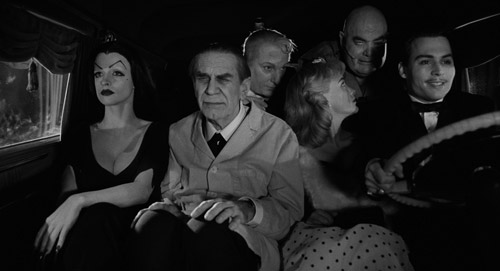
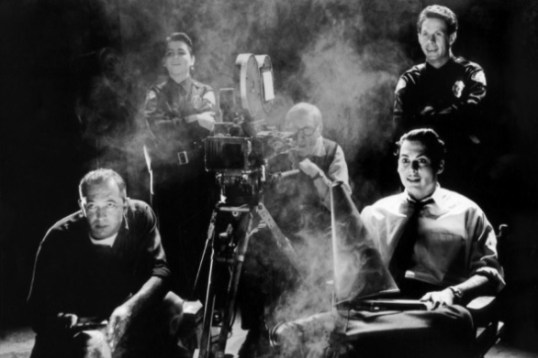
Personally, I’m of the opinion that Ed Wood is Tim Burton’s best film. It’s certainly one of the few Burton films that actually holds up after repeat viewings. Watching the film, it’s obvious that Wood and Burton shared a passionate love for the movies and that Burton related to Wood and his crew of misfits. It’s an unabashedly affectionate film, with none of the condescension that can sometimes be found in Burton’s other film. Burton celebrates not just the hopes and dreams of Ed Wood, Bela Lugosi, Tor Johnson and Criswell but also of all the other members of the Wood stock company, from Vampira (Lisa Marie) to Bunny Breckenridge (Bill Murray), all the way down to Paul Marco (Max Casella) and Loretta King (Juliet Landau). Though Ed Wood may center around the character of Wood and the actor who plays him, it’s a true ensemble piece. Landau won the Oscar but really, the entire cast is brilliant. Along with those already mentioned, Ed Wood features memorable performances from Sarah Jessica Parker and Patricia Arquette (one playing Wood’s girlfriend and the other playing his future wife), G. D. Spradlin (as a minister who ends up producing one of Wood’s films), and Mike Starr (playing a producer who is definitely not a minister).
For me, Ed Wood is defined by a moment very early on in the film. Wood watches some stock footage and talks about how he could make an entire movie out of it. It would start with aliens arriving and “upsetting the buffaloes.” The army is called in. Deep delivers the line with such enthusiasm and with so much positive energy that it’s impossible not get caught up in Wood’s vision. For a few seconds, you think to yourself, “Maybe that could be a good movie…” Of course, you know it wouldn’t be. But you want it to be because Ed wants it to be and Ed is just do damn likable.
As I said before, Ed Wood is a highly stylized film. It focuses on the good parts of the Ed Wood story, like his friendship with Bela Lugosi and his refusal to hide the fact that he’s a cross-dresser who loves angora. The bad parts of his story are left out and I’m glad that they were. Ed Wood is a film that celebrates dreamers and it gives Wood the happy ending that he deserved. The scenes of Plan 9 From Outer Space getting a raptorous reception may not have happened but can you prove that they didn’t?
I suppose now would be the time that most reviewers would reflect on the irony of one of the worst directors of all time being the subject of one of the best films ever made about the movies. However, I’ll save that angle for whenever I get a chance to review The Disaster Artist. Of course, I personally don’t think that Ed Wood was the worst director of all time. He made low-budget movies but he did what he could with what he had available. If anything, Ed Wood the film is quite correct to celebrate Ed Wood the director’s determination. Glen or Glenda has moments of audacious surrealism. Lugosi is surprisingly good in Bride of the Monster. As for Plan 9 From Outer Space, what other film has a plot as unapologetically bizarre as the plot of Plan 9? For a few thousand dollars, Wood made a sci-fi epic that it still watched today. Does that sound like something the worst director of all time could do?
Needless to say, Ed Wood is not a horror film but it’s definitely an October film. Much as how Christmas is the perfect time for It’s A Wonderful Life, Halloween is the perfect time for Ed Wood.


 Through the Shattered Lens