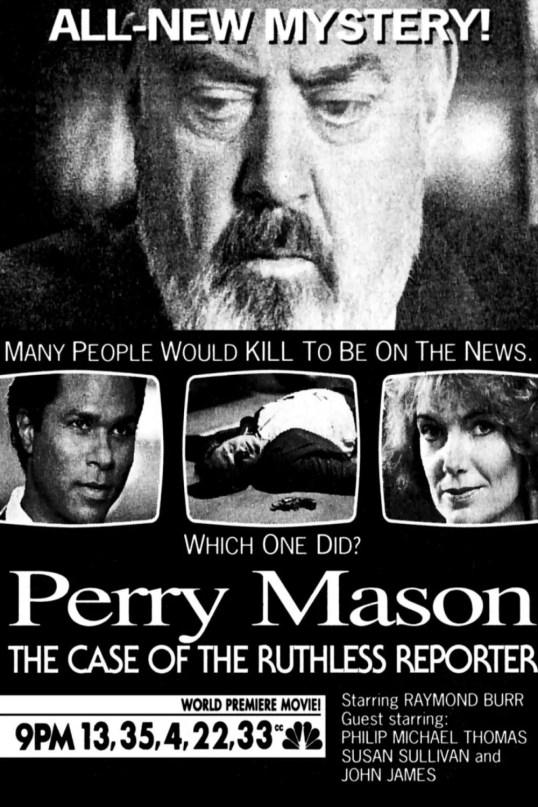
When arrogant news anchor Brett Huston (John James) is shot and killed, his co-anchor Gillian Pope (Kerrie Keane) is arrested and charged with the crime. It looks like an open-and-shut case because Brett was shot with Gillian’s gun. Luckily, Gillian is friends with Perry Mason (Raymond Burr) and soon Perry is on the case with Della Street (Barbara Hale) and Ken Malansky (William R. Moses).
Now this is how you do a Perry Mason movie! Brett’s murder is linked to a memo that he wrote in which he criticized the other members of the news team and argued that they should all be fired. All of the suspects are enjoyably eccentric. There’s a weatherman (Peter Jurasik) who wants to be a stand-up comedian. There’s the sports reporter (Philip Michael Thomas) who used and sold steroids. There’s the producer (Susan Sullivan), who was also Brett’s ex-wife. Brett even insulted the station manager (Jerry Orbach, who previously appeared as a different suspect in The Musical Murder). Ken, as usual, finds time for romance, this time with reporter Cassie Woodfield (Mary Page Keller) who appears to have someone trying to kill her as well. Along with a great cast of characters, this mystery had a solution that took me by surprise but which also made sense when I looked back on it. The final courtroom reveal was perfect. This is also probably the only Perry Mason film where the hours of a hamburger restaurant proved to be instrumental to the case.
2014’s TheSong tells the story of Jed King (Alan Powell).
Jed is a singer-songwriter. He is also the son of David King, a country-western superstar who drank too much, smoked too much, and had an extramarital affair with Jed’s mother. (He initially spotted her while she was bathing in a lake.) After her then-husband killed himself, Jed’s mother married David but their marriage was fraught with difficulty. Jed grew up in a conflicted household. After his father died, Jed found himself expected to carry on in David’s name. Try as he might, he found himself permanent overshadowed by the legacy of David King.
(If all this sounds familiar, that’s because it’s a country-western version of the story of King David, Bathsheba, and Solomon.)
While performing at a wine festival, Jed meets and falls in love with Rose Jordan (Ali Faulkner). They marry and start a family. Jed writes a song about Rose and it becomes his first legitimate hit. Years later, Jed is a superstar, touring while his wife raises their son. It’s an arrangement that seems to work fine until Jed meets his new opening act, fiddler Shelby Bale (Caitlin Nichol-Thomas).
Soon, in the tradition of Johnny Cash, Jed King is drinking too much and popping pills and losing his way on the road. He comes home only briefly and Rose starts to feel as if the only reason he even bothers is so he can have sex. Jed’s life is soon falling apart….
TheSong is based on Song of Songs and the story of King Solomon and, to give credit where credit is due, the film is actually pretty clever in the way it updates the story. If you know the story, it makes sense that David and Jed King would both be musicians. King David spying Bathsheba in her bath becomes David King spying Bathsheba in a lake. Naamah, the only one of Solomon’s wives to be named, becomes Rose Jordan. (Naamah was said to be from what is now Jordan.) The Queen of Sheba, who tempted Solomon into sin and paganism, becomes Shelby Bale. David and Solomon were rules. David King and his son Jed are celebrities and really, there’s not that much difference nowadays. The film’s dialogue and especially Jed’s thoughts (heard in voice over) are largely borrowed from SongofSongs and again, the film actually does a good job of modernizing them without getting away from the main theme. This is one of the rare faith-based films that’s not only willing to frankly discuss sex but which also acknowledges that sexual desire is a normal thing and nothing to be ashamed of. There’s a maturity to this film that you don’t often find in the faith-based genre.
As you can probably guess, I really like TheSong. It’s well-acted, well-directed, and the film looks great. It might some like faint praise to say that TheSong looked like a real movie but, again, that’s an accomplishment for this particular genre. Alan Powell and Ali Faulkner had wonderful romantic chemistry. That said, my favorite performance came from Caitlin Nichol-Thomas, who turned Shelby Bale into a true force of chaos. TheSong remains a favorite of mine.
2016’s Deepwater Horizon tells the story of the 2010 explosion that led to the biggest oil spill in American history.
Owned by British Petroleum, the Deepwater Horizon was an oil rig sitting off the coast of Louisiana and Texas. A series of explosions, which were found to be the result cost-cutting and negligence on the part of BP, killed eleven men, injured countless others, and led to an 87-day oil spill that leaked 210 million gallons of oil into the Gulf of America (or the Gulf of Mexico, as it was known back then. I know, it can be heard to keep track). I can still remember when the disaster happened. It was seen as an early test of the “government-can-fix-anything” philosophy of the Obama era and it pretty much proved the opposite. Private citizens (including Kevin Costner) offered to help and were rebuffed. The governor of Louisiana was criticized for ordering the construction of barrier islands, even though they were more effective than was that the federal government was offering up. The CEO of British Petroleum issued a self-pitying apology. For a generation coming of political age in 2010, witnessing the government’s ineffective attempts to deal with the oil spill was as radicalizing a moment as the COVID lunacy would be for people coming of age in 2020.
In all the chaos surrounding the oil spill, it was often overlooked that 11 people died in the initial explosion. In all the rightful criticism that was directed towards British Petroleum, the heroic efforts of the workers on the Deepwater Horizon, all of whom risked their lives to try to prevent the disaster from getting worse, were also often overlooked. To an extent, Deepwater Horizon corrects that oversight, paying tribute to the men on that rig while also portraying the extent of the environmental disaster caused by BP’s negligence.
The film centers of Jimmy Harrell (Kurt Russell) and Mike Williams (Mark Wahlberg), two engineers who attempt to warn BP execs like Donald Virdrine (John Malkovich) that cutting costs on safety will inevitably lead to disaster. Russell, Wahlberg, and Malkovich are all ideally cast, with Russell and Wahlberg capturing the spirit of men who try to do their job well and who live their life by the philosophy of not leaving anyone behind. Malkovich is playing a corporate stooge, the man who many people blamed for the disaster. But, to his credit, Malkovich is able to turn Virdrine into a complex character. Virdrine makes terrible mistakes but he never becomes one-dimensional corporate villain. Though Deepwater Horizon is dominated by its special effects and the explosion is an undeniably intense scene, the film doesn’t forget about the human cost of the disaster. Russell, Wahlberg, and Malkovich are supported by good performances from Ethan Suplee, Gina Rodriguez, and Kate Hudson. (Hudson, in particular, deserves a lot of credit for making her thinly-written role into something compelling.) Kurt Russell does such a good job of capturing Jimmy’s quiet confidence and his expertise that, the minute he’s injured by the explosion, the audience knows that Deepwater Horizon is doomed. If even Kurt Russell can’t save the day, what hope is there?
Director Peter Berg specialized in films about ordinary people who found themselves caught up in extraordinary situations. His well-made and earnest films — like Lone Survivor, Patriots Day, and this one — were rarely acclaimed by critics, many of whom seemed to take personal offense at Berg’s unapologetically patriotic and individualistic vision. Personally, I appreciate Berg’s pro-American aesthetic. At a time when we were being told that individuals didn’t matter and that everyone should be content with merely being a cog in a bigger machine, Berg’s films came along to say, “This is what team work actually means.” It’s been five years since Berg’s last film. Hopefully, we will get a new one soon.
It’s funny. Despite being a Texas girl, I know very little about football and, whenever I have found myself watching a game, I’ve usually end up getting bored out of my mind. I’m not a huge fan of sports films, either. It’s just not my thing. And yet, as a result of doing this series of reviews, I’ve watched more football films over the past month than I had probably seen in my entire life previously. Some of the films that I’ve reviewed specifically were football films — The Pom Pom Girls, All The Right Moves, and Varsity Blues, for example. However, even the film that weren’t specifically about the sport often featured scenes set on the football field. Just think of Forest Whitaker in Fast Times At Ridgemont Highor the socially conflicted jocks from Dazed and Confused.
For a lot of films, football and high school seem to go together. And one of the most acclaimed high school football films is 2004’s Friday Night Lights. Now, I have to admit that Friday Night Lights is not one of my favorite films. It’s a football film, I’m not into football, and therefore, Friday Night Lights is a film that I respect more as a well-made film than like as a source of entertainment. Perhaps the best thing that I can say about Friday Night Lights is that I understand why so many people who do love football also happen to love this film.
And I do have to say that I appreciate that Friday Night Lights is also a film about Texas that actually manages to realistically portray my home state without resorting to the predictable clichés that dominated Varsity Blues.
Taking place in Odessa, Texas, Friday Night Lights follows the 1988 season of the Permian Panthers. As opposed to most sports films, Friday Night Lights does not focus on a team of lovable underdogs. Instead, the Panthers are already known for being a championship team. As the season begins, Coach Gary Gaines (Billy Bob Thornton) is under tremendous pressure to continue that winning tradition. However, when the team’s star player is injured during the first game of the season, the Panthers suddenly find their pre-ordained winning season in doubt. Gaines finds himself being alternatively celebrated and demonized depending on how the previous night’s game has gone and his players find themselves under tremendous pressure from everyone in town. The film features a great performance from Billy Bob Thornton and a really good one from Derek Luke, playing a player who abruptly goes from being a future superstar to a present could-have-been. In fact, the entire film is well-acted with even country singer Tim McGraw giving a surprisingly multi-faceted performance as a former player-turned-drunk.
In short, Friday Night Lights is a lot like Varsity Blues, except that it doesn’t suck.
(Incidentally, Friday Night Lights did inspire a TV series. I never watched it.)


 Through the Shattered Lens