Non-Fiction Review: The Serial Killer Letters by Jennifer Furio


One thing that I would probably never have the courage to do would be to seek correspondence with a serial killer.

That’s just me.  I mean, I like horror movies.  I do have a bit of a morbid streak.  I devour true crime books and I do occasionally watch those trashy docudramas that show up on A&E and Netflix.  But I have never personally known any serial killers and I’m totally happy to keep it that way.  I don’t care if they are incarcerated and perhaps in serious mental need of pen pal to communicate with.  If you’ve killed over three people, I’m not sending you anything with my return address on it.

Jennifer Furio, however, disagreed.  In the 90s, she wrote to over 50 serial killers and several of them wrote back.  She then published that correspondence in the 1998 book, The Serial Killer Letters.  My main reaction, while reading the book, was a desire to ask, “What were you thinking!?”  Furio doesn’t include any of the letters that she wrote to the killers.  Instead, she only includes the letters that she got in return.  Still, just from reading those letters, it’s obvious that she revealed quite a lot of details about her life to these men.  Quite a few of them thank her for sending them a picture.  One complains that her smile is too wide and that “whoever told women to smile all the time should be cold cocked.”  Quite a few of them ask her to send them money.  Another offers her what appears to be marital advice.  Randall Woodfield, an ex-football player who was only convicted of one murder but who is suspected of having committed 18 others, sends several flirtatious letters and shirtless pictures of himself.  Judging from Woodfield’s comments, he was, at the very least, under the impression that Furio was flirting back.  There are times that the reader really does wish that Furio had included her own letters to the serial killers, if just to provide context for some of their replies.  Instead, it is left as an open question as to what she said to get some of them to open up to her in the way that they did.

However, even with Furio’s contribution to the conversation missing, the letters do make for interesting and disturbing reading.  Some of the killers admit their guilt.  Others continue to insist that they were railroaded by the cops or the FBI.  Quite a few claim that it was their partner who committed all of the murders and that they were just along for the ride.  Some, like Texas’s own Henry Lee Lucas, claim to have found God.  Some write about how ashamed they are of themselves while others show no shame at all.  What every single one of them has in common is an intense sense of victimhood.  Even the ones who admit their guilt and claim to feel shame over what they did are quick to argue that the world never gave them a chance to be anything other than a killer.  A few of them, like David Gore (who was executed for his crimes in 2012) did such good job of seeming to express contrition that it wasn’t until I re-read their letters that I noticed that most of them still managed to weasel out of actually accepting responsibility for their actions.  Instead, it was because they were raised by an abusive parent or because they fell in with the wrong crowd or the education system failed them or …. well, just about everyone had an excuse.  Even locked away in prison and with no hope of ever gaining freedom, the majority of the book’s killers continued to manipulate and try to control others.  With some, it was no doubt intentional.  With others, it was probably such a natural thing that they don’t even think before doing it.  It was just their nature.

It makes for disturbing reading but it also provides a valuable service.  At a time when it seems as if every serial killer is destined to either have a movie or miniseries centered around themselves and their crimes, it’s good to be reminded that these people are losers.  In this book, you can learn that from reading their own words and looking at the often childish handwriting that they used to scrawl out their claims of victimhood.  Jennifer Furio wrote letters to over 50 serial killers and there wasn’t a Hannibal Lecter or a Dexter Morgan to be found.
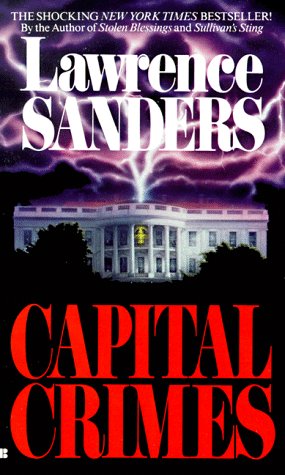
Novel Review: Capital Crimes by Lawrence Sanders


Tell me if the plot of the 1990 novel, Capital Crimes, sounds familiar.

The President of the United States is struggling.  The economy is bad.  The U.S. is long ground internationally.  The President’s approval ratings are plummeting.  The members of his own party are searching for a way to get rid of him.  However, the President himself is more concerned about the health of his son, a hemophiliac who seems destined to suffer an early death if he’s not somehow cured of his condition.

Everything looks hopeless until the President meets Brother Kristos.  Brother Kristos is a wild holy man from the backwoods, a sensualist who drinks vodka, believes that the best way to worship is to have an orgy, and who claims that he has a direct line to God and that he can heal the President’s son.  Kristos not only makes the claim but he backs it up by actually doing it.  The President and his wife soon become dependent on the mysterious Kristos.  Kristos goes from being an obscure cult leader to one of the most powerful men in the country but is he a servant of God or the Devil?  While Kristos sets about seducing all of the women in Washington, others try to investigate his background.  Is Kristos a charlatan or does he truly have magical powers?

If this sounds familiar, that’s probably because you’re familiar with Rasputin, the Russian monk who became a shadowy and much-feared influence on the family of Nicholas II, the final Tsar of Russia.  In fact, Capital Crimes so closely follows the story of Rasputin that you kind of have to wonder why no one in the book ever seems to pick up on the connection.  Russia exists as a rival to the United States in Capital Crimes and, as such, one assumes that Rasputin must have existed as well.  And yet no one in the book ever says, “Hey, remember when this happened before and it didn’t end well?  Maybe we shouldn’t invite the unwashed holy man to live in the White House?”

Capital Crimes is one of the books that I found in my aunt’s paperback collection.  I read it a few weeks ago and, beyond the fact that it was so obviously based on the story of Rasputin, there wasn’t anything particularly memorable about it.  The reader is continuously told that Brother Kristos is incredibly charismatic and that his piercing stare can hypnotize almost anyone but telling and showing are two different things and Kristos is such a ludicrous figure that it’s hard to take him seriously.  (Then again, I imagine many initially said the same thing about Rasputin.)  The book flirts with suggesting that Kristos actually does have supernatural powers but it neve really commits to the idea, which is a shame.  If you’re going to write a book about a Rasputin in the White House, you might as well go all out and fully embrace the supernatural aspect of the story.  Instead, the book gets bogged down in the political machinations of all the people who would like to replace the president.  It’s a bit dull.

The book is credited to Lawrence Sanders, who I know wrote quite a few best sellers and who is usually listed among the better thriller writers.  Capital Crimes feels extremely sloppy and derivative so I’m going to assume that it was written strictly for the money.  That’s not necessarily a criticism, of course.  Money’s a good thing!  But so is an interesting plot.

Book Review: Blood, Sweat & Chrome: The Wild and True Story of Mad Max: Fury Road by Kyle Buchanan


Wow, I thought as I read Kyle Buchanan’s oral history of the making of Mad Max: Fury Road, Charlize Theron and Tom Hardy really did not like each other.

I have to admit that I feel a little bit bad that my main reaction to Blood, Sweat, & Chrome centered around the most “gossipy” part of the book, the chapter in which everyone interviewed talked about how Theron and Hardy simply did not get along during filming.  That, of course, is also the part of the book that got the most media attention when it first came out.  Overall, it’s really a very small part of the overall story.  The books deals with much more than just Charlize and Tom.  It discusses how the stunts were achieved.  It documents just how much time George Miller spent planning Fury Road and also how the project was changed by Mel Gibson’s very public fall from grace.  There’s a very touching chapter that deals with Hugh Keays-Bryne, the Australian actor who played memorable villains in both the first and, to date, the last of the Mad Max films.  There’s a lot of good stuff in Blood, Sweat & Chrome but it’s the chapter about Hardy and Theron that will probably capture the attention of most readers.  They’re movie stars, after all.  We’re all fascinated by stars, especially when they don’t get along.

As for why Theron and Hardy didn’t get along, the people interviewed for the book all have their theories.  Some say that Hardy was not only feeling pressure over stepping into Mel Gibson’s shoes but that he was also miffed to realize that he was primarily going to be a supporting player in his own movie.  Others say that it was a conflict in working styles, with Theron going out of her way to always be professional and on time while Hardy was a bit more relaxed when he would show up on the set.  Nicholas Hoult (who comes across as being both a professional and a gentleman) says that being on set with them often felt like being in the back seat of a car while your parents are fighting up front.  Whatever the reason, Hardy and Theron did not enjoy either’s company while filming.  Shouting matches were followed by meetings with George Miller, who Theron observes was not necessarily always on her side when it came to her conflict with Tom Hardy.  And while actors arguing during filming is hardly a unique event, what stands out about Theron and Hardy is that they both appeared to continue to dislike each other even after filming ended.  Even with the success of the film, one gets the feeling that the two of them will never voluntarily star opposite each other again.  Or, at the very least, they’ll get a lot of money before agreeing to do so.

What’s interesting though is that Hardy and Theron’s dislike for each other was probably a major factor in Mad Max: Fury Road‘s success.  One reason why Fury Road stands out is because neither Furiosa nor Max end up having the type of relationship that you might otherwise expect.  Though they eventually work together, they never become a couple.  Neither surrenders to the other.  Furiosa never stops fighting and Max never stops wandering.  Even when they become allies, there’s still that tension there.  Neither one really trusts the other.  As was so often the case with the production of Mad Max: Fury Road, Theron and Hardy’s contentious relationship, something that should have led to disaster, actually served to make the film better.

Reading Buchanan’s book, one comes away with the impression that, for all the difficulties that were encountered during filming, Mad Max: Fury Road was almost a blessed production.  Everything that went wrong only served to make the final product better.  George Miller’s struggles to get the film into production gave him the time he needed to create a film that had a good deal more thematic depth than the average action sequel.  The harsh working conditions were the perfect backdrop for the film’s equally harsh world.  Mel Gibson’s troubles allowed Miller to rethink the character of Max and also gave Miller room to make Furiosa an equally important character.  That few people were expecting much from Mad Max: Fury Road allowed Miller to take the world by surprise.  Even the fact that many were surprised when Fury Road won Best Picture from the National Board of Review allowed the film to enter the Oscar season as an appealing underdog.  Of course, while Mad Max: Fury Road did win the most Oscars that year, it did not win Best Picture.  But I can promise you that, as you sit here reading this, more people are currently watching Mad Max: Fury Road than are watching Spotlight.

Mad Max: Fury Road is a great film and Blood, Sweat, & Chrome provides an in-depth look at how that happened.  It’s hard not to be inspired by George Miller and he refusal to give up on the project.  Much like Furiosa, Miller never stopped fighting.  Neither Furiosa nor Miller found what they were initially expecting at the end of their journey.  Instead, they discovered something better and, as a result, their stories will never be forgotten.

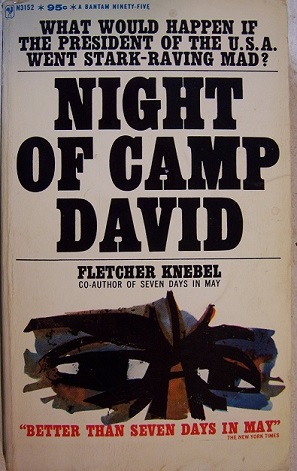
Book Review: Night of Camp David by Fletcher Knebel


The 1966 novel, Night of Camp David, deals with the presidency of Mark Hollenbach.

Mark Hollenbach is an old school Democrat, the type of old-fashioned liberal who would probably not have much of a place in today’s party.  Hollenbach is known for his competent and loyal staff and his demand that everyone around him be just as morally upright as he feels that he is.  Therefore, when Hollenbach’s Vice President gets caught up in a minor scandal, everyone knows that Hollenbach is going to eventually pick a different running mate when it comes time to run for reelection.

But who will Hollenbach pick?  The Speaker of the House is viewed as being too much of an old-style political boss.  The Secretary of State might be the smartest man in Washington, D.C. but Hollenbach is convinced that the voters are not ready for a Jewish vice president.  After a night of lukewarm jokes at the Gridiron Dinner, Hollenbach invites Sen. Jim MacVeagh of Iowa to come talk to him at Camp David.  During their conversation, Hollenbach reveals that he’s planning on naming MacVeagh to the ticket.

This takes MacVeagh by surprise because even he realizes that he’s not really qualified to be president.  He’s too young and, as more than one character points out over the course of the book, he has a reputation for being rather lazy.  An even bigger problem is that the married MacVeagh has a mistress named Rita and there’s no way that Hollenbach would accept an adulterer on his ticket….

(Okay, I heard that.  Stop laughing.  This book was published in 1965.  Obviously, it was a more naïve time.)

Of course, there’s an even bigger problem than Jim MacVeagh not living up to the president’s moral standards.  It also appears that Mark Hollenbach is losing his mind.  MacVeagh soon discovers that Hollenbach has decided that Europe can no longer be trusted and that it’s time for America to make peace with Russia!  As well, Hollenbach feels that the media is trying to sabotage his presidency and, as such, it’s time to maybe rethink that whole freedom of speech thing.  MacVeagh realizes that the pressures of the office have gotten to Hollenbach and that he’s becoming dangerously paranoid.  But only MacVeagh knows it and how can he reveal the truth without destroying his career and his marriage?

Today, of course, the idea of the President being a paranoid buffoon is not that shocking.  For that matter, a lot of Hollenbach’s delusions are today pretty much a part of the standard political discourse.  One gets the feeling that there’s quite a few people who would happily embrace Hollenbach’s desire to destroy the First Amendment.  (“YoU cAn’T yElL fIrE iN a ThEaTeR!” someone is tweeting at this very moment.)  But again, this book was published in 1965.  Joe Biden wasn’t even in the Senate when this book was published, that’s how old it is.  In many ways, Night of Camp David feels prophetic.  Today, of course, it’s interesting to read a book like this and marvel at the idea that people were once shocked by the idea of a paranoid president.

Though it gets off to a slow start, Night of Camp David picks up steam once MacVeagh discovers that Hollenbach is using the FBI to investigate anyone who he perceives as being either a potential ally or a potential threat.  (Hmmmm, imagine that….)  Fletcher Knebel was the co-author of Seven Days In May and he obviously knew how to put together a political thriller.  Jim MacVeagh and Rita are both interesting characters, especially Rita.  She can do better than Jim MacVeagh and she knows it.  The book ends on what seems like a note of wishful thinking but, again, it was 1965.

Paul Greengrass has apparently been developing a film adaptation of this book.  I don’t know if that project is still happening, though Greengrass seems like he would be able to do the story justice.  Personally, I would suggest Tom Hanks as Hollenbach and Austin Butler as MacVeagh.  I mean, if it worked for Elvis….

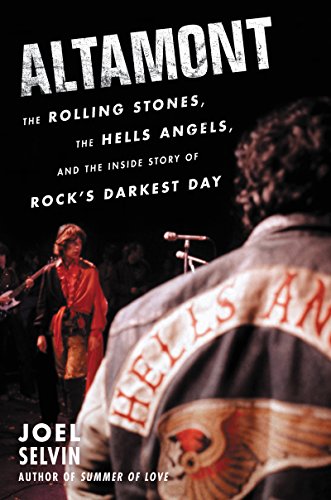
Book Review: Altamont: The Rolling Stones, the Hells Angels, and the Inside Story of Rock’s Darkest Day by Joel Selvin


First published in 2016, Altamont: The Rolling Stones, the Hells Angels, and the Inside Story of Rock’s Darkest Day takes a look at the infamous free concert that was held at California’s Altamont Speedway in 1970.

The Free Concert was meant to be a sequel of sorts to Woodstock, with bands like Jefferson Airplane, Santana, Crosby Stills Nash and Young, The Grateful Dead, and the Flying Burrito Brothers teaming up with the Rolling Stones in order to give everyone a free day and night of good music and good vibes.  While the music may have good (seriously, what a line up!, even if the Dead ultimately refused to take the stage), the vibes were anything but.  Not only was the concert hastily put together but someone came up with the bright idea of getting the Hell’s Angels to provide security.  After a day that was frequently marred by violence (among the victims was Jefferson Airplane’s Marty Balin, who was actually knocked unconscious while the band was performing), Altamont came to an apocalyptic conclusion with the murder of a young concertgoer named Meredith Hunter.  The concert may have been sold as a west coast Woodstock but, instead, it become one of the events that is regularly cited as signifying the end of the 60s.

There’s a spectacular documentary called Gimme Shelter, which contains not only footage of the violence while it happened but also features scenes of lawyer Melvin Belli setting up the concert and performing for the camera.  (“I’m opening for the Stones,” he says at one point.)  While the documentary does a good job of showing what happened, it doesn’t dig into why it happened.  Fortunately, Joel Selvin’s Altamont provides a good, in-depth history of not just what happened at Altamont but also how it all came to be.  Selvin explores what led the Stones to holding a free concert in the first place and also how a mix of 60s naivete and greed led to catastrophe.  While the Stones come across as being a bit too detached from the counter culture to actually understand what they were dealing with at Altamont, the Grateful Dead come across as being in denial about the violence lurking underneath the scene.  Meanwhile, the other performers simply try to complete their set without getting sucked in to the bad vibes all around them.  Jefferson Airplane’s performance, which was vividly captured in Gimme Shelter, is revealed in its full horror in Selvin’s book.  (Having forgotten to put in her contact lenses, Grace Slick found herself trying to calm people who she could barely see.)  Of course, as bad as the Airplane’s experience was, they still had no problem leaving their drummer behind when they finally escaped the concert.  Poor Spencer Dryden.  (Apparently, the other members of the band had decided that they didn’t particularly Dryden so why not abandon him with the Hell’s Angels?  Someday, someone will make a very good movie about Jefferson Airplane.)

Selvin not only writes about the bands and the Hell’s Angels but also about some of the people at the concert, many of whom found themselves in a war zone.  Perhaps most importantly, he writes about Meredith Hunter and the life he led before that terrible night at Altamont.  As a writer, Selvin is compassionate but also honest.  Every character, from the famous to the forgotten, emerges from Selvin’s narrative as a complex and interesting human being.  Selvin humanizes the people involved with Altamont without ever trivializing the tragedy of it all.

Altamont is often held up as being the reverse image of Woodstock.  Of course, Woodstock ’99 ended up having more in common with Altamont than with the original three days of peace, love, and music.  Joel Selvin’s book is a fascinating look at how that happened and what it all means.

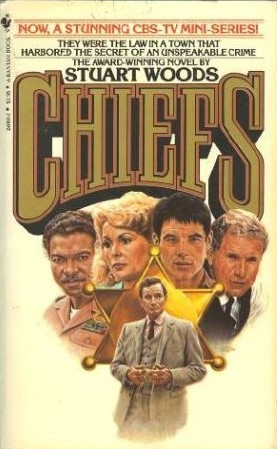
Book Review: Chiefs by Stuart Woods


First published in 1981, Chiefs follows the town of Delano, Georgia over the course of five decades.

Delano starts out as a small, rural town, one that sit uneasily on the dividing line between the old and the new South.  Under the leadership of forward-thinking civic leaders like Hugh Holmes, the town starts to grow.  And, like any growing town, it needs a chief of police to maintain the peace.  In 1919, a simple but honest farmer named Will Henry Lee is selected as the town’s first chief of police.  Not selected is the wealthy Foxy Funderburke.  That’s probably for the best because Will Lee is determined to do a good job and fairly treat all of the town’s citizens, regardless of their race or their economic class.  Foxy, meanwhile, is a serial killer who has been killing young men and dumping their bodies all over the county.

Chiefs tells the story of three men who serve as Chief of Police while Delano grows and Foxy continues to murder anyone that he can get his hands on.  Will Henry Lee is followed by Sonny Butts, a war hero who soon turns out to be a corrupt and racist psychopath.  Sonny is eventually followed by Tucker Watts.  As the town’s first black police chief, Tucker has to deal with both racism and Foxy Funderburke’s murders.  However, Tucker himself has a secret of his own, one that links him back to the very first chief of police.

Chiefs is kind of all over the place.  Not only does the novel follow the growth of Delano and the decades-long investigation into all of Foxy Funderburke’s murders but it also finds time for appearances from Franklin D. Roosevelt and a subplot about Billy Lee, Will Henry Lee’s son, running for governor of Georgia and potentially replacing LBJ as Kennedy’s running mate in 1964.  (The President, of course, explains that he’ll make his decision after returning from Dallas.)  At times, it gets to be a bit too much.  The mystery of the Delano murders too often gets pushed aside for the far less interesting political stuff.  Chiefs was Stuart Woods’s first novel and he makes the common first-timers mistake of trying to cram too much into his story.

The book is at its best when it just sticks to Delano.  Foxy Funderburke is not just a murderer but also a symbol of the times when there law was only arbitrarily enforced in the former Confederacy and wealthy, white landowners could pretty much do whatever they wanted without having to worry about the consequences.  Foxy represents the old ways and each chief, even the evil Sonny Butts, represents just a little bit of progress towards the new way.  Though his prose is rarely memorable, Stuart Woods was a good storyteller and Foxy Funderburke is a memorable villain.  (And, to be honest, Foxy Funderburke is a brilliant name.)  Even if their characterizations aren’t particularly deep (Will Lee is honest, Sonny is narcissistic, Tucker is determined to prove himself), the three men who oppose him are all worthy adversaries and it’s interesting see how, over several decades, the three of them each finds a different piece of the puzzle until Foxy’s true nature is finally exposed.  Will Henry Lee may not have known Sonny Butts and Sonny certainly would never have even spoken to Tucker Watts but, in a way, the three of them work together to solve the town’s greatest mystery.

In the end, the book appealed to the side of me that loves a mystery and it also appealed to my dedicated history nerd side.  Chiefs is flawed but compelling.

Non Fiction Book Review: The Nashville Chronicles by Jan Stuart


First published in 2000, Jan Stuart’s The Nashville Chronicles is a look at both the making and the legacy of one of the best films of the 70s, Robert Altman’s Nashville.

Starting with Joan Tewksbury’s fateful journey to Nashville to search for ideas for a screenplay for a film that Robert Altman wanted to make about the capitol of country music and ending with the details of a mercifully unrealized sequel, The Nashville Chronicles details just about everything one could want to know about the making of Altman’s film and it does so in an always entertaining fashion.  Jan Stuart’s love of the film is obvious but so is Stuart’s understanding of the film’s satirical take on politics, celebrity, and Americana.

Much like Altman’s film, Stuart’s book is free-wheeling look at a period of American culture, featuring a large and disparate group of characters. Stuart focuses on the collaborative nature of the film, emphasizing that the actors often brought their own ideas and, in some cases, issues to project.  Stuart interviewed almost every member of the cast who was still alive in 2000.  (The only person he couldn’t track down was Dave Peel, who played Bud Hamilton.)  The actors prove to be as interesting as the characters that they played and Stuart does a wonderful job of capturing not only their quirks but also how their own lives often informed their performances.  Ned Beatty emerges as a plain-spoken but intelligent artist while Henry Gibson is as droll as the character he played was calculating.  Keith Carradine talks about how his dislike of the character he was playing actually made his performance more effective.  Karen Black is wonderfully eccentric while Geraldine Chaplin provides an outsider’s view to the uniquely American experience of Nashville, both as a town and a movie.  The enigmatic Michael Murphy expertly straddles the line between the establishment and the counterculture while Thomas Hal Phillips predicts the next 50 years of American political history with the speeches that he wrote for the often heard but always unseen presidential candidate, Hal Phillip Walker.  And, throughout it all, Robert Altman oversees the production, a talented but mercurial director who could be both amazingly supportive and amazingly cold whenever he felt slighted.  Altman emerges as a genius who could be shockingly petty to those who he felt had disappointed him.

The book covers the filming of all the major moments from the film, including the prophetic finale.  The book also explores a proposed Nashville sequel, which would have featured all of the surviving characters ten years after the first film.  Haven Hamilton, for instance, would have followed in Hal Philip Walker’s political footsteps.  Reading about the proposed outline for the sequel, it’s hard not to feel that it’s a good thing that it never moved beyond the idea stage.  As Stuart’s book makes clear, Nashville was a once-in-a-moment success and not something that could be easily duplicated.  Nashville ended with one tragedy, one surprising act of heroism, and the birth of a new star.  It was the perfect ending and any attempt to continue the story would have just cheapened it.

The Nashville Chronicles is a fascinating look at a fascinating film.

Book Review: The KGB Candidate by Owen Sela


Two weeks ago, I returned to my project of going through all of the paperbacks that I inherited from my aunt and I read The KGB Candidate.

(My aunt, by the way, is fine.  She just moved to a new place and couldn’t take all of her books with her.)

Published in 1988, The KGB Candidate is a brisk read.  It opens with CIA agent Drew Ellis losing most of his men and his lover in Germany and then switches focus to the United States and a presidential election.  Looking to continue their time in the White House, the Republicans have nominated  a decent candidate who happens to be named after Abraham Lincoln but everyone knows that the Democrats have got the momentum.  However, the Democrats also have several candidates competing for the spot at the top of the ticket and, as the convention approaches, none of them has won enough delegates to claim the nomination outright.

Who will win the nomination?  Will it be the woman who announces early on that she has no interest in being vice president?  Will it be the veteran civil rights activist?  How about the dour, bow-tie wearing academic, the one who speaks about nuclear disarmament?  Will it be the veteran politician, the one who feels that it’s his turn to run?  Or will it be the young and charismatic dark horse, the one who no one initially gave much of a chance but who stunned the establishment by becoming a contender?

It’s an important question, not just because the winner of the nomination will probably win the election but also because one of the candidates is secretly pro-Russian!  KGB agent Boris Pomarev is determined to get his candidate into the White House.  He’s even stolen a computer program that can correctly predict how people are going to vote and what answers a candidate should give to the tough questions of the day.  However, Pomarev is responsible for the death of Drew Ellis’s team.  Along with wanting to protect democracy, Ellis is looking for revenge….

The KGB Candidate was an entertaining read.  Author Owen Sela does a good job with the action scenes and the characters are memorable without being particularly deep.  I have to admit that I was amused by the debate scene, in which all of the potential KGB candidates introduced themselves to the convention delegates.  Each candidate represented a different stereotype that most readers would associate with the Democratic Party and the American Left and one gets the feeling that Sela wasn’t particularly impressed with any of them.  Of course, in real life, there’s very little chance of any of us ever seeing a contested convention.  The primary system is designed to force each party to quickly coalesce around whoever has the momentum.  Still, contested conventions are always fun to read about.

For me, the most interesting part of the book dealt with the computer program that could predict who would win the election.  In the book, everyone is shocked that a program could do such a thing and I guess, in 1988, it might have been a shocking idea.  But today, that’s the sort of thing that people take for granted.  I remember that, all through 2016, all I heard was that Hillary Clinton was guaranteed to win because her entire campaign was based on data analysis and algorithms.  At the time, I thought that was kind of a hubristic way to run things and it turned out that I was right.  I also felt it was a bit of a depressing way to look at the world, if just because it assumed that people would always behave in the same way and that it wasn’t even necessary to actually listen to the voters or even ask for their votes.  Algorithms have their place but, in the end, people are more than just data points.

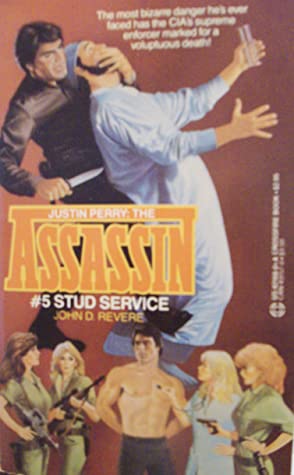
Book Review: Stud Service by John D. Revere


In 1985, Justin Perry’s fifth and final adventure was published.  In Stud Service, the CIA’s most deadly and sex-obsessed assassin discovers that his whole life has been manipulated to lead to one moment, the moment when he will be sacrificed to Halley’s Comet.  Before the sacrifice, of course, his sperm will be preserved by a secret cult that will use it to create hundreds of genetically perfect warriors who will conquer the Earth and rule it for the next 50,000 years….

Okay, I’m sensing that some of you think I’m making this up.  I’m not.  That is the plot of the final Assassin novel.  Justin Perry discovers that SADIF is a front for a cult that worships Halley’s Comet and that his sperm is the key to their plan to rule the world.  Actually, there’s several cults.  It turns out that there’s many different divisions within the Halley Society and one of them is run the Old Man, who was Justin’s mysterious handler at the CIA.  As the Old Man explains it, he just wanted to serve his country and make the world a better place.  But he also has a brain tumor that is driving him mad.

It’s actually kind of an interesting wrap-up for the series.  If nothing else, it actually explains why, over the course of the previous four books, people from Justin’s past kept randomly popping up and turning out to be SADIF agents.  Since birth, Justin has been cultivated and developed to be a potential sacrifice to the comet.  Even the Old Man and his sister were involved in it.  Everything over the past four books has been about developing Justin into a heartless killing machine and, significantly, this book features Justin realizing that he no longer “enjoys” killing as much as he once did.  He’s rediscovered his humanity and that humanity allows him to survive, even when he has hundreds of Halley cultists trying to masturbate him to death.

That said, even though the book nicely wraps up the weirdness of the series, it’s still a bit of mess.  Trying to keep straight who works for each faction of the Halley Society requires taking notes, which is more activity than Justin Perry really deserves and this is one of those action novels where there’s considerably more exposition than action.  It’s safe to skim over the final fourth of the book because nothing really happens until the final page or so.  Somehow, the book manages to be extremely sordid and rather dull at the same time.

This was the final Justin Perry story.  He saved the world a lot.  Interestingly, it does appear that the author meant for this to be the final novel.  This wasn’t a case of the publisher saying, “We’re not wasting any more money on this series.”  Instead, all four of the previous book lead to this fifth one and it ends on a definite note of conclusion.  One gets the feeling that the author felt that he had said everything that he needed to say.  Of course, it’s impossible to guess what exactly it was that he was trying to say.  I personally suspect the whole thing was meant to be an elaborate joke on the people who regularly read novels about violent spies and never once considered that their literary heroes were actually deeply damaged sociopaths.  If so, bravo.

Book Review: Mike Nichols: A Life by Mark Harris


Mike Nichols.

That’s a name that should be familiar to anyone who claims to be a student of film or a lover of Broadway.  Originally born Mikhail Igor Peschkowsky in Berlin, Germany, the rise of the Hitler led to Nichols and his family immigrating to the United States in 1939.  By that time, the seven year-old Nichols had already been completely bald for three years, the result of a bout of whooping cough.  Like many who have had first-hand experience with trauma, Nichols developed an appreciation for the absurdity of life and a rather dark sense of humor.  After studying to be an actor, Nichols found fame as a satirist and a comedian, performing with Elaine May.  He would later go on to become not only an important theatrical director but also an important film director.  With his directorial debut, Who’s Afraid of Virginia Woolf?, he helped to destroy what was left of the production code.  With The Graduate, he helped to define the generation gap.  With Carnal Knowledge, he explored sexual frustration and ennui.  With Catch-22, he proved that even a great director can struggle to adapt an unfilmable book.

Mike Nicholas was an important director but, because his work was never quite as flashy as some of his contemporaries and because he spent as much time directing for the stage as for the movies, it always seems as if he runs the risk of being overlooked by film lovers.  Luckily, Mark Harris’s biography, Mike Nichols: A Life, not only presents the details of his life and career but it also makes a convincing case that Nichols is a director who, despite all of his awards and the admiration of those who worked with him, has been a bit underrated.  Harris convincingly argues that, while Nichols’s films dealt with timeless issues, they also often defined the era in which they were made.  Who’s Afraid of Virginia Woolf? and The Graduate are both definitive films of the 60s.  Carnal Knowledge is a film that captures the disillusionment of the early 70s, with Jack Nicholson and Art Garfunkel playing men destined to never escape their self-imposed mental prisons.  Working Girl captured the greedy atmosphere of the 80s while Primary Colors epitomized America in the 90s and Closer captured the confused morality of the aughts.

To his credit, Harris doesn’t make the mistake of idealizing Nichols.  Harris is just honest about the Nichols films that don’t work as he is about the ones that do.  The failure of Catch-22 was as due to Nichols’s new-found cockiness as a director as it was to the unwieldy source material.  On What Planet Are You From?, Nichols develops an almost instant and somewhat irrational dislike of comedian Garry Shandling, which is a bit unfortunate as Shandling was not only the star of the film but also in need of a director who would work with him to conquer his insecurities.  This biography is honest about both Nichols’s strengths and his weaknesses and, as such, it becomes a fascinating look at one artist’s creative process.

It also become a look at how American culture changed from the 1960s to the first decade of the 21st Century.  Nichols made his directorial debut in 1965 and directed his final film in 2007.  For 42 years, Nichols recorded the cultural transformation of America, from scandalizing America by having Elizabeth Taylor and Richard Burton curse at each other to making a film about the policy decisions that would eventually contribute to 9-11 and the new America that was formed as a result of that tragedy.  Mike Nichols: A Life isn’t just about Mike Nichols.  It’s about how American culture, for better and worse, has developed and changed over the last century.

If you’re looking for a good and in-depth biography about a director who deserves to be rediscovered, Mike Nichols: A Life is the one to go with.