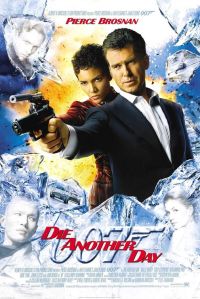
James Bond Review: Die Another Day


Leading up to the North American release of the latest James Bond feature film, Skyfall, The Shattered Lens is reviewing each and every James Bond film in the history of the franchise. Today’s film is the controversial Die Another Day, the twentieth film in the James Bond franchise, and the final such film to feature Pierce Brosnan in the titular role as 00-agent James Bond. Despite launching to mixed reviews – particularly overseas, where it generated significantly negative reaction in North and South Korea – it was at the time the highest grossing Bond film of all time.

Our cold open for this film has us in North Korea. There, 007 is assuming the identity of a diamond smuggler who is assisting a North Korean Colonel, Tan-Sun Moon, in laundering blood diamonds as part of an ongoing search for advanced military hardware. In order to bypass the landmines of the Korean Demilitarized Zone, the good Colonel has constructed an entire army of hover vehicles which can cross the region without triggering the mines, allowing for a land invasion of South Korea. Bond proceeds with the exchange, but is identified by Zao (Rick Yune), Colonel Moon’s right hand man. Bond triggers an explosion which badly disfigures Zao’s face, which becomes embedded with dozens of diamonds. Colonel Moon attempts to escape on a hovercraft, and Bond pursues him, eventually chasing the Colonel off the edge of a waterfall, apparently killing him. Afterward, Bond is captured by General Moon, the Colonel’s father, and is imprisoned.

After over a year of imprisonment and torture, Bond is traded during a prisoner exchange for Zao. Upon returning to MI6, M (Dame Judi Dench) tells Bond that his 00-status has been suspended. Both she and the Americans believe that Bond cracked under torture and revealed classified information, necessitating the prisoner exchange that brought him back. However, the release of Zao leaves both M and Bond extremely bitter. Determined to recapture Zao, Bond evades MI6’s security and disappears. He travels to Hong Kong, seeking a way back into North Korea, but his contact there informs him that Zao has attempted to disappear in Cuba and provides him with the necessaries to travel there instead.

After he arrives in Havana, Cuba, Bond investigates a clinic there which specializes in gene therapy that is virtually unknown in the first world. Bond’s local contact describes it as prolonging the lives of their leading citizens, and the richest folks in the West, but Bond also learns that the gene therapy would allow a person to totally restructure their appearance and assume a whole new identity. During his investigation, he meets a woman who introduces herself as Jinx (Halle Berry) who, initially unknown to Bond, is an NSA agent on a similar investigation, albeit one with presumably very different goals. Bond locates Zao inside the clinic, and a chase ensues. Although Zao ultimately manages to escape by helicopter (and Jinx in dramatic fashion by diving off the sea wall and boarding a waiting boat which drives her off), Bond recovers a pendant left behind by Zao. Upon unscrewing it, Bond discovers a cache of diamonds. Upon inspection, the diamonds are chemically identical to diamonds found in Sierra Leone, but they bear the identifying mark of a diamond mine owned by a British billionaire and thrill seeker, Gustav Graves (Toby Stephens). Bond is determined to investigate.

This forms the basis of the remaining plot. Our set pieces this time aren’t quite so varied, as much of the remaining story plays out in Iceland, where Graves’ diamond mine is situated, and where he has constructed a special ice hotel for the purpose of a technology convention. Eventually, we return to Korea, for a final showdown that seems somehow empty, despite the increasingly high stakes in terms of both explosions and technology.

The truth, ultimately, is that Die Another Day is a bit of a mess. It has a seemingly incessant procession of action sequences, but they raise the stakes primarily through CGI and improbable wizardry, in a way that threatens our suspend disbelief. I know that this is Bond, and that in 80s-early 00s Bond very much fell into the trap (who didn’t?) of ‘bigger and better’. However, this film takes things a bit too far in my estimation. Its villains aren’t quite as fun as the ones in the past two films (well, Mr. Stamper is kind of a drag I suppose), and don’t really fit the Bond mold. The story is pretty straightforward, but probably doesn’t receive quite the treatment that it deserves to get us established in it. The interactions between Bond and M are a bit too stiff, and I say that even keeping in mind tomorrow’s review piece, Casino Royale. There’s something about Die Another Day that made me think everyone involved was just going through the motions, like a sense of fatigue just hung over the proceedings. It was a bit of a bummer.

As for the women of Bond, Die Another Day actually has a lot to recommend. Breaking convention, this section is heavy with spoilers, but I’m going to risk it just this once. Don’t read on if you’re new to this film and planning to watch it!

Die Another Day continues to feature Dame Judi Dench as a pleasantly strong and uncompromising intelligence chief (I probably haven’t made enough of how much I enjoy her in the role of M in my reviews up to this point). In addition, we’re treated to Halle Berry as Jinx, an ass-kicking NSA agent who seems to do a lot of getting outmaneuvered and captured for being so adept. I didn’t care for Berry’s performance in this film, and I’d be lying if I said she stacked up well against Tomorrow Never Dies’ Michelle Yeoh as a Chinese intelligence agent. Still, compared to some of the other Bond girls, Berry is definitely a warrior. The other major female character, however, is Miranda Frost (Rosamund Pike), a frigid and beautiful MI6 agent… actually, a double agent, who betrayed Bond in the cold open. Pike’s character definitely gives off the edge of competence and deadliness that I, for one, am rooting for in female characters in any Bond movie, and she sells it well. Unfortunately, she’s not nearly as fun as Elektra King, as her motivations are completely unexplored and she just feels like an add-on to the existing plot surrounding some dangerous North Koreans.

Overall, this is probably not one of the better Bond films, though I’d argue that it doesn’t deserve the bad rap that some have given it either. It’s not a terrible film, just overwrought in a kind of Michael Bay way that undermines the characters and concepts. This is a common complaint of all four Pierce Brosnan films, especially, as well as some of the Roger Moore and Timothy Dalton efforts. However, this is the one that I most agree with that assessment of. This film really gets out of control with effects and gadgetry.

That’s it for today’s review. I leave you with the theme from Die Another Day, performed by Madonna. Tomorrow’s review will be of 2006’s Casino Royale.
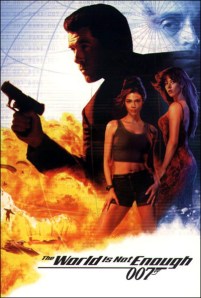
James Bond Review: The World Is Not Enough


But it is such a perfect place to start.

Hello everyone! As a prelude to the North American release of Skyfall, we here at The Shattered Lens have been reviewing each and every single James Bond film in the history of the franchise. Today we examine the nineteenth film in the James Bond franchise, and the third to feature Pierce Brosnan as the titular super spy, Ian Fleming’s James Bond. Its title? The unpretentious The World is Not Enough.

This time our cold open has Bond in negotiations with a Swiss banker for the return of a significant amount of money belonging to British Knight, Sir Robert King, who is a personal friend of M (Dame Judi Dench). Negotiations break down quickly, when Bond reveals that King was buying a report over which an MI6 agent was killed. The banker not only refuses to disclose information, but actually threatens Bond. Bond takes control of the situation in predictable fashion, offing the Banker’s underlings and capturing the man in question. However, before the banker can give up the name of the man who hired him, he is picked off by his own assistant – revealed to be a lovely young assassin (Maria Grazia Cucinotta), who disappears before Bond can do much in the way of response. With the police already on their way, Bond escapes out a window, and heads back to jolly old England.

When Bond returns to MI6 headquarters, Sir King takes possession of his money. However, Bond deduces seconds too late that the money has been trapped with a binary compound explosive that King inadvertently triggers, blowing up the suitcase of money, Robert King, the entire room he is present in, and a huge chunk of the wall of MI6 headquarters. Bond arrives just in time to see the same assassin outside in a speed boat, aiming a mounted gun his direction. Upon seeing Bond, she opens fire, but then quickly turns tail and flees the scene. Bond seizes a speed boat from Q and goes in pursuit. After a truly remarkable chase sequence (by sea, by land, and by air!) Bond catches up with the assassin, who commits suicide by firing into the tanks of her own hot air balloon rather than risk being taken alive. Bond falls and is heavily injured, and the assassin is killed.

Bond convalesces under the care of one Dr. Molly Warmflash (Serena Scott Thomas), but unwilling to actually wait for his wounds to heal, he “persuades” the good doctor into giving him a clean bill of health, the way only James Bond can. Medically cleared, he invites himself into a high level planning session with M where they trace the assassination of Robert King back to its likely perpetrator – a notorious Soviet terrorist, Renaud (Robert Carlyle). Recognizing the danger he represents, M sent 009 to kill Renaud. Although the agent got a shot in, and it struck Renaud in the head, the bullet miraculously failed to kill the terrorist right away. Instead, it slowly burrows through the matter of his brain, dampening and destroying his senses one by one. Dr. Warmflash speculates that while Renaud will eventually die from his wound, in the meantime he feels no pain, and is particularly dangerous as a result. Renaud had previously abducted and held hostage King’s beautiful daughter, Elektra (Sophie Marceau), for ransom. M believes that Renaud is attempting to strike against the King family again. Concerned with Elektra’s safety, she assigns 007 to personally see to her security.

Things ramble on quickly from there. Like Tomorrow Never Dies, there are no shortage of action pieces in The World is Not Enough. The film has a healthy dose of plot twists and is finely paced, never really descending into a lull. It has excellent set pieces, including a kind of cart racing down an oil pipeline, a battle in a caviar factory (which includes a notable cameo from our old friend Valentine, first introduced in Goldeneye [a fun role that is heartily embraced by actor Robbie Coltrane]), and even climactic showdown aboard a Soviet nuclear submarine Unfortunately, The World is Not Enough suffers from a couple of limitations that hold it back from being a truly great Bond film. Yes, that’s right folks, it’s time we talked about one of the more infamous Bond girls… Dr. Christmas Jones (Denise Richards).

Now, I don’t necessarily hate Denise Richards, but she’s not what I’d call a paragon of acting ability. She doesn’t bring a ton of range to a character that is already a bit on the weak side. Dr. Jones, a short-short short-dress short-skirt clad nuclear physicist, is not short on brains. She’s also athletic, and able to keep up with 007’s crazy antics for the most part. She’s also a patently unbelievable character, a stretch even for James Bond, even for latter-day Pierce Brosnan James Bond. She doesn’t ever really fit into this film, and while the movie’s plot ultimately deals with a nuclear threat (as always, I won’t spoil the film’s more important plot details!) and it seems like Dr. Jones’ expertise might be useful… mostly, she just offers some rather obvious exposition, and serves as a sexual object for one important sequence in the film’s final third. So, hooray? Compared to ass-kicking Chinese secret agent Wai Lan, the main thing that Denise Richards’ character brings to the James Bond franchise is cup size. And more easy puns on her name than you can shake a stick at.

This film is also notable for being the tragic final appearance of Desmond Llewelyn in his long time role as “Q”. Although the film … “humourously” … introduces John Cleese as Q’s successor early in the film, there were no official plans to cut Desmond Llewelyn from future Bond films, and he had not announced plans to retire. Unfortunately, Llewelyn was killed in a traffic collision shortly after the film’s premiere. R.I.P.

That having been said, I still very much like this movie. For reasons which are not entirely clear, I think I’ve seen it a dozen times or so (maybe it’s just on BBC a lot?) and nothing about it ever makes me want to turn the film off. In fact, vibrant performances by the film’s villains and an energetic Judi Dench as M (more active in this film than in … probably any other) kind of bring this one to life for me. Of course, this film definitely telegraphed a possible dive off the cliff’s edge… something which we may or may not journey through together in tomorrow’s film, the much-maligned Die Another Day.

In the meantime, let me leave you with my all-time favourite James Bond theme, presented by Garbage:

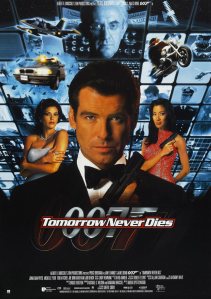
James Bond Review: Tomorrow Never Dies


In anticipation of the North American release of the latest 007 adventure, Skyfall, we here at The Shattered Lens are systematically going through each and every film of the James Bond franchise and reviewing them for you! Today, we’ll take a look at the eighteenth film of the James Bond franchise, and the second one to star Pierce Brosnan as James Bond. It’s one of my personal favourites… Tomorrow Never Dies.

It’s the return of Pierce Brosnan as Agent 007, a cold-war relic modernized for a more discerning audience. While the Bond of old – Connery in particular – could flash his smile, make a pun, and have a girl in bed, the modern Bond is often challenged by the women in his life. As a modern viewer, I’m much more comfortable with this view of the sexes, though it would be quite a stretch to say that Bond has ‘struggles’ trying to find the affections of women. Anyway.

Our cold open takes us to the Russian border, and a so-called Terrorist bazaar. Yes, it’s more or less a marketplace of weapons, illegal technology, and mercenary services. And it’s under surveillance by MI6 and the British armed forces, led by M (Dame Judi Dench) and Admiral Roebuck (Geoffrey Palmer). MI6’s analysis is being led by the strangely memorable Charles Robinson (Colin Salmon), M’s Chief of Staff in this film, and the next two. Although his part is minor, Salmon impressed me enough in this part (the first time I can recollect seeing him; Tomorrow Never Dies was a first day viewing for my father and I when it released) that I instantly associate him any time I see him with his role in this film, not in the newer Resident Evil franchise, or in any of his other work. Robinson is in contact with an unidentified (but I’ll bet you can guess!) agent on the ground who is observing the terrorist bazaar through a telephoto lens. In addition to the formidably terrifying hardware, the as-yet-un-named agent also identifies cyber terrorist Henry Gupta (Ricky Jay) an American wanted for all kinds of technology-related crimes. Although he seems to have obtained an extremely secret, extremely valuable, American GPS code cracking machine, I’m sure he won’t turn up later.

Eager to be rid of “half the world’s terrorists” as he describes it, Admiral Roebuck first attempts to negotiate a Soviet strike using ground assets against the bazaar. When the Soviet liaison reports that casualties would be inconvenient to the electorate so close to party elections, Roebuck instead opts for a British naval strike which will dismantle the bazaar – cruise missiles launched from afar. Overriding M’s objections that the survey of the bazaar is not yet complete, Roebuck provides authorization for missile launch, and in no time, two massive cruise missiles are en route.

It’s about this time that we learn that the mysterious, unnamed, ground agent in Russia is Agent 007 – an unsmiling Pierce Brosnan. Bond has detected a pair of L-39 Albatross fighters, one of which has been outfitted with nuclear-yield weapons of Soviet origin. At best, the cruise missile attack will scatter weapons-grade plutonium over a huge area, and Admiral Roebuck immediately orders the cruise missiles to be aborted remotely. Unfortunately, the missiles are already out of range in the network of (presumably Afghani) canyons they are maneuvering down. If nuclear disaster is to be averted, it’s up to an unsmiling 007 – now revealed as M’s agent in the field.

As anyone could have predicted, Bond chooses a heroically stupid solution. He charges into the bazaar, knocking out several terrorists and seizing an automatic weapon. Clearing enemies from his area, he makes his way to the L-39 with the nuclear payload. After dispatching the pilot, Bond boards the aircraft, and barely manages to get airborne before the cruise missiles detonate behind him, wiping out most of the terrorists involved. Suspiciously, it seems that Henry Gupta survived the naval strike. I continue to remain convinced that he won’t pop up again later in the story, though. After escaping aboard his stolen aircraft, Bond’s reel man inexplicably feels the need to strangle him which will crash and kill them both while Bond is pursued by a second L-39. Eventually, Bond manages to eject his would-be strangler straight up into the other aircraft, neatly eliminating his problems, and he heads home.

In a reveal with our evil super-villain, Elliot Carver (Jonathan Pryce), we learn that he is manipulating headlines for the profit of his super powerful Viacom-esque media conglomerate. I wonder if that Gupta fellow and his stolen GPS controller will show up again?

I probably don’t need to spoil much more about the plot than that. Suffice to say that the concept behind this Bond yarn is actually a touch on the original side. It correctly anticipated the importance of mass media, its complete transformation into a corporate entity (rather than a ‘news’ entity), and some of the possible consequences. Of course, the plot of the film has also aged terribly, because the internet has changed everything about communication in a way that we would never have anticipated in the mid 90s. Still, Tomorrow Never Dies has always struck a chord with me for both the nature of its villain, and his designs upon the world. The rest of the villainous cast is somewhat less impressive, as beyond Carver, we have the eminently forgettable Mr. Stamper (Götz Otto) and the certainly-not-a-plot-point Henry Gupta to satiate our need for nemeses. Oh, and a hired assassin, but I’ll get to him in a moment. Suffice to say that Mr. Stamper is not exactly this generation’s Oddjob, and we can probably leave it there.

Once we pass the initial setup, the action of Tomorrow Never Dies doesn’t really let up. It’s very tech-heavy, the true realization of the gadet-heavy accusations that are often levied against post-Connery bond. Yes, Pierce Brosnan has a huge variety of gadgets at his disposal. Notable in this particular film is Bond’s seemingly indestructible BMW, which leads to a humourous exchange between he, a hired hitman named Dr. Kaufmann (Vincent Schiavelli), and a gaggle of minions attempting to break into the vehicle with hammers and other tools.

As usual, the women around Bond are beautiful. In this incarnation, we get a heavy dose of Paris Carver (Teri Hatcher), Elliot’s trophy wife, and a former flame of James Bond’s (to, I assume, no one’s surprise) as well as Colonel Wai Lin (Michelle Yeoh) an ass-kicking Chinese intelligence agent who is assigned to the same case as Bond. Yeoh’s character enters the film relatively late, but repeatedly proves her chops as Bond’s Chinese counterpart. She is healthily proficient with firearms and has all of the ninja skills that we would expect from any slight Asian female character in a Bond film.

The set pieces of Tomorrow Never Dies are probably also worth noting, as they range from Elliot Carver’s bizarrely fortress-like mass media headquarters (notably, also, a haven for both digital media and the printing of a newspaper), to extensive time spent in China, to Elliot Carver’s special stealth boat. The production values of the film are certainly not lacking, and unlike so many more ‘modern’ action films, Bond is not immersed in a CGI universe, but rather surrounded by practical effects that make it easy for us to fall into the story and its various locales.

Let me leave you with the theme to Tomorrow Never Dies, also oddly amongst my favourites!