Bolo (1977, directed by Bolo Yeung)


The plot of Bolo is almost indescribable but I shall give it a try.

As far as I can tell, the film is supposed to take place during the final days of the Ching Dynasty in China.  The sheriff of a tiny rural village has been beheaded by gangster so the decision is made to have all of the local prisoners pull straws, with the two winners getting to leave the prison and become the town’s new law enforcement officers.  The winners are the hulking but well-meaning Bolo (Bolo Yeung, for once playing a good guy) and Ma (Jason Piao Pai).  Ma is a con artist while Bolo is in prison for killing his wife because he hadn’t seen her before their arranged marriage and was horrified to discover how ugly she was.  (Ha ha, I guess?)  Bolo and Ma are told not to try to escape and are then sent on their way to the village.

After a visit to the local brothel ends in a fight, Bolo gets down to trying to clean up the village.  That’s not going to be easy because almost everyone in the village is a gangster and the village’s mayor would rather appoint the local pimp as the new sheriff.  Bolo, however, starts to get results so the mayor plots to poison Bolo.  That doesn’t work but he does frame Bolo for a crime that he didn’t commit which leads to Bolo and Ma committing a real crime.  Bolo also falls in love with a 7 foot woman.

Bolo is like a Kung Fu version of the type comedic spaghetti westerns that Bud Spencer and Terrence Hill used to make in the 70s, with the exception that it’s far more incoherent than anything that ever starred Spencer and Hill.  Friends become enemies and enemies become friends and back again with shocking regularity in Bolo and, though there’s many fights, it’s rarely clear why anyone’s fighting.  A typical scene features a woman asking Bolo to watch her baby and then stabbing him in the stomach when he makes a face about the baby’s dirty diaper.  A wounded Bolo staggers into a doctor’s office, where the doctor bandages him up and then the two of them have a fight, during which time the bandage falls off and we discover that Bolo is apparently no longer wounded.

The film is also a comedy but it’s difficult for me to judge how effective it might have been because 1) I saw a poorly dubbed version and 2) much of the humor appeared to be very specific to China and Chinese culture.  For instance, there’s a lengthy scene where Ma and a woman play something called “the numbers game.”  The film presents it as being a big deal and I think it was meant to be comedic but I have to admit that I have no idea what they were doing.  To me, it seemed like they were just shouting out random numbers while holding up their hands.  To everyone else in the movie, it appeared to mean something else.  So, I won’t judge the film’s comedy beyond saying that Belo Yeung, who also directed as well as starred, appeared to have a gift for physical comedy that he didn’t get a chance to show off in his other films, mostly because he was usually cast as a villain.  There’s also a scene where a grocer attacks someone with a cucumber and that’s funny just because cucumber’s are funny.

Even if it’s never clear why anyone’s fighting and the sound effects often don’t match the actions of the combatants, some of the fight scenes are exciting.  That’s really the main reason why anyone’s going to watch something like Bolo and in that case, the movie doesn’t disappoint.  The fights are cool.  It’s just too bad that the plot keeps getting in the way.

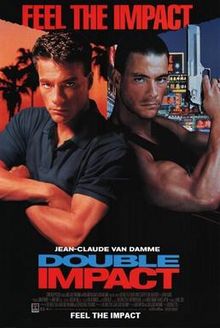
Twice the Van Damme: Double Impact (1991, directed by Sheldon Lettich)


Twice the Van Damme means double the damme trouble in Double Impact!
In this low-budget action flick, Jean-Claude Van Damme plays twin brothers, Chad and Alex Wagner.  When they were just six months old, their parents were murdered in Hong Kong and the brothers were separated.  Chad grew up to become a goody-goody martial arts instructor in Los Angeles.  Alex grew up to become a part of the Hong Kong underworld.  Under the direction of the parent’s former bodyguard, Uncle Frank (Geoffrey Lewis), the twins are reunited and team up to take down the gangster who killed their parents.

When it comes to second-tier 90s action heroes, Jean-Claude Van Damme was never as good as Dolph Lundgren but he was still a thousand times better than Stephen Seagal.  The secret of Van Damme’s success was that, in real life, he was capable of doing all of the thing that he did in the movies.  Van Damme didn’t need a stunt double or trick editing to look athletic.  It’s easy to laugh at Van Damme’s propensity to do the splits in every film he made but everyone knows that if Stephen Seagal had ever tried to do the same thing, he probably never would have been able to stand back up.

Double Impact was made early in Van Damme’s career, after he had established himself with Bloodsport but before he went mainstream with Timecop.  Van Damme is credited with co-writing the script and it’s the first Van Damme film to feature him playing twins, an idea to which he would return a surprising number of times.  The movie is full of moments between the twins that were designed to make critics and audiences say, “He really can act!”  Unfortunately, at that time, Van Damme really couldn’t act.  Chad smiles like a goof.  Alex smokes a cigar and is an angry drunk.  When Chad fears that his mentor has been murdered, he shouts, “NO!” in a way that will remind you of Rainier Wolfcastle’s reaction to his partner getting gunned down in McBain.  That’s the extent of their characterizations.  It wouldn’t be a problem except that the movie is nearly two hours long and that’s a long time to spend listening to Jean-Claude Van Damme argue with himself.

There are a few action scenes, which is the main reason for watching any Van Damme film other than JCVD, but they’re mostly perfunctory.  The bad guy’s main henchman is played by Bolo Yeung and the fight scenes between him and Van Damme are exiting to watch.  Otherwise, Double Impact is damme forgettable.

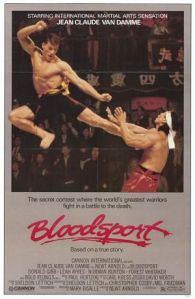
A Movie A Day #246: Bloodsport (1988, directed by Newt Arnold)


Bloodsport is one of Jean-Claude Van Damme’s earliest films and it is Damme good!

Forgive the terrible opening line but that is how they actually used to advertise Jean-Claude Van Damme films.  Everything was either Damme exciting or Damme amazing or Damme spectacular.  Though it was made by Cannon and had a much lower budget than the films Van Damme made during his 90s heyday, Bloodsport is still a Damme quintessential Van Damme movie.

Bloodsport claims that the story it tells is true.  Frank Dux (Van Damme) is a U.S. Army captain who goes AWOL so he can compete in Kumite, an illegal martial arts tournament that is held in Hong Kong.  Kumite is the only martial arts tournament where it is legal to kill your opponent.  Chong Li (Bolo Yeung) became champion by killing anyone who lasts more than a minute with him.  At first, no one believes that an American like Frank Dux has a chance of winning the Kumite.  What they do not know is that Frank was trained by the legendary Senzo Tanaka.  Frank is not just competing for personal glory.  He is also competing in honor of Tanaka’s dead son.

Bloodsport is both Van Damme and Cannon Films at their best.  Shot on location in Hong Kong, Bloodsport not only features Van Damme doing his thing but also gives him a memorable sidekick, Ray Jackson (Donald Gibb), who talks like a professional wrestler and gets all of the best lines.  When Ray and Frank first meet, they bond over a video game that appears to be an extremely early version of Street Fighter.  Also keep an eye out for Forest Whitaker (!), playing one of the CID officers who is assigned to track down Frank and arrest him for desertion.

Like any good Van Damme film, Bloodsport lives and dies on the strength of its fights and it does not skimp on the blood, the chokeholds, or the high kicks.  Bolo Yeung is a great opponent for Van Damme but everyone know better than to try to beat Jean-Claude Van Damme.  When it comes to fighting Van Damme, Duke put it best: