Film Review: Hitler — Beast of Berlin (dir by Sam Newfield)


1939’s Hitler — Beast of Berlin opens with a shot of Nazi stormtroopers marching down a Berlin street.  As they pass, every civilian stands and gives them the stiff-armed Nazi salute.  A couple sitting in a park does it.  A woman pushing a baby carriage does it.  A group of children do it.

Despite outward appearances, not everyone in Berlin is a supporter of Hitler or the Nazis.  Hans Memling (Roland Drew) is an intellectual and a veteran of World War I.  He knows that Germany’s economic policies are, in fact, making the country weaker.  He knows that Hitler is determined to provoke a war that Germany cannot win.  Prophetically, Hans speaks of the risk of German citizens being forced to fight in a war that is only being fought on behalf of Hitler’s ego.  He warns that Berlin and Germany will be destroyed if Hitler is not stopped.

Along with a group of other dissidents, Hans prints an underground newspaper, one that presents the truth about what is happening in Germany.  Working with him, among others, is his brother-in-law, Karl (Alan Ladd, in an early role) and a priest named Father Pommer (Frederick Giermann).  Their contact in the Gestapo is Alfred Stahlhelm (played by Hans Heinrich von Twardowski, a German actor who escaped Germany when Hitler came to power).  Stahlhelm is an alcoholic who fears that he will accidentally slip up when he’s drunk.  As he explains it, a member of the Gestapo is expected to drink and visit brothels when he is off-duty.  If he doesn’t, he will be immediately suspected of insubordination.

When the Gestapo does come for Hans’s operation, Hans finds himself separated from his wife (Steffi Duna) and imprisoned.  The only thing that keeps Hans alive is that the camp commandant is an old friend from World War I.  Hans can only watch as his allies are either executed or forced, after torture, to declare their loyalty to Hitler.  When Hans is finally given an opportunity to escape, he must decide whether to flee to Switzerland or to remain in Germany and continue to fight the Nazi regime.

The most interesting thing about this film is that it was made in 1939 and released into theaters a month after Germany invaded Poland.  The film was released at a time when America was still officially neutral and when isolationism was still a popular policy.  It was released at a time when many Americans were still dealing with the trauma of World War I and, as such, felt that Europe should be left alone to deal with its conflicts on its own.  As such, the film struggled with both the enforcers of the Motion Picture Production Code but also with local censors who felt that the film might offend the German communities within their towns.  James G. Stahlman, editor of the Nashville Banner, was moved to write an editorial calling for the film to be banned because it might inspire audiences to want to go to war with Germany.  Despite all that, Hitler — Beast of Berlin did well at the box office, though many theater owners chose to advertise it as being titled either Beast of Berlin or The Goose Steppers.

Seen today, parts of the film seem naive.  Despite the film being fervently and unapologetically anti-Nazi, it is still obviously a film made at a time when the full depravity of the Nazi regime had not yet been revealed.  The scenes in the concentration camp feel as if they could have been lifted from any 1930s prison film and they certainly come nowhere close to depicting what we now know was actually happening.  Indeed, the film barely acknowledges the anti-Semitism that lay at the heart of Nazi ideology.  But the film does do a good job of portraying life in a society where no one can be trusted and where simply saying the wrong word can lead to prison, torture, and even worse.  The film captures the fear and paranoia of living under a dictatorship and certainly, it deserves credit for calling out the Nazis and their leaders by name.  At a time when many people were living in denial about what was happening in Europe, this film took a clear and firm stand.  In 1939, the film may have been called “propaganda” but today, it feels like prophecy.  Everything that Hans predicts in this film would come to pass in reality.  The film was a warning that was heeded too late.

The TSL’s Horror Grindhouse: Single White Female 2: The Psycho (dir by Keith Samples)


13 years after the release of the first Single White Female and a countless host of imitations, an official sequel was released straight-to-video in 2005.  Subtitled “The Psycho,” (because apparently, Jennifer Jason Leigh was totally stable in the first film), Single White Female 2 tells the story of what happens when one roommate becomes obsessed with the other.  It all leads to murder and sexual infidelity and sudden hairstyle changes.

Maybe you’re thinking that this sounds exactly like the first Single White Female.  And, okay, there are some similarities.  But just consider some of the differences!

1. In the first Single White Female, Jennifer Jason Leigh’s character grows obsessed with Bridget Fonda after moving into Fonda’s apartment.  In Single White Female 2, Tess (played by Allison Lange) becomes obsessed with Holly (Kristen Miller) after Holly moves into Tess’s apartment.  See, this time, the psycho has her name on the lease.  HUGE DIFFERENCE!

2. In the first Single White Female, the plot is set in action after Bridget Fonda discovers that Steven Weber cheated on her.  In the sequel, the plot is set in motion by Holly’s original roommate, Jan (Brooke Burns), seducing a client who Holly was also sleeping with.  Again, that’s a huge difference and it also leads us to wonder if maybe Holly just sucks at choosing roommates.

3. In the first Single White Female, Jennifer Jason Leigh played an unstable bookstore employee.  In the sequel, Tess is a nurse who has a history of killing people who she feels would be happier dead.  In other words, Tess is a psycho with a mission.

4. In the first Single White Female, Jennifer Jason Leigh’s character hung out in a sleazy S&M club.  In the sequel, Tess actually performs on stage.

5. The first Single White Female actually looked like a real movie whereas the sequel has the flat and rather bland look of a film shot for and on video.

6. In the first Single White Female, you could understand why an insecure person would want to steal Bridget Fonda’s identity.  In the sequel, Holly’s identity doesn’t seem to be interesting enough to justify trying to steal.

7. In the first Single White Female, Jennifer Jason Leigh gave a performance that inspired both fear and sympathy.  In the sequel, Tess is just your typical straight-to-video movie psycho.  There’s no indication that she could have ever been anything other than a straight-to-video movie psycho.

8. The first Single White Female was a good film, almost despite itself.  The sequel is rather dull.

So, I guess my point here is that, if you want to watch a movie about a roommate stealing someone’s identity and getting a new haircut, the first Single White Female is the one to go with.  The sequel doesn’t really add anything worthwhile to the story, nor does it improve on it in any way.  Give some credit to Brooke Burns, who plays Holly’s untrustworthy ex-roommate and who, at the very least, seems to understand the type of movie in which she’s appearing.  Brooke Burns gets the worst lines but she at least seems to be having fun delivering them.  Otherwise, it’s best just to forget about this sequel.

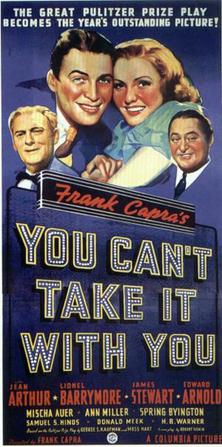
Lisa Reviews An Oscar Winner: You Can’t Take It With You (dir by Frank Capra)


(With the Oscars scheduled to be awarded on March 4th, I have decided to review at least one Oscar-nominated film a day.  These films could be nominees or they could be winners.  They could be from this year’s Oscars or they could be a previous year’s nominee!  We’ll see how things play out.  Today, I take a look at the 1938 best picture winner, You Can’t Take It With You!)

“You can’t take it with you.”

If there’s any one belief that defines the worldview of Martin Vanderhof (Lionel Barrymore), it’s this.  It doesn’t matter how much money you make in your life.  It doesn’t matter how successful you are at business or anything else.  The fact of the matter is that, when your time is up, you won’t be able to take any of that stuff with you.  Instead, Grandpa Vanderhof (as he’s called by his large family) believes that the most important thing to do during your lifetime is to make friends and pursue what you’re truly interested in.

Vanderhof has another belief, one that particularly appealed to be me.  He has never paid income tax.  He doesn’t see the point of giving money to the government when he doesn’t feel that they’ll make good use of it.  When an outraged IRS agent (Charles Lane) stops by Vanderhof’s sprawling house and demands that Vanderhof pay his taxes, Vanderhof refuses.  When the IRS man argues that the income tax is necessary to pay for the Presidency, the Congress, and the Supreme Court, Vanderhof offers to give him five dollars.  “Hell yeah!” I shouted at the TV.  With an attitude like that, Vanderhof should have moved down here to Texas.  We would have elected him governor.

Grandpa Vanderhof is the head of a large and cheerfully eccentric family, all of whom live together under the same roof.  Penny (Spring Byington) writes novels because, years ago, a typewriter was accidentally delivered to the house.  Her husband, Paul (Samuel S. Hinds), has a basement full of fireworks.  Essie (Ann Miller) loves to dance and spends almost the entire movie twirling from room to room.  Her husband, Ed (Dub Taylor), is a xylophone player.

Of course, it’s not just family living in the Vanderhof House.  There’s also Potap Kolenkhov (Mischa Auer), a Russian who is “teaching” Essie how to dance.  There’s Rheba the maid (Lillian Yarbo) and Donald (Eddie Anderson) the handyman.  Actually, the house appears to be open to just about anyone who wants to stay.

And then there’s Penny’s daughter, Alice (Jean Arthur).  Alice is the most “normal” member of the family.  She has just become engaged to Tony Kirby (James Stewart) and she is still trying to figure out how to introduce Tony’s stuffy parents (Edward Arnold and Mary Forbes) to her eccentric family.  What she and Tony don’t know is that Mr. Kirby is currently trying to buy up all the houses that are near a competitor’s factory.  Only one homeowner has refused to sell.  The name of that homeowner?  Martin “Grandpa” Vanderhof.

It all leads, of course, to one chaotic dinner party, one lively night in jail, and a huge fireworks display.  It also leads to true love, which is nice.  Jimmy Stewart and Jean Arthur are even more adorable here than they were in Mr. Smith Goes To Washington.

Based on a Pulitzer-winning play by George S. Kaufman, You Can’t Take It With You was the second comedy to win the Oscar for Best Picture.  The first comedy to win was 1934’s It Happened One Night.  It’s probably not coincidence that both of these films were directed by Frank Capra.

Seen today, You Can’t Take It With You seems a bit slight for an Oscar winner.  Grandpa Vanerhof is a lovable eccentric.  Tony’s father is a stuffy businessman.  Hmmm … I wonder whose philosophy is going to be victorious at the end of the movie?  Still, predictability aside, it’s a delightfully enjoyable film.  While it never quite escape its stage origins, it features wonderful performances from all the usual members of the Capra stock company.  James Stewart and Jean Arthur are a charming couple while Lionel Barrymore gives a performance that is so warmly likable that it’s hard to imagine that, just 9 years later, he would be so perfectly cast as the heartless Mr. Potter in It’s A Wonderful Life.  Of course, my favorite member of the member was Essie, mostly because I also like to dance from room to room.  While it’s hard to justify awarding it Best Picture over The Adventures of Robin Hood and Grand Illusion, You Can’t Take It With You is still a wonderfully fun movie.

It’ll make you smile and laugh.  Who can’t appreciate that?

http://www.youtube.com/watch?v=0WY9RAroTS0


Lisa Reviews an Oscar Winner: All Quiet On The Western Front (dir by Lewis Milestone)


all_quiet_on_the_western_front_1930_film_poster
“When it comes to dying for your country, it’s better not to die at all!”

— Paul Baumer (Lew Ayres) in All Quiet On The Western Front (1930)

Tonight, I watched the third film to ever win the Oscar for Best Picture, the 1930 anti-war epic, All Quiet On The Western Front.

All Quiet On The Western Front opens in a German classroom during World War I.  Quotes from Homer and Virgil, all exalting heroism, are written on the blackboard.  The professor, a man named Kantorek (Arnold Lacy), tells his all-male class that “the fatherland” needs them.  (It’s all very patriarchal, needless to say.)  This, he tells them, is a time of war.  This is a time for heroes.  This is a time to fight and maybe die for your country.  He beseeches his students to enlist in the army.  The first to stand and say that he will fight is Paul Baumer (Lew Ayres).  Soon, almost every other student is standing with Paul and cheering the war.  Only one student remains seated.  Paul and the others quickly turn on that seated student, pressuring him to join them in the army.  That seated student finally agrees to enlist, even though he doesn’t want to.  Such is the power of peer pressure.

A year later, a visibly hardened Paul returns to his old school.  He’s on furlough.  He’s been serving in a combat zone, spending his days and nights in a trench and trying not to die.  He’s been wounded but he hasn’t been killed.  He can still walk.  He can still speak.  He hasn’t gone insane.  He is one of the few members of his class to still be alive.  (That student who didn’t want to enlist?  Long dead.)  When Kantorek asks Paul to speak to his new class, Paul looks at the fresh-faced students — all of whom have just listened to Kantorek describe the glories of war — and Paul tells them that serving in the army has not been an adventure.  It has not made him a hero.  The only glory of war is surviving.  “When it comes to dying for one’s country, it’s better not to die at all!”  Kantorek is horrified by Paul’s words but he needn’t have worried.  The students refuse to listen to Paul, shouting him down and accusing him of cowardice and treason.

(This scene is even more disturbing today, considering that we live in a time when accusations of treason and calls for vengeance are rather cavalierly tossed around by almost everyone with a twitter account.)

What happened between those two days in the classroom is that Paul saw combat.  He spent nights underground while shells exploded over his head.  He watched as all of his friends died, one by one.  One harrowing night, spent in a trench with a French soldier who was slowly dying because of Paul stabbing him, nearly drove Paul insane.  In the end, not even his friend and mentor, Kat (Louis Wolheim), would survive.  From the first sound of bombs exploding to the film’s haunting final scene, the shadow of death hangs over every minute of All Quiet On The Western Front.  By the end of it all, all that Paul has learned is that men like Kantorek and the buffoonish Corporal Himmelstoss (John Wray) have no idea what real combat is actually like.

All Quiet On The Western Front may be 87 years old but it’s still an incredibly powerful film.  There are certain scenes in this pre-code film that, after you watch them, you have to remind yourself that this film was made in 1929.  I’m not just talking about a swimming scene that contains a split second of nudity or a few lines of dialogue that probably wouldn’t have made it past the censors once the production code started to be enforced.  Instead, I’m talking about scenes like the one where a bomb goes off just as a soldier attempts to climb through some barbed wire.  When the smoke clear, only his hands remains.  And then there’s the sequence where the camera rapidly pans by soldier after soldier falling dead as they rush the trenches.  Or the scene where Paul literally watches as one of his friends, delirious and out-of-his-mind, suddenly dies.  Or the montage where a pair of fancy boots is traded from one doomed soldier to another, with each soldier smiling at his new boots before, seconds later, laying dead in the mud.  Or the harrowing scene where Paul tries to keep a French soldier from dying.

All Quiet On The Western Front remains a powerful film.  It’s perhaps not a surprise that, when it briefly played in Germany, the Nazis released live mice in the theaters to try to keep away audiences.  (Both the film and the book on which it was based were later banned by the Nazi government.)  Sadly, we’ll never get to see All Quiet On The Western Front the way that it was originally meant to be seen.  A huge hit in 1930, All Quiet On The Western Front was rereleased several times but, with each rerelease, the film was often edited to appease whatever the current political climate may have been.  Over the years, much footage was lost.  The original version of All Quiet On The Western Front was 156 minutes long.  The version that is available today is 131 minutes long.  But even so, it remains a harrowing and powerful antiwar statement.

With all due respect to both Wings and Broadway Melody, All Quiet On The Western Front was the first truly great film to win the Oscar for Best Picture.  Sadly, it remains just as relevant today as when it was first released.

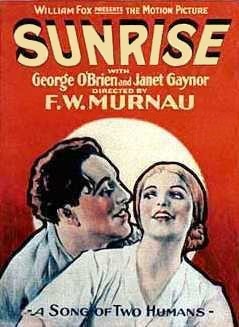
Embracing the Melodrama, Part II: Sunrise (dir by F.W. Murnau)


Sunrise_vintage

Last year, I published 60 film reviews under the heading of Embracing the Melodrama.  Embracing the Melodrama was one of the first review series that I had ever done and I had so much fun doing it that I figured, “Why not try it again?”

In other words, welcome to Embracing the Melodrama, Part II!

Over the next three weeks, I will posting, in chronological order, 128 reviews of films that embrace the melodrama.  As before, these reviews will be in chronological order and they will include everything from Oscar winners to grindhouse exploitation to made-for-television dramas.  It should be fun!

And, considering that we’re talking about 128 reviews here, it should at least help me make a dent in my goal to see every single movie that has ever been made.

Let’s start things off by taking a quick look at the 1927 silent film, Sunrise.  Directed by German expressionist F.W. Murnau, Sunrise is widely considered to be one of the greatest films ever made and for once, popular opinion is correct.  The film tells a simple story.  The Woman From The City (Margaret Livingston) takes a vacation out in the country.  (We know she’s dangerous because she wears black lingerie.)  She stands outside of a farmhouse and whistles.  Soon, the Man (George O’Brien) steps out of the farmhouse and joins the Woman.  Inside the farmhouse, the Wife (Janet Gaynor) can only dream of what life was like when she and the Man first fell in love.

The Man and the Woman meet at the edge of the lake and kiss as the moon shines down on them.  They’re having an affair, though the film — in its dream-like way — leaves it ambiguous as to just how long the affair has been going on.  (Indeed, the film almost seems to suggest that The Woman has sprung from the Man’s subconscious, a creation of his darkest desires.)  The Woman wants the Man to murder his wife and come back to the city with her.  At first, the Man refuses but, as the Woman talks to him, he starts to visualize the city.  And, make no mistake about it — the city that the man visualizes is a scary place that resembles the dreamworld of The Cabinet of Dr. Caligari.  But, at the same time, it’s also a lot more fun than the farm.

Now, you may be wondering why this familiar sounding tale is considered to be one of the best films of all time.  The story itself is simple and deliberately allegorical.  The film is less about the story and more about how Murnau tells it.  Murnau fills the screen with hauntingly surreal images that are both beautiful and frightening at the same time.  When the title cards appear on-screen, the lettering literally fades in and out and adds to the entire movie’s dream-like feel.  Watch the scene below where the Woman first suggests killing the Wife and the Man visualizes the city:

Infatuated with the Woman, the Man plans to drown the Wife but, at the last minute, has a change of heart.  The Wife, however, flees to the city herself.  The Man follows her and attempts to win back her love.  The city itself changes when the Man and the Wife are in it together.  What seemed dark and threatening under the influence of the Woman is now revealed to be fun and vibrant.  The film transforms from being an early example of film noir to being a screwball comedy.

How many other films can you think of that feature both a murderous femme fatale and a drunk pig?

And yet, as much joy as the Man and the Wife find in the city, both the farm and the Woman await their eventual return.  And there’s a storm coming…

Interestingly enough, at the first Oscar ceremony, two awards were given for Best Picture of the year.  The first award — for Outstanding Production — went to Wings, a big budget action spectacular about World War I.  The other award — for Unique And Artistic Presentation — went to Sunrise.  I’ve read a lot of speculation about which film the Academy meant to name the best of the year but, to me, it’s fairly obvious that the Academy meant for Outstanding Production to honor the year’s big blockbusters while Unique and Artistic Presentation would honor the “art” films.

And, to be honest, I think that, way back in 1928, the Academy had the right idea.  Why should they only give out one award for best picture, as if all films can be judged by only one standard?  Why not give out separate awards for the best comedy or the best thriller or the best film made for a certain amount of money?  Why not bring back the Oscar for Unique and Artistic Presentation?

For whatever reason, the Academy discontinued the Unique and Artistic Presentation Award after the 1st ceremony and, in the future, only one film would be named best of the year.  Since Outstanding Production eventually become known as Best Picture, Wings has been immortalized as the first film to win best picture.

And, nothing against Wings, but the Academy would have been smarter to have gone with Sunrise.  Certainly, it would have won them the respect of future film students.

You can watch Sunrise below!

http://www.youtube.com/watch?v=GnLVMREVA6M