Late Night Retro Television Review: 1st & Ten 2.6 “The Unkindest Cut”


Welcome to Late Night Retro Television Reviews, a feature where we review some of our favorite and least favorite shows of the past! On Wednesdays, I will be reviewing 1st and Ten, which aired in syndication from 1984 to 1991. The entire series is streaming on Tubi.
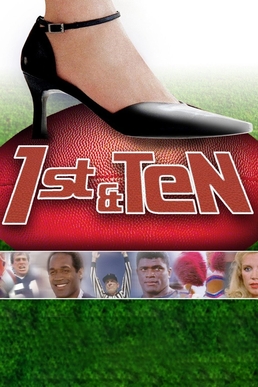
Yay!  Training camp is over!

Episode 2.6 “The Unkindest Cut”

(Dir by Bruce Seth Green, originally aired on September 29th, 1986)

When arrogant quarterback Johnny Valentine refuses to enter drug rehab, Diana reacts by having him traded to Buffalo.  Johnny may be a superstar but he won’t be playing for the Bulls.  That means that Yinessa, the player who nearly kicked off the team twice, is now the starting quarterback.  Yinessa also makes up with his girlfriend (Katherine Kelly Lang) so I guess he’s having a good week.

Bubba has to lose five pounds to retain his starting position.  When he goes in to be weighed, it appears that he’s only lost four pounds.  Bubba quickly takes off his gold watch and he makes weight!  Good for Bubba, I guess.

Finally, Rick Lampert (Marcus Allen) shows up at training camp is given a number 32 jersey by T.D. Parker (O.J. Simpson).  Lampert’s like, This is your number.  Parker replies that the number now belongs to Lampert.  Awwww!  In the role of T.D. Parker, O.J. Simpson has a way of slashing his way to the heart of the matter,

Training camp finally ended with this episode and I’m glad about that because those training camp episodes were getting really dull.  I have to be honest, though.  We’re halfway through the second season and I still don’t feel like I know any of these characters.  Donald Gibb occasionally makes me laugh as Dr. Death.  And, as T.D. Parker, OJ Simpson seems like a really nice guy.  Otherwise, though, this show feels oddly hollow.  Of course, that may be because I’m watching the syndicated version, which apparently edited out a lot of nudity and bad behavior on the part of the players.

Oh well.  Let’s see how the team does!  This episode ends with Diana saying she wants to win a championship.  Does Yinessa have it in him to lead the team with victory?  With OJ Simpson as his coach, he better!
I Watched 61* (2001, Dir. by Billy Crystal)


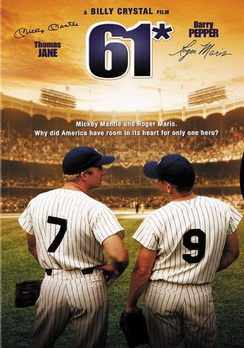
61* is about two baseball player and two friends who couldn’t seem to be more different.

Roger Maris (Barry Pepper) is an introverted family man who doesn’t like it when reporters show up at his house in search of a story or a quote.  He’s a good ball player, one of the best, but he doesn’t want to be a celebrity.  Mickey Mantle (Thomas Jane) is a larger-than-life personality, a beloved figure on the field and in the dugout.  Mickey loves being famous and the fans love him.  Both Maris and Mantle are members of the New York Yankees.  Because Mantle is struggling with his drinking, he becomes Maris’s roommate when they’re on the road.  In 1961, the two friends both go after Babe Ruth’s record of 60 home runs in a season.  The press presents their season as a battle, a race to see who will be the first to hit the sixty-first home run of the season.  Mantle and Maris, though, are just swinging the bat and making plays.

I really enjoyed 61*, which is a baseball film made by and for people who love baseball.  I liked the contrast between the quiet Maris and the charismatic Mantle.  Even though Maris is a hard worker and a good ballplayer, Mantle is the fan favorite and the one that people actually want to break the record.  I appreciated that Maris and Mantle remained friends even when the press tried to turn them into rivals.  That’s what teamwork is all about.  Barry Pepper and Thomas Jane were great as Maris and Mantle and the movie showed how each man dealt with the stress of possibly breaking Babe Ruth’s record.

(Why is there an asterisk in the title?  Babe Ruth set his record in a season that only had 154 games.  The 1961 baseball season was 8 games longer.  The asterisk was added as a reminder that Maris and Mantle had 8 more games than Ruth did to try to break the record.  Baseball fans understand how important accurate statistics are to a player’s career and a team’s season.)

61* celebrates the way baseball used to be, a game played by athletes who had to depend on skill and teamwork instead of performance enhancing drugs.  The movie opens with Maris’s family watching as Mark McGuire closes in on breaking the record.  McGuire would only briefly hold the record.  He would lose it, for 48 minutes, to Sammy Sosa and then, three years after winning it back, he would lose it a second time to Barry Bonds.  Of course, Roger Maris won the record without using steroids so, as far as I’m concerned, it still belongs to him.

If you’re a baseball fan, 61* is a film that you have to see.

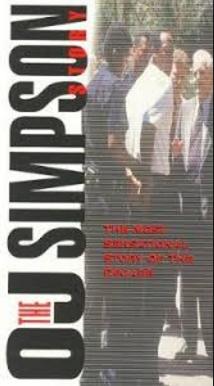
A Movie A Day #193: The O.J. Simpson Story (1995, directed by Alan Smithee)


Long before O.J.: Made In America

Before The People vs. O.J. Simpson

Before American Tragedy

Before today’s live, televised parole hearing…

There was The O.J. Simpson Story.

In 1994, shortly after O.J. Simpson was charged with the murders of Nicole Brown Simpson and Ron Goldman, Fox rushed The O.J. Simpson Story into production.  It was one of many “true life” stories that showed up as television movies during the 90s.  There was a movie about Woody Allen and Mia Farrow’s divorce.  There was a movie about David Koresh and the Branch Davidians, which actually aired while the siege in Waco was still ongoing.  There were three movies about Amy Fisher.  So, of course, O.J. would get a movie.

Though the movie was produced in 1994, it was not allowed to air in 1995 so that it would not prejudice any of the jurors in the case.  (After all, they might have done something crazy like ignore all of the DNA evidence and let O.J. go free.)  I think the legal authorities may have been giving The O.J. Simpson Story too much credit.  There were many bad made-for-TV movies made in the 90s but The O.J. Simpson Story may very well be the worst.  The only thing it could prejudice some against is television.

Opening with the discovery of the murders in Brentwood, The O.J. Simpson Story mixes scenes of O.J. (played by Bobby Hosea, who shows not a hint of O.J.s famous charisma) talking to the police and his lawyer, Bob Shapiro (Bruce Weitz, slightly more credible than John Travolta was in The People vs. O.J. Simpson) with flashbacks to O.J.’s youth, first marriage, and his relationship with Nicole (blandly played by Jessica Tuck, who, beyond the color of her hair, looked nothing like Nicole).  The film also devotes some time to O.J.’s friendship with A.C. Cowlings, who, as a young man, is played by Terrence Howard.

Several of the famous incidents of the case are wanly recreated.  The famous bronco chase is there, of course.  O.J. is shown beating Nicole in the infamous 1989 incident, which the movie suggests was triggered by Nicole telling O.J. that he would never win an Oscar for appearing in The Naked Gun.  But, since the movie was rushed into production before the trial even began, it is remarkable how much is left out.  There’s no Mark Furhman finding the black glove.  There’s no Kate Kaelin, Faye Resnick, Johnnie Cochran, or even Marcia Clark.  Because the movie was made before the trial had even begun, it does not even take a stand on whether or not O.J.’s guilty.  Narratively, it is an incomplete movie and evidence of why movies that claim to tell true stories should not be rushed into production before the story itself has been completed.

As for the film’s dialogue, when O.J. first meets Nicole, he asks her, “Any problem with going out with a brother?”

“Yeah,” Nicole says with a smile, “I’m in the Ku Klux Klan.”

Not surprisingly, The O.J. Simpson Story was directed by Alan Smithee, which was the pseudonym used by directors who felt that their movie has been so butchered by outside interference that they should not even be credited with the final result.  The O.J. Simpson Story is one of the worst Smithee films that I have ever seen.  Compared to The O.J. Simpson Story, Smithee’s work on Let’s Get Harry was Oscar-worthy.

As for the real life O.J. Simpson, earlier today, he was granted parole from the Nevada Parole Board.  He will be released from prison on October 1st.  He has said that he hope to be allowed to move to Florida after being released.  The real-life O.J. Simpson story continues.

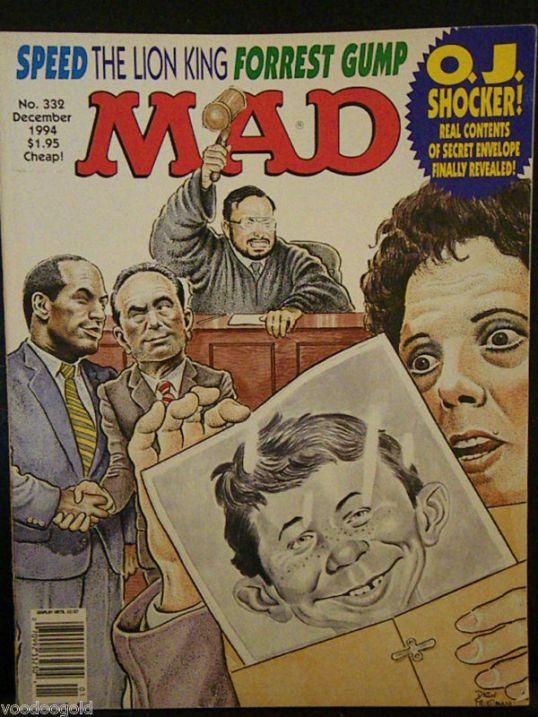
When it comes to the long saga of O.J. Simpson, it seems appropriate to give the last word to MAD Magazine: