After a blow-up at work, air traffic controller John Chester (John Candy) is given five weeks of paid leave. He takes his family to Florida, where they rent a beach house and discover that their summer town is controlled by snobbish sailing champion Al Pellett (Richard Crenna). It’s the snobs vs slobs as Pellett tries to kick John and his family out of their summer rental and John tries to prove himself to his son and daughter (Joey Lawrence and Kerri Green) by winning the local sailing championship. Luckily, John has Sully (Rip Torn), a modern-day pirate captain, on his side.
John Candy was a remarkable talent. It’s just a shame that he didn’t appear in more good films. He will always be remembered for films like Splash, Uncle Buck, Planes, Train, and Automobiles, and Only The Lonely but unfortunately, most of his starring roles were in lightweight, forgettable far like Summer Rental. Candy is likable as John Chester and sympathetic even when he’s losing his temper over every minor inconvenience. But the film itself never really does much to distinguish itself from all of the other 80s comedies about middle class outsiders taking on the richest man in town. Candy is stuck playing a role that really could have been played by any comedic actor in 1985. It’s just as easy to imagine Dan Aykroyd or even Henry Winkler in the role. It feels like a waste of Candy.
The best thing about the film is Rip Torn’s performance as Sully. Torn’s performance here feels like a dry run for his award-winning work as Artie on The Larry Sanders Show. I would have watched an entire movie about Sully. As it is, Summer Rental is inoffensive and forgettable.
In 2020’s Nomadland, Frances McDormand stars as Fern.
Fern had a job working in an U.S. Gypsum plant in Nevada but, after years of steady employment, she’s laid off. Recently widowed and struggling to pay the bills, Fern sells almost everything that she owns and moves into a van. She travels across the country, taking work where she can find it and hanging out at other camps with self-styled “nomads.” She meets Bob Wells, the real-life guru of the van-dwelling, nomad lifestyle. She forms cautious friendships with other people who have decided to spend their lives in their vans, traveling from one location to another. Some of them are people who have fallen on hard times. Some of them are just people who don’t want to be tied down. One thing that becomes clear about Fern is that, while she’s a kind and caring soul, she’s also not one to allow people to get too close to her. She values her independence.
The film becomes a portrait of people who have been largely forgotten by conventional society but who have created a society of their own. (Fern may occasionally work at an Amazon warehouse but one gets the feeling that she would never order anything from there herself.) The film centers on Frances McDormand’s performance as Fern but most of the people that she meets are played by actual nomads. Director Chloe Zhao directs in documentary fashion, emphasizing the natural beauty of America and the lined but strong faces of people who are determined to live life their own way.
Nomadland can seem like a curious best picture winner. It’s almost plotless and, at time, the film itself can seem a bit heavy-handed in its portrayal of the nomad lifestyle. (I value my independence but I doubt that I could handle living in a van. And, even if I could handle it, I wouldn’t want to.) Even though it’s only been a few years since Nomadland won its Oscar, it sometimes seems as if it’s become one of the forgotten Best Picture winners. Some of that is because Nomadland won during the COVID pandemic, at a time when the release a lot of the films that were expected to be big Oscar contenders (like West Side Story and Top Gun: Maverick) were moved back so they could be released in theaters. While Nomadland did get a limited theatrical release, most people who watched it did so on Hulu. The 2020 Best Picture nominees were films that probably would not have been nominated in a different year and Nomadland, with its cinema verité style, is far more lowkey than the typical dramatic Oscar winner. Fairly or not, the film’s reputation has also suffered due to the failure of director Chloe Zhao’s The Eternals.Nomadland is perhaps now best known as being a part of a cautionary tale about what happens when a director makes an acclaimed film and then gets hired to do a Marvel movie.
(You have to feel bad for Chloe Zhao, who was the second woman to win the Oscar for Best Director but who was given the award as a part of perhaps the worst ceremony in the history of the Oscars. So determined were the producers to end on the triumphant note of Chadwick Boseman receiving a posthumous Oscar that both Zhao and Nomadland‘s victories were treated as distractions. And then, of course, Boseman didn’t even win the Oscar. It was an awkward night all around.)
That said, I can understand why Nomadland was embraced when it was released. It came out at a time when people were not only scared of getting COVID but also having to deal with the government’s heavy-handed approach to dealing with the pandemic. Living off the grid and away from society was something that looked very attractive to a lot of people back then. Future film students may be confused as to why Nomadland was so honored but it was definitely a film of its time. People forget (or willfully choose to ignore) how crazy things felt during the pandemic. When Fran told the world to leave her alone, she spoke for many.
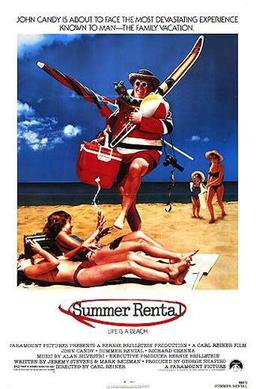 After a blow-up at work, air traffic controller John Chester (John Candy) is given five weeks of paid leave. He takes his family to Florida, where they rent a beach house and discover that their summer town is controlled by snobbish sailing champion Al Pellett (Richard Crenna). It’s the snobs vs slobs as Pellett tries to kick John and his family out of their summer rental and John tries to prove himself to his son and daughter (Joey Lawrence and Kerri Green) by winning the local sailing championship. Luckily, John has Sully (Rip Torn), a modern-day pirate captain, on his side.
 Through the Shattered Lens