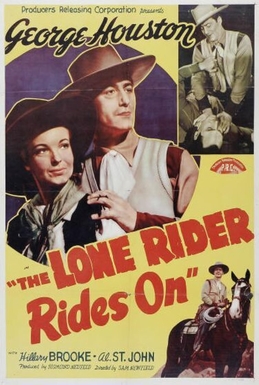
The Lone Rider Rides On (1941, directed by Sam Newfield)


In the days of the wild west, Tom Cameron (George Houston) rides the range alone, seeking vengeance for the murder of his family.  They were killed when their wagon train was ambushed by the same outlaws who has previously sold them a plot of land.  Tom was a child at the time and he only remembers that the leader of the outlaws had a distinctive facial scar.  Tom Cameron is The Lone Rider.

No, not the Long Ranger.  The Lone Rider!  George Houston was an opera star who made for a surprisingly convincing gunslinger and the movie opens with him singing I Am The Lone Rider, just to make sure that it was understood that his vengeance-driven vigilante was a completely different character from that other vengeance-driven vigilante.  The Lone Rider is looking to avenge his family and, with the help of store keeper “Fuzzy” Jones (professional sidekick Al St. John), the Lone Rider does just that.  Though this is a standard B-western, the plot is a little more serious than most other B-movies.  This was the first of several Lone Rider movies and, despite the obviously low budget, there’s some emotional heft to its story.  Tom discovers that his brother (Lee Powell), who he thought had died in the attack, actually survived and joined up with the gang.  The story is about both Tom’s vengeance and his brother’s redemption.  Fans of the genre will enjoy the film’s classic western story and George Houston’s convincing performance as a gunslinger on a mission.

The Lone Rider would ride on for 16 more movies, the last one being released in 1944.  In 1942, George Houston was replaced in the lead role by Robert Livingston.  Houston went from starring in westerns to becoming one of Hollywood’s most respected vocal coaches.  (Howard Keel was one of his students.)  Shortly after the Lone Rider road for the last time, George Houston died while planning his musical comeback.  He had a heart attack and the police, thinking he was just intoxicated, tossed him in the drunk tank where he subsequently died.  He was only 48 years old.

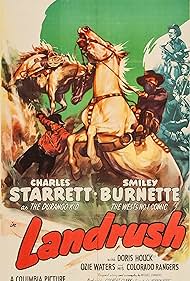
Landrush (1946, directed by Vernon Keays)


Steve Harmon (Charles Starrett) rides again!  This time, he’s investigating the murder of a Pony Express rider.  The murderer is outlaw leader Claw Hawkins (Bud Geary), who is working with rancher Kirby Garvey (Steve Barclay) to cheat the local homesteaders out of their land.

When local newspaper editor Jake Parker (Emmett Lynn) is attacked for trying to expose Claw Hawkins, Steve puts on a mask and dark clothing and, as the Durango Kid, he moves Jake to the carpentry shop owned by Durango’s old friend, Smiley Burnette.  While Jake continues to spread the word to the homesteaders, Durango works to prevent Claw and Kirby from taking all of the land for themselves.

This is a typical Durango Kid film.  This is not the first time that I’ve seen the Durango Kid protect the rights of homesteaders and, as usual, the main villain is not the outlaw that everyone fears but the respectable citizen who is controlling him.  Along with the usual gunfights and horse chases, Landrush has an exciting sequence where Durango and the homesteaders have to deal with a series of fires that have been set by Claw to keep the homesteaders from reaching their land.  Charles Starrett is as authentic a cowboy as ever.  Unfortunately, Bud Geary and Steve Barclay aren’t very interesting as the villains.  People who have watched several Durango Kid films will regret that series regulars Frank Fenton and Jock Mahoney weren’t cast in the roles.

As usual, Smiley Burnette provides comedy relief and sings two songs.  This time, he’s accompanied by Ozie Waters and His Colorado Rangers.

Gunning For Vengeance (1946, directed by Ray Nazarro)


Steve Landry (Charles Starrett) rides into another town and is once again named the new sheriff.  Luckily, Steve’s old friend Smiley Burnette is working as the town’s blacksmith.  Steve makes Smiley his deputy and then sets about trying to break up a gang of cattle rustlers.  When Steve learns that his jurisdiction does not extend beyond the city limits, he dons the disguise of his alter ego, The Durango Kid, to go after the outlaws.

Has Steve met his match in Belle (Phyllis Adair), the saloon owner who is the secret leader of the outlaws?  She notices that The Durango Kid’s boot tracks are the same as Steve’s boot tracks.  I’m surprised that no one has ever noticed that before.  Steve went through a lot of trouble to disguise himself as Durango but he never bothered to change his boots.

This entry in the Durango Kid series features a lot of Smiley Burnette so your enjoyment on the film will depend on how much tolerance you have for Smiley’s songs and his style of humor.  Each film featured Smiley being followed around by a different group of musicians.  In this one, Smiley is accompanied by The Trailsman.  When Smiley accidentally locks himself in a jail cell, the Trailsman stand on the other side of the bars and sing a song about how Smiley can’t get out of the cell.  Smiley does eventually get out but, later on, he’s knocked out cold during an attempted jail break.  Smiley’s not much of a help in this one.

This has all of the typical Durango Kid elements, including the stock footage of the stampeding cattle that appeared in nearly all of his films.  There’s another saloon fight and a gunfight towards the end.  Durango rides out of town alone, leaving Smiley behind, but we know they’ll soon be reunited in another adventure.

Streets of Ghost Town (1950, directed by Ray Nazarro)


Years ago, Bill Donner (George Cheseboro) double-crossed the other members of the Selby Gang and ran off with all of their stolen gold.  Now, Donner is blind and half-crazy.  When he says that he hid the gold in the ghost town of Shadeville, the Durango Kid (Charles Starrett), Smiley Burnette, and Sheriff Dodge (Stanley Andrews) ride off to find it.

Shadeville is long abandoned and, as the three men spend the night in a deserted saloon, Smiley is worried about ghosts.  The Durango Kid tells the story of the first time he met the Selby Gang.  The next morning, they discover that they are not the only ones who have come to Shadeville to look for the gold.

Like many of the later Durango Kid movies, Streets of Ghost Town is mostly made up of stock footage to Starrett’s earlier films.  This was a cost-cutting technique on the part of Columbia Pictures but it actually works because the flashbacks were always to the horse chases and the gunfights that the audience came to see in the first place.  In the days before home video and cable, those scenes were probably still new to many of the people sitting in the theater.

Starrett always made for a good hero and Smiley Burnett’s comic relief never took away from the films’s storylines.  This outing features a great scene where Durango shoots a skull in the dark just to let anyone watching him know that he’s a good shot.  I also enjoyed George Cheseboro’s manic performance as a man who really loves his gold.  Despite all of the stock footage, Streets of Ghost Town is still an above average Durango Kid film, predictable but entertaining if you’re a fan of the genre.