Since today is Labor Day, I figured this would be a good time to share a short film about management….
Wait, that doesn’t sound right.
Well, no matter. The boss in Hired! may not be eligible to join a union but, as we can see in this 1941 film, he’s still willing to work hard. Or, at least, he’s willing to work hard after his father drunkenly calls him out for not being a very good boss. On the surface, this short film might look like it’s about Jimmy and his struggle to convince people to buy a new car. But, actually, it’s about a boss who needed to be reminded of the importance of working with his employees and helping them out. Of course, it could also be possible that Jimmy is struggling because he’s incredibly awkward for a salesman. And the boss could be struggling because he’s a middle-aged man who apparently still lives at home with his parents and takes orders from his cantankerous father. One gets the feeling that there’s enough underlying resentment in this film to fuel a season’s worth of Arthur Miller plays.
Hired! was made for Chevrolet and it was meant to teach managers how to inspire their salesmen. Of course, given that the film was made in 1941, it’s probable the Jimmy enlisted in the armed services after Pearl Harbor and eventually came back home as such a big war hero that he really didn’t need a job selling cars anymore. Instead, Jimmy ran for Congress and eventually chaired the House Oversight Committee. That’s what I hope happened.
Just in time for the Labor Day, here’s a short film from 1949 about How To Keep A Job!
Edward is kind of a dummy. He goes to a job interview and spends the whole time not only trashing his former employer but also trying to avoid admitting that he was fired from his previous job. Fortunately, the man interviewing him can tell that Edward still has potential, despite the fact that he’s kind of a squirmy idiot.
The interviewer tells Edward the story of twin brothers who worked in shipping. One brother was smart and responsible and always a good worker. That bother is now on the verge of being promoted. The other brother, Walter, was irresponsible and more concerned with getting ready for a date than actually doing his job. The message would seem to be that Edward is running the risk of turning into Walter but wait a minute! There’s a twist!
This is certainly an earnest short film. Of course, when seen today, it’s more goofy than educational. I have to admit that films like this always used to make me feel guilty because they’re like, “You must follow these exact steps to get and keep a job,” and I’m over here like, “Or you can just wait for a friend of your mom’s to give you a job!” But anyway, here’s How To Keep A Job!
Since this is Labor Day weekend, it seems like an appropriate time to share a short film about one of our most valuable professions, teaching.
In 1947’s Maintaining Classroom Discipline, Mr. Grimes is a Math teacher who is disappointed in his stupid, stupid students. How should he deal with them? This short film gives us two options. The first half of the film (which, if we’re going to be honest, is the more fun half of the film), Mr. Grimes is hard-nosed and sarcastic, telling the students that he’s very disappointed in them and giving them all detention when they make fun of him. (One of them even misses football practice!) This approach does not work and, instead, leads to montage of Mr. Grimes giving detention to student after student. One student is kicked out of class and told not to return until he’s ready to apologize. I mean, seriously, Mr. Grimes is basically telling him that he can just leave the school if he wants.
The second half of the film features Mr. Grimes instead being polite about the low test score and patiently explaining to his students how ratio works. When one student tries to make fun of Mr. Grimes, the entire class rolls their eyes. Earth-2 Mr. Grimes is a good teacher and his class would die for him!
Personally, if I was a teacher, I have no idea how I would maintain discipline. I’d probably just make sure that my classroom was near the principal’s office so I can pull him in whenever I wanted to. To me, the worst thing about giving a student detention isn’t the fact that the student will resent you for it but that apparently, you’re required to stick around until detention has been served. Seriously, I enjoy working and all but I also like going home.
Anyway, let’s all learn from Mr. Grimes, shall we?
Since we are entering the Labor Day weekend, this seems like a good time to share a blast from the past that comes us all the way from 1947.
In The Secretary’s Day, viewers are told and shown what it takes to be a secretary. Do you know how to take dictation? Do you know how to carefully open up letters? Do you know how to be courteous to random people who wander into the office? More importantly, do you know how to make sure that Marge the Stenographer never gets into her head to try to seal your job away from you?
I watched this short film with a bit more interest than usual because I actually have worked as an administrative assistant in the past. Watching the film’s lead character obsess over her desk calendar brought back some memories but I think that just has more to do with the fact that I’m obsessed with calendars than anything else. To me, the main message of this film seemed to be, “A secretary’s day is pretty dull but at least she can bully the stenographer.”
Anyway, here’s a trip back to 1947! The war is over, the Great Depression was now a memory, and Americans, flush with victory, were looking for jobs! Check out The Secretary’s Day!
In this short film from 1951, a young American airman goes to a small town while on furlough. He goes to sleep in a freedom-loving American town but, when he wakes up, things have changed. The people are no longer friendly. The streets are patrolled by sinister soldiers. A man gives a speech in the town square, announcing that no one is allowed to defy the state. When a woman tries to speak up, she’s grabbed by soldiers. When the airman tries to defend her, he’s grabbed as well. A judge listens as the airman defends America and the first amendment. The judge says that the airman would make a good propagandist. The airman would rather be executed.
What’s happened!?
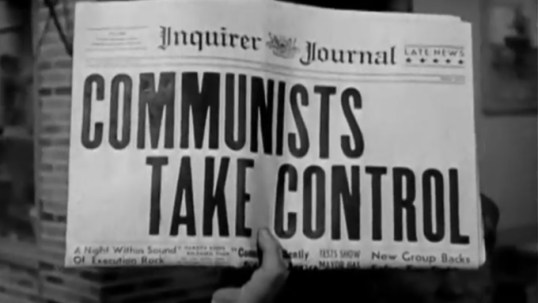
Well, here’s what the newspaper says:
That’s right! The communists have taken control and apparently, it only took them a few hours to do it. The airman somehow slept through the whole thing. It really does make me wonder whether he’s someone who I really want in an important position when it comes to defending this country. Sleeping through a communist coup takes a lot of effort.
Fear not, though. There’s a twist ending. I won’t spoil it, other than to say that it makes about as much sense as a member of the Air Force sleeping through a communist coup. You can watch it for yourself:
On the one hand, this film is pure propaganda. On the other hand, authoritarianism has become very popular lately and not just among communists. This short film may be heavy-handed but it probably seems a bit less heavy-handed today than it did just a few years ago. In the film, the enemy is communism. In real life, the enemy is anyone who would say that freedom of speech and thought should be curtailed. It’s true that they always have what sounds like a good reason for sacrificing freedom, whether it be to protect the workers or to protect the children or to make the world a safer place. But, in the end, the main goal is to make sure that only one voice can be heard.
Watch this short film on a double bill with the original Red Dawn. What a great way to celebrate May Day.
It may seem strange to celebrate the Ides of March by sharing an educational film about The Holy Roman Empire, seeing as how it was famous for being neither holy nor Roman nor an Empire. But then again, the fact that the name “Roman Empire” was still being appropriated into the 19th century shows you just how powerful a hold the Roman Empire had over people’s imaginations. Everyone wanted to be Roman and everyone wanted to be a part of an empire. Of course, there would have been no Roman Empire if not for the Ides of March.
Add to that, this 1961 film features not only a teacher but also historical reenactments. I love cheap looking historical reenactments!
Here, for your educational viewing, is a blast from the past. From 1961, it’s a look at The Holy Roman Empire!
From 1959, here’s a short film that asks the question, “What made Sammy speed?”
(I’m going to guess that the title is meant to pay homage to the novel, What Makes Sammy Run?)
Sammy Robertson (played, in flashbacks, by David Felshaw) was a popular high school student until he was killed when his car collided with a truck. A local detective tries to figure out what caused the accident to happen. To be honest, I’m not really sure why there’s any question as to why it happened. Sammy was speeding. He ran a stop sign. The truck crashed into his car. It’s tragic and there’s definitely a lesson to be learned about paying attention to the road but it’s not particularly complicated. It really doesn’t seem like the sort of thing that would require a massive criminal investigation. It’s not like Sammy was smuggling drugs or drinking or driving or anything like that. At most, the cops might want to ask themselves why the stop sign was at such a strange angle.
Still, since there’s apparently no other crimes being committed in this town, the detective spends a few days talking to Sammy’s relatives and his friends and trying to figure out why Sammy felt it was okay to speed. (The driver of the truck, meanwhile, is totally let off the hook. How fast was he going because it looks like he really messed up Sammy’s car.) The detective learns that Sammy’s father wasn’t a particularly good driver. He learns that Sammy’s little brother looked up to Sammy whenever he would drive fast. He learned that Sammy’s friends were impressed by his car and his total lack of concern when it came to safety. (That said, most of them still refused to ride with him. They knew better than to risk their chances to attend the next sock hop.) He learns that, shortly before the accident, Sammy’s boss couldn’t give him a raise and that Sammy failed in his attempts to join the school’s baseball team. Broke and not destined for athletic glory, Sammy needed to feel like a man so he ignored the speed limit and the stop sign. He had issues with authority, the detective tells us.
Yes, the detective tells us a lot. That’s because this is a Sid Davis production and no Sid Davis production was complete without a judgmental narrator. In this case, the narrator decides that everyone was to blame for Sammy driving too fast so I guess the message here is to let a bad player on the team and always give your employees a raise whether you can afford it or not. If you don’t, the worst possible thing that could happen will happen. That was another frequent Sid Davis lesson. The worst always happens, no matter what. That said, my main takeaway from this film was that Sammy was just naturally self-destructive. It really doesn’t sound like anyone could have saved Sammy. Sammy’s enemy was not the coach, his boss, his father, the cops, or even his little brother. Sammy’s greatest enemy was himself.
Anyway, here’s a blast from the past from 1959. Watch it the next time you’re tempted to drive too fast.
Today, we have a special election day blast from the past!
In 1982 (and not 1980, regardless of what the title of the YouTube video says), former Cincinnati Mayor Jerry Springer entered the race for governor of Ohio. He was one of three major candidates to enter the Democrat primary. During the campaign, Springer cut this memorable commercial in which he let voters know that, a few years earlier, he “spent some time with a woman (he) shouldn’t have” and that he “paid her with a check.”
Despite Jerry’s claim that “the nomination is finally within grasp,” he came in a distant third. Of course, if Springer had won that election, America would never have had the Jerry Springer Show or any of the shows, like Maury, that followed its example. So, Ohio, it’s all on you. Elections have consequences.
On October 1st, Case reviewed Moon. What better way to celebrate October 31st than taking a trip to the moon with classic film that came out 120 years ago?
Directed and written by Georges Melies, A Trip to The Moon is often cited as the first sci-fi film and the image of the capsule crashing into the eye of the man in the moon is one of the most iconic in film history. Seen today, the film seems both charmingly innocent and remarkably ahead of its time.
For me, it always takes a minute or two to adjust to the aesthetic of early films. We’ve grown so used to all the editing tricks that modern filmmakers use to tell their stories that these old silent films, with their lack of dramatic camera movement and obvious theatrical origins, often take some effort to get used to. Still, the effort is often worth it.
Here then is Georges Melies’s 1902 science fiction epic, A Trip To The Moon.
For today’s blast from the past, we have another dream film from Georges Méliès. In this film, a man (played by the director) appears to dream of a mermaid. This film is from 1904 and, 118 years later, it’s still a charmingly surreal vignette. Georges Méliès reveals himself to be not only a dreamer but a pioneer of the type of special effects that we today take for granted.


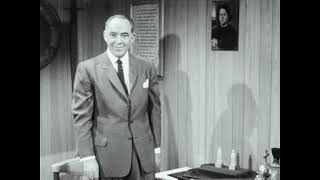
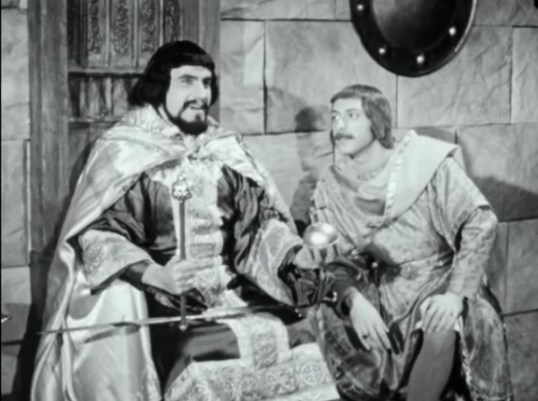 Here, for your educational viewing, is a blast from the past. From 1961, it’s a look at The Holy Roman Empire!

 Through the Shattered Lens