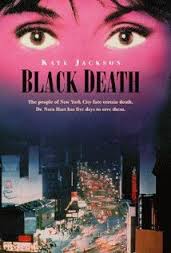
Quiet Killer (1992, directed by Sheldon Larry)


When wealthy teenager Sarah Dobbs (Kathleen Robertson) vomits up blood and then drops dead in the middle of New York City, the coroner’s office is baffled as to what killed her.  As far as anyone knows, Sarah has just been suffering from the flu, which she apparently contracted when she was recently overseas.  However, there is one doctor in New York who thinks that she knows what’s happening.  Dr. Nora Hart (Kate Jackson) takes one look at Sarah’s case and decides that the Black Death — the same plague that wiped out half of the world’s population in 54 AD — has come to New York!

Nora wants to shut down the city immediately but Mayor Carmichael (Al Waxman) says that would not only lead to mass panic but it would also an economic disaster.  Working with a team of other doctors (including Jerry Orbach, who is always a welcome presence in New York films), Dr. Hart tries to track down everyone who Sarah came into contact with and quarantine them before both a panic and a pandemic breaks out.  Unfortunately, one congressman (Howard Hesseman!) doesn’t want to go into quarantine because that would mean admitting that he was in Manhattan to visit his mistress.  Despite everyone’s best efforts, mass panic follows.

Quiet Killer (which is also known as Black Death) is a made-for-TV movie that used to show up on late night television throughout the 90s.  It’s a typically overwrought disaster film and it’s easy to laugh at some of the dialogue and some of the acting.  (Kate Jackson is particularly wooden in the lead role.)  The first time I saw it, I thought the most interesting thing about it was that it featured Howard Hesseman as a congressman.  For those who know Hesseman best for playing characters like Dr. Johnny Fever on WKRP, it’s strange to see him playing a member of the establishment.  Hesseman isn’t bad in the role but it never makes sense that he wouldn’t be able to think of a way to explain away his presence in Manhattan.  You would think a politician would be better at coming up with an alibi or that he could have pulled some strings to keep it from being revealed that he had been quarantined.  Instead, he decides to just run off and potentially infect the entire nation.  That’s not what I pay my tax dollars for.

Quiet Killer is a good example of how real-life events can shape how we view a film.  Up until just a few months ago, this would have seemed like just another cheesy disaster movie.  Watch it today and it feels prophetic.  Hopefully, by this time next year, it will be back to just being cheesy.
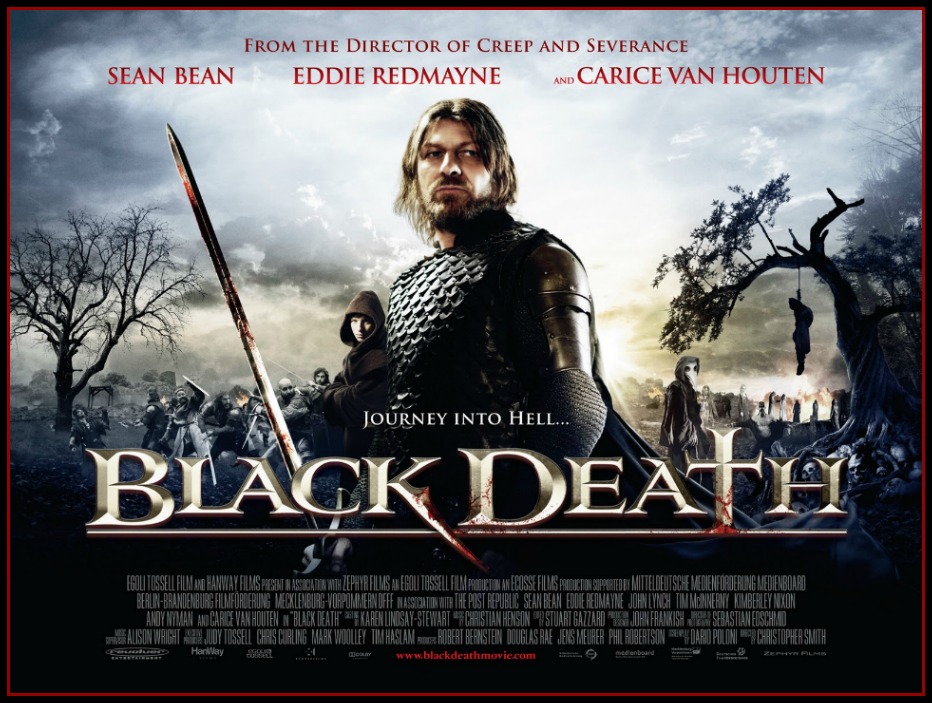
Quickie Review: Black Death (dir. by Christopher Smith)


British filmmaker Christopher Smith has been flying under the radar of most of the film-going public. He’s already a filmmaker with five films to his credit of varying quality, but each showing his growth as a director with each successive release. In 2010, Christopher Smith released his sixth film in the UK with some film festival showings in the US soon thereafter. Black Death continues Smith’s work in the horror genre with this latest film a historical horror piece which tries to take a look at the subject matter of the Black Death of medieval Europe in a realistic, gritty light.

The film is set during in 1348 plague-ravaged England where a Osmund, a young monk, has a crisis of faith as he agonizes over his celibate vows to God and his love for Avrill, a young woman in town who also has feelings for Osmund. Avrill gives Osmund a week to find the answer to his dilemma and will wait for him at the marshes in that alloted time. Osmund finds his answer as templar knight Ulric (played by Sean Bean) and a group of his soldiers arrive at the monastery on a mission to find a village said to be untouched by the plague and one which might be providing a safe haven for a necromancer who has brought the dead back to life. Osmund seizes on this chance to leave the monastery and lead Ulric and his men through the marshes and to this village.

During their travel the group loses a couple men to bandit attacks and to the plague itself. They also come across a band of villagers about to burn a young woman for witchcraft. At first, Ulric seems to take pity and show compassion to this young woman, but instead kills her himself for the crime she is accused of. Ulric reminds Osmund and his men that they have no time for such distractions as they a much more important task ahead of them. A task which soon brings them to the very village which seem to be free from the plague many attribute to God punishing the sinners and other’s as the Devil tormenting the faithful.

It’s this ambiguous theme of how the Black Death was seen by villagers, soldiers and faithful which becomes an overriding theme in the film. Smith, using Dario Poloni’s screenplay, goes about exploring how those in power on both sides of the question — of whether God or the Devil was responsible for the plague — hold such a major influence on the minds of the uneducated populace. Ulric, Osmund and the group do find their necromancer, but it’s not all what they’ve expected and, for Osmund, this mission becomes a tragic one which tests his faith in God, his church and all that he’d been taught (indoctrinated some would call it) to believe. Osmund becomes the spiritual battleground from which Ulric and the necromancer fight over his eternal soul and the effect this has on the young monk turns out a surprising fashion which brings to mind Michael Reeves own historical piece and one of the greatest horror films of all-time in Witchfinder General.

Christopher Smith’s direction continues to improve and shows in Black Death as he’s able to make not just the subject of this horrific era in Europe’s medieval past, but at the same time use a deft hand to explore themes of faith, spirituality, role of religion as control and how fundamentalism doesn’t just affect those with religious conviction but also those who follow the secular path. It helps that Smith had a capable ensemble cast led by Sean Bean’s usual strong performance. Eddie Redmayne as Osmund seemed to be a one-note cipher through the first-half of the film, but once he arrives in the village his character begins to open up in complex ways that we’re never sure if he’ll fall on the side of the angels or the demons even right up to the end and even then it’s left ambiguous.

Black Death marks the latest in Christopher Smith’s tour of the horror genre and it’s many varying subjects to hone his growing craft as a filmmaker. The film ended up being entertaining despite having such an oppressive atmosphere and tone to not just the story, but to the very setting. There’s enough blood and gore spilled (using practical effects and not a sign of CGI to be seen) during scenes of fighting and torture to satisfy gorehounds who might come across the film. It also should work the mind of those also looking not just for the grue but also something to stimulate the mind. It’ll be interesting to see what Christopher Smith has next to follow-up this well-done and executed historical horror film.

Black Death: Trailer


There’s a film called Black Death that came out sometime around 2010 that seems to have fallen below the radar of most everyone. It’s a British historical horror film from upcoming genre filmmaker Christopher Smith. The film stars Sean Bean in the role of a knight during the Black Death era of Europe.

From what I’ve seen of the trailer and read about the film it seems to be a horror film that looks at the Black Death era of history with a slightly supernatural bent to it. Even the trailer gives gives the film a certain Wicker Man vibe to it. Holy warriors of the Christian faith coming into a village untouched by the Black Death. A village whose inhabitants might be dabbling with powers from a much older and earthy religion to keep the village safe. It definitely sounds like this film might have been influenced by that classic horror film starring Edward Woodward.

I like the look of the film as seen through the trailer. It almost looks black and white with splashes of vibrant colors here and there. Black Death hasn’t been announced as having a North American theatrical release date so this film looks like it will be a blu-ray release for me to finally see it.