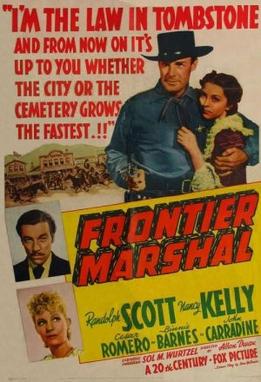
Frontier Marshal (1939, directed by Allan Dwan)


When Wyatt Earp (Randolph Scott) arrives in the town of Tombstone, he takes the law in his own hands by preventing a local outlaw named Indian Charlie (Charles Stevens) from destroying the saloon owned by Ben Carter (John Carradine).  For his trouble, Earp is beaten up by Carter’s men.  Earp, however, does get a  job as the town’s new marshal.

After some initial weariness, Wyatt befriends an alcoholic dentist and gunfighter named Doc Holliday (Cesar Romero).  While Earp keeps the peace in Tombstone, Doc is torn between two women, dancehall girl Jerry (Binnie Barnes) and his ex-girlfriend, Sarah (Nancy Kelly).

With Carter and his man planning on robbing a payroll train and also kidnapping frontier performer, Eddie Foy (played by the real Foy’s son, Eddie Foy, Jr.), it is only a matter of time before Earp takes on Carter at the legendary O.K. Corral.

Frontier Marshal was only the second sound film to be made about Wyatt Earp’s time in Tombstone and it was the first to use Earp’s name.  (In the first film version of the story, also called Frontier Marshal, Earp’s name was changed to Michael Wyatt.)  This was because Wyatt’s widow was offended by some of the material that was included in the biography that served as the basis for Frontier Marshal and threatened to sue anyone who wanted to make a movie out of it.  In order to get her permission to make the film, 20th Century Fox agreed that no reference would be made to Wyatt’s marriage in the film.  Mrs. Earp ended up suing anyways.  20th Century Fox settled.

As for the film, it’s in no way historically accurate and it pales in comparison to My Darling Clementine, Gunfight at the O.K. Corral, Tombstone, and the Star Trek episode where Kirk, Spock, and McCoy thought they were in the old west.  It is, however, better than The Gunfighters episode of Dr. Who.  Randolph Scott is convincing as an upright and law-abiding Wyatt Earp, quite a contrast to the real Wyatt.  The movie though is stolen by Cesar Romero, who plays Doc Holliday as being pathologically self-destructive.  Cesar Romero is not necessarily the first name that comes to mind when you think of a great western actor but he’s very convincing here.  John Carradine is a perfect villain and keep an eye out for Lon Chaney, Jr. as one of his henchmen.  Unfortunately, the final gunfight feels rushed and, for all the build up, it isn’t as exciting as it should be.  Frontier Marshal will mostly be of interest to those curious to see how Doc Holliday, Wyatt Earp, Tombstone and the Gunfight at the O.K. Corral were portrayed in films before they became a sacrosanct part of the mythology of the Old West.

Frontier Marshal was later remade, as My Darling Clementine, by John Ford.  Ward Bond, who played Morgan Earp in Ford’s film, plays the original town marshal in Frontier Marshal.  Charles Stevens, who plays Indian Charlie in Frontier Marshal, was often falsely described by the Hollywood publicity mill as being the real-life grandson of Geronimo.  He also appeared in My Darling Clementine, once again playing the role of Indian Charlie.  It was one of the nearly 200 films he made before he died in 1964.

A Pirate’s Life For Me!: THE SPANISH MAIN (RKO 1945)


gary loggins's avatarcracked rear viewer

Today we celebrate the birthday of classic actor Paul Henreid (1908-1992)  


THE SPANISH MAIN is one of those films where the acting is cranked up to 11 and tongues are held firmly in cheek. That’s not a bad thing; this is a fun, fast-paced romp that doesn’t require much thinking, a colorful piece of mind candy that doesn’t take itself too seriously and features a great cast. It’s not what you’d normally expect from director Frank Borzage, usually associated with weightier matters like 7TH HEAVEN, A FAREWELL TO ARMS, THREE COMRADES, STRANGE CARGO , and THE MORTAL STORM. Maybe after all that heavy drama, the veteran needed to lighten up a bit!

Paul Henreid  stars as our hero Laurent Van Horn, a Dutch captain whose ship is wrecked in the Caribbean waters near Cartagena. The Spanish Viceroy there, Don Juan Alvarado (Walter Slezak ), is a tyrant who holds the…

View original post 415 more words

Film Review: The Private Life of Henry VIII (dir. by Alexander Korda)


This afternoon, as part of my mission to see every single film ever nominated for best picture, I watched Alexander Korda’s 1933 biopic The Private Life of Henry VIII.

Now, I have to admit that I’ve never been a big fan of the historical King Henry VIII as I have a hard time finding much sympathy for a man who beheads one wife, not to mention two of them.   I like to imagine that he met his end in much the same way that Joe Spinell meets his end at the end of Maniac, with all of his dead wives suddenly showing up and ripping off his head.  But, Henry is one of those larger-than-life historical figures that always seems to end up as the subject of movies, speculative fiction, and, of course, Showtime television series. 

The Private Life of Henry VIII is one of the better known recreation of Henry’s life on-screen.  For the most part, the film ignores Henry’s policies as king and instead is a darkly humorous recreation of his relationships with five of his six wives.  (His first marriage, to Catherine of Aragon, is ignored.)  The episodic film opens with the execution of Anne Boyelen (Merle Oberon).  This sequence establishes the film’s tone early and it’s actually a lot more cynical than we usually expect a film from 1933 to be.  In between shots of Boyelen waiting to meet her fate, we get extended scenes of two executioners — one French and one English — arguing about which nationality is better when it comes to chopping off heads.  Meanwhile, the members of Henry’s court spend their time whispering innuendo about Henry’s new wife, Jane Seymour (Wendy Barrie).  When Henry (played by Charles Laughton) finally shows up on the scene, he turns out to be a buffoon, a childish man who happens to control the destiny of England.  After Jane dies in childbirth, Henry marries Anne of Cleves (played by Laughton’s wife, Elsa Lanchester).  Anne, however, finds Henry to be repulsive and, in the film’s most obviously comedic segment, she goes out of her way to make herself as sexually unappealing as possible in order to convince Henry to give her a divorce.  (This, of course, led to the split between England and the Catholic Church but the film doesn’t dwell on that.  This is a comedy, not Man For All Seasons.)  After the divorce, Henry finally marries Catherine Howard (Binnie Barnes) who has spent the whole movie pursuing Henry.  For the first time in the movie, Henry is portrayed as being truly in love, unaware (at first) that Catherine only married him for his crown and is actually having an affair with Thomas Culpepper (Robert Donat). 

The Private Life of Henry VIII was not the first movie to be made about Henry VIII but it’s probably the most influential because of Charles Laughton’s Oscar-winning performance in the title role.  Laughton’s performance pretty much set the standard as far as future Henry’s were concerned.  His Henry is buffoonish womanizer who does everything to excess.  (This is the film that pretty much created the whole image of monarchs as men who don’t use forks, knives, or spoons.)  However, as over-the-top as Laughton’s performance may seem, it’s actually full of very subtle moments that suggest the actual human being lurking underneath all of the bluster.  It’s hard not to sympathize with Laughton’s Henry as he struggles to explain what sex is to Anne of Cleves or with his obvious pain when he discovers that he’s been betrayed by the only one of his wives that he actually loved.

(Of course, any similarity between Laughton’s Henry and the real-life Henry is probably a coincidence.)

The Private Life of Henry VIII was the first British film ever nominated for best picture and, perhaps because it wasn’t made by the Hollywood establishment, it hasn’t aged as terribly as most films from the 30s.  While the film does have its slow spots, the performances of Laughton, Oberon, and Lanchester still hold up well and some of the film’s dark comedy almost feel contemporary.  Oddly enough, this British film about English history lost to an American film about English history, Cavalcade

(I should mention that I haven’t seen Cavalcade so I can’t say whether it was a better film.  I’m going to have to see Cavalcade eventually but it’ll be later than sooner as the movie is only available as part of a DVD boxed set that costs close to 300 dollars.  Agck!)