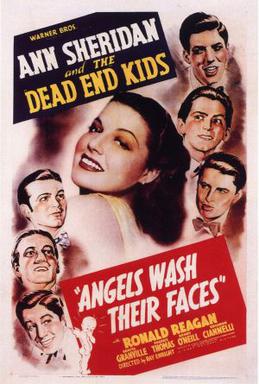
Angels Wash Their Faces (1939, directed by Ray Enright)


Gangster William Kroner (Bernard Nedell) and his henchman Martino (Eduardo Ciannelli) frame teenager Gabe Ryan (Frankie Thomas) for setting several buildings on fire.  Because Gabe has just gotten out of reform school and is a member of a local neighborhood gang, they know that no one will believe him or his sister, Joy (Ann Sheridan).

What Kroner and Martino did not count on were the Dead End Kids (Billy Halop, Bobby Jordan, Leo Gorcey, Gabriel Dell, Huntz Hall, and Benard Punsley).  They’re not going to sit by while the adults send their friend to jail.  Plus, one of their friends was killed in one of the fires.  The kids are out for revenge and sympathetic district attorney Pat Remsen (Ronald Reagan) is on their side.

As a publicity stunt, the city is holding an election for “Kid Mayor.”  The Kid Mayor gets to run the city for a week.  What could go wrong?  Billy Halop decides to run for Kid Mayor so that he can order the arrest of Kroner and then beat a confession out of him.

Angels Wash Their Faces was one of the last of the studio-made Dead End Kid films.  After this one, they would be sent down to Poverty Row and their films would be more obviously comedic.  Angels Wash Their Faces starts out as a juvenile delinquent drama, with Gabe struggling to rebuild his life and keep on the right track.  Then it becomes a goofy comedy, with Billy Halop running for mayor and unleashing vigilante justice on the bad guys.  I’m not sure that any city would actually give the “kid mayor” the power to lock people up.  Whoever came up with the idea of a kid mayor should be run out of politics.

On the positive side, Ann Sheridan is beautiful.  Future president Reagan is his usual friendly self.  On the negative side, the movie, overall, lacks the edge that made the first few Dead End Kids films memorable and the Dead End Kids themselves seem to be pretty much interchangeable.  Huntz Hall would have made a better mayor.


Challenge of the Range (1949, directed by Ray Nazarro)


On the frontier, someone is raiding the homes of ranchers like Jim (Henry Hall) and Judy Barton (Paula Raymond).  The Homeowners Association summons Steve Roper (Charles Starrett) to bring a stop to the raids.  Everyone suspects that Cal Matson (Steve Darrell) and his son, Rob (Billy Halop), are behind  the raids but Steve, as the Durango Kid, discovers that a third party is trying to set everyone at war with each other for his own benefit.

The entry in the Durango Kid series was Charles Starrett’s 103rd western.  It’s not a particularly distinguished entry, relying heavily on stock footage.  I did find the idea of the film’s bad guy trying to manipulate the Bartons and the Matsons into destroying each other to be interesting but the movie doesn’t do much with it and the identity of main villain will be obvious to anyone who watches the film.  There is one good scene where Steve disarms three bad guys and then makes them walk all the way back to town without their boots on.  Steve doesn’t mess around.

Smiley Burnette provides the comic relief and a few songs.  This time, Smiley’s a dime store writer researching his next book.  Musically, he is accompanied by The Sunshine Boys.  103 movies in and Smiley still hasn’t figure out that Steve and Durango are one of a kind.

Film Review: Dead End (dir. by William Wyler)


Originally released in 1937, Dead End is a gangster film with social conscience.  Based on a Broadway play and featuring a screenplay by the iconic progressive writer Lillian Hellman, Dead End is a crime film that’s more interested in the root causes of crime than in crime itself.

Dead End takes place over the course of one day in the slums of New York City.  While tenement children spend their time swimming in the East River and idealizing gangsters, wealthy people live in high-rise apartments and depend on the police and their doorman (played, naturally enough, by Ward Bond) to keep them protected from the poor people living next door.

Among the poor is Drina (Sylvia Sidney), who divides her time between marching on a picket line and trying to keep her younger brother Tommy (Billy Halop) from hanging out with the local street gang, the Dead End Kids (Huntz Hall, Bernard Punsly, Leo Gorcey, and Gabriel Dell).  Drina’s childhood friend is Dave (Joel McCrea), an idealistic architect who is having an affair with a rich man’s mistress (Wendy Barrie).

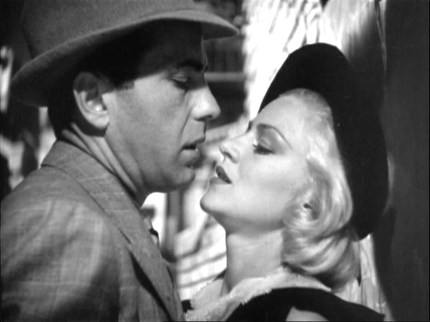
Complicating things is the arrival of Baby Face Martin (Humphrey Bogart).  Like Dave, Martin grew up in the slums.  However, while Dave is trying to escape by making an honest living, Martin has already escaped by choosing a life of crime.  Now, he’s viewed as a hero by Tommy and his friends and with wariness by Dave and Drina who know that Martin’s presence will eventually lead to the police invading their home.  Martin, however, is more concerned with seeing his mother (Marjorie Main) and his ex-girlfriend (Clare Trevor), who has become a prostitute and is suffering from syphilis.

For a film that was made close to 80 years ago, Dead End holds up pretty well.  Is this because it’s a brilliant film or just because the connection between poverty and crime has remained one of the constants of human history?  It’s probably a combination of both.  Considering that Dead End was filmed on a Hollywood backlot, it’s a surprisingly gritty and realistic film that only occasionally feels a bit stagey.  The film’s entire cast does a good job of bringing this particular dead end to life, though the obvious star of the film is Humphrey Bogart.  As played by Bogart, Baby Face Martin is both sympathetic and despicable, the epitome of the potential that can be found and wasted in any American city.

Dead End was nominated for best picture but lost to The Life of Emile Zola.  The film also received a much deserved nomination for best art design but lost to Lost Horizon while Clare Trevor lost the race for best supporting actress to Alice Brady, who won for In Old Chicago.  Perhaps most surprisingly of all, Humphrey Bogart did not even receive a nomination for his excellent work in Dead End.  Meanwhile, the film’s tough gang of street kids proved to be so popular that they, as a group, were cast in several other films.  Originally credited as the Dead End Kids (and later known as the Bowery Boys), they ended up making a total of 89 films together.  With the possible exception of Angels With Dirty Faces, none of those films are as highly regarded as Dead End.