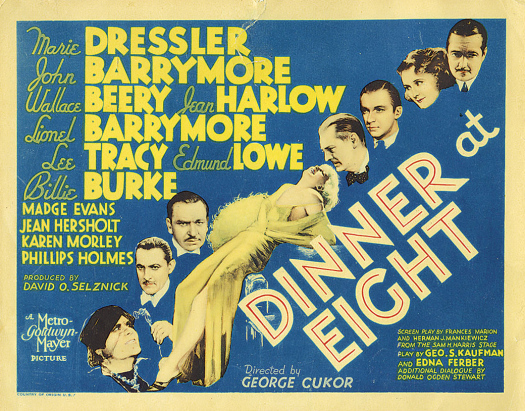
After the success of 1932’s all-star GRAND HOTEL, MGM studio boss Louis B. Mayer kept his sharp eyes peeled for a follow-up vehicle. The answer came with DINNER AT EIGHT, based on the witty Broadway smash written by George S. Kaufman and Edna Ferber. Mayer assigned his newest producer (and son-in-law) David O. Selznick, fresh from making hits at RKO, who in turn handed the director’s reigns to another MGM newcomer, George Cukor. Both would have long, prosperous careers there and elsewhere. Frances Marion and Herman Mankiewicz adapted the play to the screen for the studio with “more stars than there are in heaven”, and those stars truly shine in this film (in the interest of fairness, the stars will be presented to you alphabetically):
John Barrymoreas Larry Renault
The Great Profile plays aging, alcoholic former silent star Larry Renault in a role that surely hit close to home.
The fourth film in Mill Creek’s Fabulous Forties box set was 1941’s Topper Returns. Topper Returns was the third (and final) film to be made about Cosmo Topper (Roland Young). Cosmo Topper is an upper class and mild-mannered banker who likes to collect automobiles and who is married to the somewhat daffy Clara (Billie Burke). Cosmo would seem to be a pretty normal guy, except for the fact that he can talk to dead people. In the first Topper film, a ghost played by Cary Grant helped him to learn how to appreciate life. In the second Topper film, Topper Takes A Trip, a ghost played by Constance Bennett helped to save Topper and Clara’s marriage. And in this Topper film, a ghost helps …. well actually, the ghost doesn’t help Topper out at all. Instead, Topper helps the ghost solve her own murder.
When Gail Richards (Joan Blondell) visits her friend Ann Carrington (Carole Landis) for the weekend, she has no idea just how weird things are going to get. First off, while Gail and Ann are riding in a taxi to the big and foreboding Carrington mansion, a mysterious man in black shoots out the taxi’s tires. Though the taxi crashes, both Gail and Ann survive and are able to hitch a ride from Ann’s neighbor, Cosmo Topper.
Once they get to the mansion, Gail meets Ann’s strange family. Gail loves the mansion and who wouldn’t, seeing as how it is big and dark and full of secret passageways? However, Gail makes the big mistake of switching beds with Ann. Later that night, when that man in black sneaks into the bedroom and attempts to stab Ann to death, he ends up killing Gail instead. When we next see Gail, she’s a ghost who can’t leave our world until her murder has been solved.
No worries! Gail isn’t that upset about being a ghost. In fact, she seems to be rather amused by it all. She floats right over to Topper’s house and demands that he come over and solve her murder. After some initial reluctance, Topper agrees. Topper sneaks into the Carrington mansion and gets to work searching for clues and attempting to solve the crime. Needless to say, it involves a lot of family secrets, hidden rooms, and dark passageways.
Now, I should admit that I haven’t seen the first two Topper films so I don’t know how Topper Returns compares to them. The majority of the reviews that I’ve read online seem to indicate that Topper Returns is widely considered to be inferior when compared to the first two films. It is true, as a lot of other reviewers have pointed out, that Topper himself occasionally seems almost superfluous to the film’s plot. At no point does he mention that he has a history of talking to ghosts and, if not for the fact that the film’s title is Topper Returns, it would be easy to believe that this film was the first appearance of the character.
But no matter! I enjoyed Topper Returns, mostly because I’d like to think that if I was ever murdered and came back as a ghost, I would manage to have as much fun doing so as Joan Blondell appears to be having in the role of Gail. Funny, likable, and quick-witted, Gail isn’t going to let a little thing like being dead keep her from having fun! I also appreciated that the film has a nicely morbid streak. Towards the end of the film, there’s a cheerful conversation between Gail and another ghost. Gail mentions that, as soon as the murder has been solved, she can go to Heaven and “you can go to…” Gail lets her voice trail off but still make a point of glancing down at the ground.
For a modern viewer, the most problematic part of Topper Returns is the character of Chauffeur, who is Topper’s African-American servant and who doesn’t even get a proper name even though he’s in about 80% of the movie. On the one hand, Chauffeur is written as a total racist stereotype and, as written, the majority of his lines will absolutely make you cringe. On the other hand, he’s also played by Eddie Anderson, a talented comedic actor who always played his servants in such a way as to suggest that they were actually a hundred times smarter than the white people they were working for. Though you may not like the way the character is written, it is possible to appreciate the subversive subtext that Anderson brings to his performance (a subtext which, undoubtedly, was not present in the original script). Anderson was best known for playing comedian Jack Benny’s sidekick and, at one point during Topper Returns, he announces that he’s sick of ghosts and that he’s going “return to Mr. Benny!”
Taken on its own 1941 terms, Topper Returns was an enjoyable old, dark house movie. Watch it for Joan Blondell having the time of her afterlife.
(For those following at home, Lisa is attempting to clean out her DVR by watching and reviewing 38 films by the end of this Friday. Will she make it? Keep following the site to find out!)
Do you know who Florence Ziegfeld was?
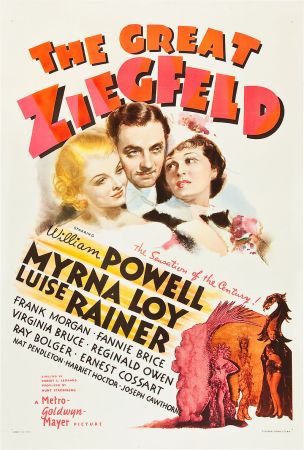
Don’t feel bad if you don’t because, until I saw the 1936 film The Great Ziegfeld, I had no idea and history is my number one obsession. Florence Ziegfeld was a theatrical producer who, in the early days of the 20th Century, produced huge spectacles. He was a showman who understood the importance of celebrity and gossip. He produced a show called The Ziegfeld Follies, which was considered quite risqué at the time but which looks remarkably tame today. Florence Ziegfeld was so famous that he even got his own Oscar-winning biopic.
The Great Ziegfeld features the always smooth William Powell as Ziegfeld. When we first meet him, he’s promoting a strongman and a belly dancer and nobody takes him seriously. But through hard work, good luck, and his own instinct for showmanship, he becomes famous and his shows gets bigger and bigger. The film follows Ziegfeld as he gets married, both times to someone he is grooming to be a star. His first wife is Anna (Luise Rainer), who loves him but divorces him when it becomes obvious that Ziegfeld’s life will always revolve around his work. His second wife is Billie Burke and we know that she is Ziegfeld’s true love because she’s played by Myrna Loy. Whenever you see William Powell and Myrna Loy in the same film, you know that they belong together.
The majority of The Great Ziegfeld is taken up with recreations of Ziegfeld’s stage shows. In fact, the film almost feels more like a musical variety show than a real biopic. (Judging from the credits, quite a few of Ziegfeld’s stars played themselves and recreated their acts on the big screen.) I can understand why this was attractive to audiences in the 1930s. With no end in sight to The Great Depression and Ziegfeld himself recently deceased, this movie was their only opportunity to see one of his spectacles. The film made sure that they got their money’s worth.
However, for modern audiences, all of the acts just add to what is already an oppressive running time. My main impression of The Great Ziegfeld was that it was really, really long. The movie itself is well-produced and William Powell and Myrna Loy are always fun to watch but the movie just goes on and on. As well, this biopic is so worshipful of Ziegfeld — the title is meant to be taken literally — that, as a result, he comes across as being one-dimensional. I did appreciate the film as a historical artifact but otherwise, it didn’t do much for me.
However, it did something for the Academy. The Great Ziegfeld was named the best picture of 1936! Luise Rainer won best actress despite only being on-screen for a handful of scenes. So many people were critical of Rainer’s award that, the very next year, the Academy introduced the award for best supporting actress.
As for why Ziegfeld won that Oscar — well, if you look at its competition and some of the other 1936 films that received nominations, you’re struck by the lack of truly memorable films. It would appear that, in a weak year, the Academy decided to give the award to the biggest production they could find.
And that was The Great Ziegfeld.
(Incidentally, if Flo Ziegfeld were alive today, he would probably be a reality TV producer.)
After I watched King Solomon’s Mines, I watched yet another 1950 best picture nominee, Father of the Bride.
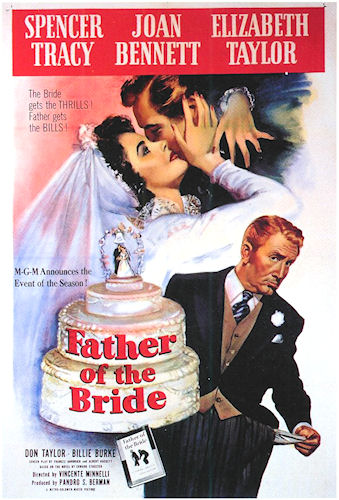
In Father of the Bride, Spencer Tracy plays a lawyer named Stanley Banks. As you might expect of any character played by Spencer Tracy, Stanley Banks is a no-nonsense type of guy. He’s set in his ways and not particularly enthusiastic about the idea of change. Stanley has worked hard to get a good job and a nice house in the suburbs. He loves his wife, Ellie (Joan Bennett) and is a firm but good father to his two boys, Tommy (Russ Tamblyn) and Ben (Tom Irish). If Stanley does have a soft spot, it’s for his daughter, Kay (17 year-old Elizabeth Taylor). Stanley admits that he’s always given Kay everything that she’s ever wanted and that she is his favorite of all his children.
However, Kay has been acting strangely as of late. She just seems to be so happy! Stanley can tell that she’s in love, though he has no idea with whom. (He is, however, happy that it’s probably not the bespectacled political radical who Kay apparently dated at some point in the past.) Finally, during an otherwise typical family dinner, Kay announces that not only is she in love but she’s also engaged to be married!
His name is Buckley (Don Taylor, who would later direct Escape From The Planet of the Apes and Damien: Omen II) and, at first, Kay refuses to even introduce him to her parents. Eventually, however, Stanley does meet Buckley and he’s happy to discover that not only does Buckley come from a wealthy family but he also owns a small business of his own.
However, just because Buckley is the perfect 1950 man, that doesn’t mean that the wedding is going to be easy. As a befuddled Stanley watches, the wedding grows more and more elaborate (not to mention, expensive!). All of the expected complications ensue: Buckley and Kay have a fight, a wedding planner makes things difficult, and Stanley does not immediately get along with Buckley’s parents. But, for the most part, Father of the Bride is about Stanley struggling to accept that his daughter has grown up and is ready to start a life of her own.
Father of the Bride is a sweet little comedy, though it seems a bit out-of-place as a best picture nominee. It’s definitely a film of its time. For all of the scenes of Stanley worrying about the extravagance of modern weddings, there’s not a subversive moment to be found in Father of the Bride. (One can only imagine what Nicholas Ray or Douglas Sirk would have done with the material.)
Fortunately, this is also a Spencer Tracy film and whatever gravitas that the film may have comes from Tracy’s honest and straight forward performance. Tracy never begs for laughs but he gets them anyway, because of the honesty that he brings to the character. Perhaps his best moment comes after Buckley and Kay have had a fight. After comforting his daughter, Stanley discovers that Buckley is at the front door. At first, the protective Stanley tells Buckley that Kay doesn’t want to see him. Suddenly, Kay comes running down stairs and embraces Buckley. Between sobs and kisses, Buckley and Kay dramatically swear to each other that they will never fight again. The camera pans over to Stanley, standing a little to the side and listening. At first, Stanley seems befuddled by how overdramatic the two of them are acting over a relatively minor fight but there’s also just a hint of sadness in Stanley’s eyes as he realizes that his daughter truly has moved on.
Father of the Bride was nominated for best picture but it lost to the far more subversive All About Eve.



 Through the Shattered Lens