The TSL Horror Grindhouse: Lord Shango (dir by Ray Marsh)


The 1975 film, Lord Shango, takes place in a small, rural town in the Deep South, where the population appears to be firmly divided between those who worship at an evangelical Christian church and those who follow the Yoruba religion.

(To answer the obvious question, I have no idea how faithful this film is to the realities of the Yoruba religion.)

Jenny (Marlene Clark), who is a waitress at a local restaurant, is a member of the evangelical church, largely because her boyfriend is a member and he thinks that her attending the church will help her to get pregnant.  Her daughter, Billie (Avis McCarther), is in love with Femi (Bill Overton), who is a follower of the Yoruba religion.  One Sunday morning, while all the church people sings hymns, a series of baptisms are held in a nearby river.  When it is time for Billie to baptized, Femi rushes into the water and objects.  After he shoves her out of the river, the men of the church grab Femi and announce that the evil must be taken out of him through what appears to be a forced baptism.  They force him under the water but, with Femi struggling, the end up holding him down for too long and Femi drowns.

Traumatized, Billie sinks into depression and Jenny grows disillusioned with the church, especially when the men who held Femi down refuse to take any responsibility for their actions.  She also learns that her boyfriend, Memphis (Wally Taylor), had sex with Billie after Billie mistook him for being the spirit of Femi.  When she finds Memphis praying in the church, she proceeds to yell and curse at him while he pathetically apologizes.

The next morning, Jenny wakes up to discover that Billie has run away, leaving behind a note that simply reads, “I can no longer live in your house.”  When the men of the church again prove to be insensitive and ineffectual when it comes to finding out where Billie has gone (and instead are more concerned about why Jenny and Memphis has not been coming to the prayer meetings), Jenny turns to Femi’s friend, Jabo (Lawrence Cook).  Under Jabo’s guidance, Jenny offers up a series of sacrifices to the local Yoruba priest (Maurice Woods) and asks for her daughter to return home.

The sacrifices appear to work.  Billie returns home and reveals that she’s pregnant with a baby that she believes to be Femi’s and which Jenny believes to be Memphis’s.  Jenny, now firmly under the control of Jabo, continues to make sacrifices and bad things continue to befall the men that she holds responsible for Femi’s death….

A frequently surreal film, Lord Shango is an interesting, if not always easy-to-decipher, portrayal of the battle of two different belief systems.  While the evangelical Christianity that Jenny first followed could only promise an eventual reward, Jabo’s tribal religion offers her immediate reward and revenge.  (Significantly, even though Billie was in love with Femi and wants to have his child, she has no interest in following his religion.)  The film is often edited to provide a direct contrast between the staged cermonies of evangelical Christianity and the sensuality of the Yoruba religion.  The film is full of Southern gothic atmosphere and is well-acted, particularly by Lawrence Cook and Marlene Clark.  That said, the film is also frequently very difficult to follow.  At times, one gets the feeling that the film is being surreal simply to be surreal and it’s hard to find a coherent message in the film’s collection of odd scenes and strange dialogue.

Lord Shango is a frequently intriguing film, as long as you’re willing to accept a little incoherence.

Horror Film Review: The Astral Factor (dir by John Florea)


Filmed in 1978 but not released until 1984, The Astral Factor tells the story of Roger Sands (Frank Ashmore).

Known as the Celebrity Killer, Roger is a serial killer who murdered women who reminded him of his famous mother.  It may seem like Roger is destined to spend the rest of his life in prison but what the legal system didn’t consider is that Roger has the ability to not only move things with his mind but to also turn himself invisible.  How did Roger get those powers?  Who knows?  At one point, Roger’s psychiatrist mentions that Roger was a student of the paranormal.  Later, it’s revealed that he had several books about the supernatural in his bedroom.  Apparently, Roger figured out how to do it himself.

Anyway, Roger is now invisible and soon, he has escaped from prison.  He is determined to kill the five women who testified against him at his trial, both because they remind him of his mother and also because he blames them for sending him to prison.  Roger strangles his victims, which in this case means that the actresses playing them have to pretend like they’re struggling with someone who can’t be seen.  In fact, Roger spends almost the entire film in a state of invisibility.

How do you catch a killer who can’t be seen?  It’s a fair question but police Lt. Charles Barnett (Robert Foxworth) might have the answer.  Barnett’s solution involves grabbing a gun and keep firing it until you hit something.  That’s a straight-forward solution but The Astral Factor is a pretty straight forward film.  The film begins with Roger turning invisible and, to its credit, it doesn’t spend too much time trying to justify or explain Roger’s magical powers.  The film understands that all the audience really needs to know is that Roger can’t be seen and that it’s up to Lt. Burnett to find a way to stop his killing spree.

The Astral Factor is a low-budget film, one that is full of formerly prominent performers who obviously showed up to get a quick paycheck.  Sue Lyon, Marianne Hill, Leslie Parrish, and Elke Sommer all play potential victims and all of them look like they would rather be doing anything other than appearing in The Astral Factor.  Robert Foxworth, to his credit, does his best to give a convincing performance as a level-headed cop who is forced to accept the reality of the paranormal.  Not only is he having to investigate a series of murders but he’s having to do it on his birthday.  Stefanie Powers plays his girlfriend, Candy.  Candy often refers to herself in the third person whenever she’s having a conversation with her boyfriend.  I tend to do the same thing so at least there was a character in this movie to whom I could relate.  Knowing the rules of the genre, I spent the entire movie expecting Candy to be put in danger and I was actually impressed when my expectations were subverted and that didn’t happen.

With the exception of a few atmospheric scenes and an entertainingly garish and tacky dance number, the film itself has the rather flat look of a made-for-TV movie, though the occasional hint of nudity indicates that it was meant to be a theatrical release.  As I mentioned at the start of this review, The Astral Factor was originally filmed in 1978 but it sat on the shelf until 1984.  That’s when a slightly shortened version was released under the title The Invisible Strangler.  Today, the film is available in countless Mill Creek Box Sets, under its original title and with its original run time restored.

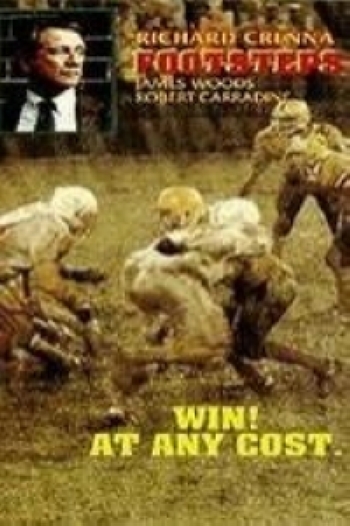
Footsteps (1972, directed by Paul Wendkos)


Paddy O’Connor (Richard Crenna) is a former football player-turned-coach whose record of success has been overshadowed by his own arrogance and heavy drinking.  O’Connor has such a bad personal reputation that he’s found himself unemployable.  Only one man is willing to give him a chance.  Jonas Kane (Clu Gulager) played football with Paddy and he’s now coaches for a small college.  Kane may not like O’Connor but he knows that O’Connor might be the key to turning around his team’s fortunes and, at the same time, saving Kane’s job.  Kane hires O’Connor to serve as a his defensive coordinator.

At first, O’Connor’s cockiness rubs people the wrong way.  It’s not until O’Connor moves offensive player J.J. Blake (Bill Overton) to defense that the team starts to win.  And once the team stars to win, everyone’s problems with O’Connor disappear.  Kane can only watch helplessly as O’Connor moves in on his girlfriend (Joanna Pettet), knowing that he owes his job to O’Connor remaining at the school.

However, when Blake gets a concussion, O’Connor is forced to decide whether or not to let him play.  Boosters like Bradford Emmons (Forrest Tucker) want Blake to play, regardless the risk.  The NFL scouts, who are looking for the next number one pick, want to see Blake on the field.  Blake says he wants to play but O’Connor can tell that he’s lying about the extent of his injury.  With everyone breathing down his neck and a syndicate of gamblers pressuring O’Connor to shave points so that the spread pays off, O’Connor has to decide what to do.

Though this made-for-TV movie may not be as well-known as some other films, it’s one of the best movies ever made about college football.  Though it may be short (only 74 minutes), it still examines all of the issues that have always surrounded college football.  Despite not getting paid for their efforts, the players risk serious and permanent injury during every game, just on the slight hope that they might someday make it to the NFL.  The coaches, who are supposed to be looking after the players, are more interested in padding out their win-loss record and hopefully moving onto bigger and better-paying jobs.  Meanwhile, aging alumni and boosters demand that the team win at all costs, regardless of what happens to the men on the field.  Footsteps intelligently explores all of those issues and suggests that the risks are ultimately not worth the rewards.

Along with an intelligent script, Footsteps is helped by a talented cast.  Crenna and especially Gulager both give excellent performance as the two rival coaches.  Al Lettieri (Sollozzo from The Godfather) plays one of the gamblers.  Beah Richards plays Blake’s mother, who makes the mistake of believing O’Connor when he says that he’s going to always have Blake’s best interests at heart.  Ned Beatty has a small role as another assistant coach who is forced to make an important decision of his own.  Keep an eye out for Robert Carradine and James Woods, both of whom have tiny roles.

As far as I know, Footsteps has never officially been released on DVD.  I saw it late one night on the Fox Movie Channel.