In No Holds Barred, Hulk Hogan plays a professional wrestler who is best-known for his mustache, his thinning blonde hair, and for ripping his shirt in half when he climbs in the ring. Hulk Hogan is playing himself except that everyone in the movie calls him Rip Thomas. Why is Hogan renamed Rip Thomas? It seems strange because NoHolds Barred features “Mean Gene” Okerlund and Jesse “The Body” Ventura as themselves and there’s nothing about Rip that’s any different from Hulk Hogan’s own wrestling persona.
Rip is the World Wrestling Federation Champion and is loved by fans across the globe. Rip may be fierce in the ring but outside of the ring, he loves children and is devoted to looking after his younger brother, Randy (Mark Pellegrino). Tom Brell (Kurt Fuller), the evil owner of World Television Network, wants to harness the star power of Rip but, when Rip refuses to sign with WTN, Brell goes his own way and hires ex-convict Zeus (Tiny Lister) to star in The Battle Of The Tough Guys.
Rip still wants nothing to do with Brell, not even when Brell sends Samantha Moore (Joan Severance) to seduce him. In fact, Rip is such a beacon of goodness that he brings Samantha over to his side. But when Zeus puts Randy in the hospital, Rip has no choice but to seek revenge in the ring.
No Holds Barred is a movie with an identity crisis. It’s a pro wrestling movie that was made to capitalize on Hulkamania and a lot of the humor was meant to appeal to the kids who were a huge part of Hogan’s fanbase but it’s also a movie in which people die, Samantha is nearly raped, and Randy is crippled by Zeus. The movie lacks the sense of fun that has made professional wrestling a worldwide phenomena. The most surprising thing about No Holds Barred is that Hulk Hogan has very little screen presence. I don’t think anyone would expect him to be a great actor but he also shows little of the charisma that made him a phenomena back in the day. Especially when compared to the ferocious Tiny Lister, Hogan is just boring. Maybe that’s the difference between Rip Thomas and Hulk Hogan.
David Paymer has a small role in No Holds Barred, playing a nervous television executive. Out of the cast, Paymer was the only one who later went on to be nominated for an Oscar and Jesse Ventura was the only one to later be elected governor of a state, at least so far. Hulk Hogan’s only 71. He’s still got time.
I became obsessed with actor Charles Bronson in 1986 after receiving a VHS copy of DEATH WISH 3 as a Christmas present. Going along with that obsession was my desire to see every Charles Bronson movie that had ever been made. As much as I enjoyed re-watching DEATH WISH 3, it was always a treat when I could rent a different Bronson film at the video store. The current Bronson movie at the video store in 1987 that appealed to me as a 13 year old boy was MURPHY’S LAW, so I wanted to rent it as often as possible. There were even a couple of times when different friends asked me to spend the night, and I had one requirement for saying yes… that we rent MURPHY’S LAW! Y’all, don’t think too bad of me for this admission. Remember, I was only 13 years old, I couldn’t drive, and I didn’t have a job so if I had to use a friend’s mom to get my Bronson fix, that’s just what I had to do! Based on the timing of my initial Bronson obsession, DEATH WISH 3 and MURPHY’S LAW are 1-2 in the films that I’ve watched the most times during my life.
In MURPHY’S LAW, Charles Bronson plays Jack Murphy, a tough cop who seems to be experiencing a series of unfortunate events:
A thief named Arabella McGee (Kathleen Wilhoite) tries to steal Murphy’s car and drives it through the window of a pizzaria. We know that’s his car because he loudly proclaims, “That’s MY car!!” He even wastes money on a sack of groceries by throwing it at his car while she’s driving away. He’s able to chase her down on foot, but she kicks him in the testicles and runs off leaving him doubled over in pain, grocery-less, and clutching the family jewels!
A mafia kingpin named Frank Vincenzo (Richard Romanus) wants to kill him because Murphy was forced to shoot and kill the kingpin’s brother. We know the cop and the kingpin don’t like each other, because a little before the shooting they have a slight disagreement in front of the mafioso’s mother over whether the brother is a scum-sucking pimp or a talent agent. Unable to resolve the debate amicably, the mafioso inquires as to whether or not Jack has ever heard of “Murphy’s Law, if anything can possibly go wrong it will?” Murphy responds with an alternative version of Murphy’s Law, the only law that he knows, and one that I greatly prefer. You get the feeling that this argument may be revisited later in the film.
Murphy’s now ex-wife Jan (Angel Tompkins) is performing extremely artistic striptease routines at a local club called Madam Tong’s. She’s also making love to the manager of the club. Rather than drinking at home alone until he passes out like most depressed men, Murphy hangs out at Madam Tong’s watching her shake her goodies for a bunch of horny lowlifes, before following them home and watching from outside until they turn off the bedroom lights. Very sad indeed.
And here’s the worst part, on one of those typical nights where he’s obsessively stalking his wife, another mystery woman (Carrie Snodgress) knocks him in the head, shoots the slimy manager and Mrs. Murphy with his gun, and then frames him for their murders. Arrested for the murders and subsequently handcuffed to the thief who tried to steal his car, Murphy must stage a daring helicopter jailbreak in order to find out who framed him and clear his name before everything and everyone he holds dear is taken from him!
There are several reasons that I loved MURPHY’S LAW back in the eighties, and that I still enjoy it now. First, of course, is Charles Bronson. He was around 64 years old when he filmed MURPHY’S LAW, but he’s still in great physical condition in 1986. One of Bronson’s greatest strengths is his screen presence, and he still dominates each frame he’s in. Second, the film has an excellent supporting cast. Carrie Snodgress is having a ball playing the main villain in the film. I’ve seen her in quite a few movies, like PALE RIDER with Clint Eastwood, and 8 SECONDS with Luke Perry, but I’ve never seen her in a role like this. Snodgress was nominated for an Oscar for her role in a 1970 film called DIARY OF A MAD HOUSEWIFE. I’ve never seen that one before, but I should probably check it out! I love Kathleen Wilhoite as Arabella McGee, the thief who ends up handcuffed to Bronson. Her vocabulary, while probably not very realistic for the streets of LA at the time, was hilarious to me as a teenager. I enjoy calling the people I love “snot licking donkey farts” on occasion to this very day. It’s Kathleen Wilhoite singing the title song over the closing credits! And Robert F. Lyons is very special to me in his role as Art Penney, Jack Murphy’s partner. We got to interview him on the THIS WEEK IN CHARLES BRONSON podcast about his roles on DEATH WISH 2, 10 TO MIDNIGHT, and MURPHY’S LAW. He was so generous with his time, and just a hell of a nice guy! I’ve attached a link to the YouTube video of the interview with Mr. Lyons if you’re interested in the great stories he tells us about his time in Hollywood! Finally, MURPHY’S LAW was directed by J. Lee Thompson, my personal favorite director who worked with Bronson. Thompson directed Bronson in 9 different films, beginning with ST. IVES in 1976 and ending with KINJITE: FORBIDDEN SUBJECTS in 1989. No matter the material, you always knew that Thompson would deliver a film with a certain quality that made Bronson look good!
I’ll always be a fan of MURPHY’S LAW, partly for nostalgic reasons, but mainly because I think it’s an entertaining mid-80’s action film for Bronson at a time when he was one of the kings of the video store!
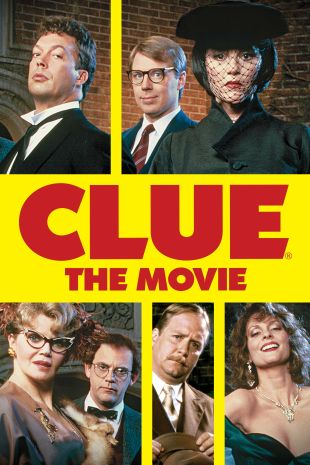
The 1985 comedy, Clue, opens with a set of six strangers arriving at an ominous mansion in New England. They’re meet by Wadsworth (Tim Curry), an oddly charismatic butler who explains that all six of the strangers have a few things in common. They all work in Washington D.C. They are all, in some way, involved with the government. And they’re all being blackmailed by Mr. Boddy (Lee Ving), the owner of the house.
The six strangers have all been assigned nicknames for the night.
Miss White (Madeleine Khan) is the enigmatic widow of a nuclear physicist who may have had communist sympathies. Actually, Miss White is a widow several times over. All of her husbands died in circumstances that were a bit odd. Is Miss White a black widow or is she just unlucky? And what about the flames of jealousy that she occasionally mentions?
Professor Plum (Christopher Lloyd) is a psychiatrist who once worked for the World Health Organization and who has an unfortunate habit of sleeping with his patients.
Mr. Green (Michaele McKean) explains that he works for the State Department and that he is also secretly gay. If his secret got it, he would be deemed a security risk or perhaps even a communist agent.
Mrs. Peacock (Eileen Brennan) is the wife of a U.S. Senator who forced to resign after getting caught up in a bribery scandal.
Colonel Mustard (Martin Mull) is a somewhat stuffy war hero-turned-arms dealer.
And finally, Miss Scarlet (Lesley Ann Warren) is Washington D.C.’s most powerful and most witty madam.
Once everyone is in the house, Wadsworth explains that the police have been called and will arrive in 45 minutes, at which point Mr. Boddy will be arrested and everyone’s secrets will be exposed. Mr. Boddy’s solution is to suggest that one of the six kills Wadsworth. After tossing everyone a weapon, Mr. Boddy turns out the lights. When the lights come back on, Wadsworth is still alive but Mr. Boddy is not. But who murdered Mr. Boddy? And in what room? And with what weapon? And what to make of the other people who were either in the house or show up at the front door, like the maid, Yvette (Collen Camp), or the motorist (Jeffrey Kramer) who shows up to use the phone or the traveling evangelist (Howard Hesseman)? Can the mystery be solved before the police show up and presumably arrest everyone?
Based on the old board game, Clue is a hilariously exhausting film, one that mixes smart wordplay and broad physical comedy to wonderful effect. It’s not often that you see a film that gets equal laughs from two people colliding in a hallway and from characters accusing each other of being communists. In fact, it’s so easy to marvel at the physical comedy (especially the lengthy scene where Tim Curry runs from room to room while explaining his theory about who committed the murders) that it’s easy to forget that the film is also a sharp satire on political corruption, national paranoia, 50s morals, and the McCarthy era in general. Since all of the characters are already convinced that they’re either surrounded by subversives or in danger of being accused of being a subversive themselves, it’s not a great leap for them to then assume that any one of them could be a murderer. I mean, if you’re willing to betray your country than who knows what you might be willing do in the study with a candlestick?
The cast is full of comedy veterans, all of whom know how to get a laugh out of even the mildest of lines and none of whom hold back. Madeline Kahn, in particular, is hilarious as Miss White though my favorite suspect, in both the game and the movie, has always been Miss Scarlet. Not only is she usually portrayed as being a redhead in the game but, in the movie, her dress is to die for. In the end, though, it’s perhaps not a surprise that the film is stolen by Tim Curry’s energetic performance. The film’s final 15 minutes are essentially a masterclass in physical comedy from Tim Curry but he’s just as funny when he’s delivering his frequently snarky dialogue. Both Wadsworth the character and Tim Curry the actor appear to be having a blast, running from room to room and shouting out accusations.
When Clue was originally released, it was released with three different endings. Apparently, the audience wouldn’t know which ending they were going to get before the movie started. I guess that the idea was to get people to go the movie three times to see each ending but I imagine few filmgoers had the patience to do that and who knows how many viewers went to multiple showings just to discover that the randomly selected ending was one that they had already seen. I’m surprised that I haven’t come across any reports of riots breaking out. Fortunately, the version of Clue that is now available for viewing features all three endings. Of course, none of the endings make much sense. Hercule Poirot would demand a do-over, especially if he was being played by Kenneth Branagh. But the fact that it’s all so ludicrous just adds to the comedy. I watched Clue two Fridays ago with a group of friends and we had a blast. It’s definitely a movie that’s more fun when you watch it with other people.
(That said, as far as incoherent solutions are concerned, the third one was my favorite and I think Poirot would agree.)
As for the board game itself, I used to enjoy playing it when I was a kid. We had really old version from the 60s and I always used to imagine what all of the suspects were like when they weren’t being accused of murder. I always imagined that Mr. Green and Miss Scarlet probably had something going on. Today, I’ve got a special Hitchcock edition of the game. It’s all good fun, this never-ending murder mystery.
One of the earliest Blaxploitaion films is TROUBLE MAN, a 1972 entry about Mr T…
…no, not THAT Mr. T! THIS Mr. T…
Thank you! This Mr. T is played by Robert Hooks, a tough talking private eye who drives a big-ass Lincoln Continental and “fixes troubles” on the mean streets of L.A. T gets hired by gangsters Chalky Price and Pete Cockrell to protect their crap games, which are getting ripped off by masked gunmen. Things go awry when Chalky shoots one of the heisters, a dude named Abby who works for rival gangster “Big”. Abby’s body is dumped and word is on the streets T did the killing. Police Capt. Joe Marx puts the heat on T, as does “Big”, so T arranges a late night summit between “Big”, Chalky, and Pete at Jimmy’s Pool Hall . “Big” arrives, but before Chalky and Pete do, some cops raid the joint. These…
 In No Holds Barred, Hulk Hogan plays a professional wrestler who is best-known for his mustache, his thinning blonde hair, and for ripping his shirt in half when he climbs in the ring. Hulk Hogan is playing himself except that everyone in the movie calls him Rip Thomas. Why is Hogan renamed Rip Thomas? It seems strange because No Holds Barred features “Mean Gene” Okerlund and Jesse “The Body” Ventura as themselves and there’s nothing about Rip that’s any different from Hulk Hogan’s own wrestling persona.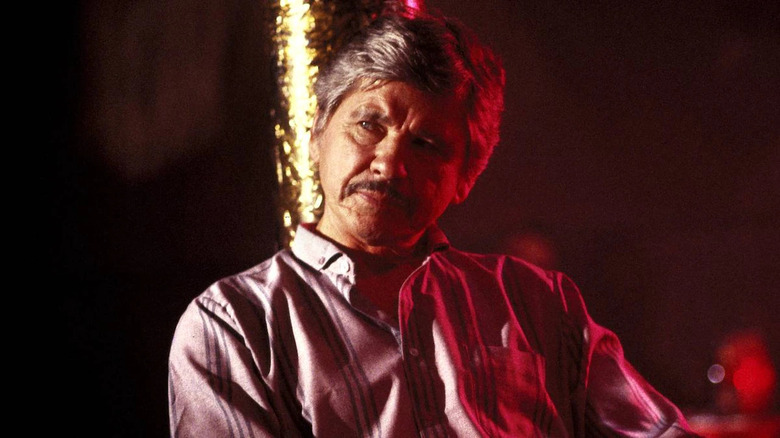


 Through the Shattered Lens