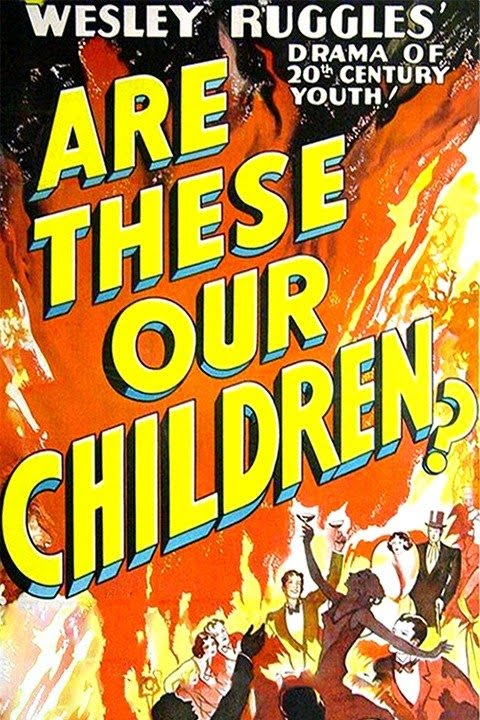
Film Review: Are These Our Children? (dir by Wesley Ruggles)


This 1931 film, Are These Our Children?, tells the story of Eddie Brand (played by Eric Linden).

Eddie was a good kid, a teenager who never had any trouble with the law and who, at one time, seemed to have a bright future ahead of him.  He came from a fine family.  They may not have been rich but they were respected around the neighborhood in New York where they lived.  It even looked like Eddie could have gone to city college and gotten a job with the parks department or something else like that.  A good job, with a pension!  Instead, Eddie Brand ended up on death row.  How did it happen?

Well, according to this film, it all begins with a high school speech contest.  All Eddie has to do is recite the Constitution from memory and …. well, I’m not really sure what Eddie is going to get out of it, beyond being known as the kid in the neighborhood who has memorized the entire Constitution.  Unfortunately, the speech contest doesn’t go as Eddie was hoping.  He forgets a few amendments and he loses his chance to be a high school big shot.  Having experienced the taste of failure for the first time in his life, Eddie decides to become a drunk.

No, seriously, that’s what happens.  Eddie starts out as a fine and upstanding citizen and then, one failed recitation later, he’s a loud-mouthed drunk who spends all of his time listening to jazz and hanging out with a bunch of other juvenile delinquents.  Of course, since this film is from the early 1930s, these are the best-dressed juvenile delinquents around.  Everyone wears a suit and a hat.  In fact, they seem to be trying to imitate the gangsters that they’ve seen in the movies.  Eddie, in particular, seems to think that he’s James Cagney.  ARE THESE OUR CHILDREN!?

One night, Eddie and the gang drop by a local store.  Though the owner may be a friend of Eddie’s family, that still doesn’t stop the drunk Eddie from impulsively shooting him.  When it appears that Eddie might get away with the murder, he and his friends start to get careless.  Eddie talks too much.  Eventually, they’re all arrested and put on trial.

Being put on trial for murder does nothing to straighten Eddie out.  He’s just as cocky as ever.  He even acts as his own counsel.  Interestingly enough, Eddie becomes a bit of celebrity.  The reporters love talking to him and the courtroom is full of Eddie Brand groupies.  And yet, everyone knows that Eddie is going to screw up eventually…..

Made during the pre-code era, Are These Our Children? is a social problem film that was supposed to leave audiences wondering what was wrong with those young kids, with their suits and their rat-a-tat dialogue.  Seen today, it’s an undeniably creaky and rather slow-moving affair.  Rather than being a victim of booze and bad friends, Eddie just comes across as being an idiot.  Director Wesley Ruggles uses a weird spiral effect to signify the passage of time and we also get one of those classic newspaper headline montages.  (“MURDER STILL UNSOLVED!” one reads.)  That said, the film does get a bit more interesting once Eddie is put on trial and he becomes a bit of a tabloid celebrity.  The film’s theme about how the media exploits crime and misery is just as relevant today as it was in 1931 and the scene in which the reporters instruct Eddie’s girlfriends on how to pose for their cameras is enjoyably cynical.

In the end, things don’t go well for Eddie.  The lesson here?  Don’t allow your children to join the Speech and Debate Club.  Only misery will follow!

Seriously …. ARE THESE OUR CHILDREN!?

An Offer You Can’t Refuse #1: The Public Enemy (dir by William Wellman)


For this month, I’ve decided to review movies about mobsters.

There’s no specific reason for that, beyond the fact that I just happen to love mobster movies.  Of course, a good gangster film is rarely just about crime.  Anyone who has ever seen The Godfather can tell you that.  At their best, American gangster films are about the American dream and the lengths that some will go to achieve it.

Plus, they’re just a lot of fun to watch.  Some of the greatest actors of all time made their mark in gangster films.

Take 1931’s The Public Enemy, for instance.

Produced during the final days of prohibition and the early years of the Great Depression, The Public Enemy tells the story of three boys who grew up poor.  Tom Powers (James Cagney) and his friend, Matt Doyle (Edward Woods) pursued a life of crime, rising through the ranks of organized crime before eventually meeting a tragic end.  The third, Mike Powers (Donald Cook), stayed on the straight-and-narrow path.  He went into the Marines and he rebuked his brother, Tom, when he discovered that Tom’s money was due to “blood and beer.”

The film opens and closes with a title card that basically tells us that Mike Powers has the right idea but, when you watch the film, you can’t help but wonder if maybe Tom had a point about his brother being kind of a sap.  Mike might be a decent citizen and he might have a chestful of medals as the result of his wartime heroics but what else does he have?  Tom Powers, meanwhile, has no education and, it would appear, no conscience, no real friends, and no one that he really loves and yet he becomes a rich man who is acquainted with powerful figures.  While Mike stays at home with their mother, Tom lives in an ornate penthouse.  When his first girlfriend (Mae Clarke) gets on his nerves, Tom shoves a grapefruit in her face and then gets an even more glamorous girlfriend, Gwen (Jean Harlow).  (Meanwhile, even dumb old Matt is doing okay for himself, marrying a woman played by Joan Blondell.)  It’s hard not to imagine that the film’s original audience — who were still reeling from the Stock Market Crash of 1929 — looked at Mike and Tom Powers and quickly decided that they’d much rather be a part of Tom’s life than Mike’s.  Even if Tom is destined for an early grave or a lifetime behind bars, at least he appears to be having fun.  Speaking for myself, I’d much rather go out with the guy who has nice clothe and his own luxury apartment than with the self-righteous dud who is still living at home with his mother.

Of course, another reason why we gravitate towards Tom Powers is because he’s played by James Cagney, who was one of the most charismatic of the stars of Hollywood’s Golden Age and whose performance still holds up today.  Cagney gives a ferocious performance, snarling out his lines and always moving like a caged animal, even when he’s just preparing to have breakfast.  He’s full of an energy that’s both dangerous and exciting to watch.  Cagney also brings a very powerful anger to the role of Tom Powers.  As played Cagney, Tom Power is not just a criminal because he’s greedy.  He’s also a criminal because he has no use for a society that he feels has rejected him since birth and which has never given him a fair chance.  He becomes wealthy not just because he wants money but because he wants to taunt everyone who ever said that he wouldn’t amount to anything.  He’s every crime is more than act of greed.  It’s also an act of rebellion, a joyful to a society that wants to tell people what they’re allowed to believe and do.  He’s the ultimate 1930s rebel, giving the the finger to not only the two Hoovers (Herbert and J. Edgar) but also to the good government leftists would be soon be swept into power with FDR.  Despite the fact that The Public Enemy was made nearly 90 years ago, there’s nothing creaky about Cagney’s performance.  It still feels vital and powerful today and it elevates the entire film.

The Public Enemy holds up surprisingly well.  The film may be close to 90 but Cagney’s ferocious performance still feels fresh and powerfully alive.


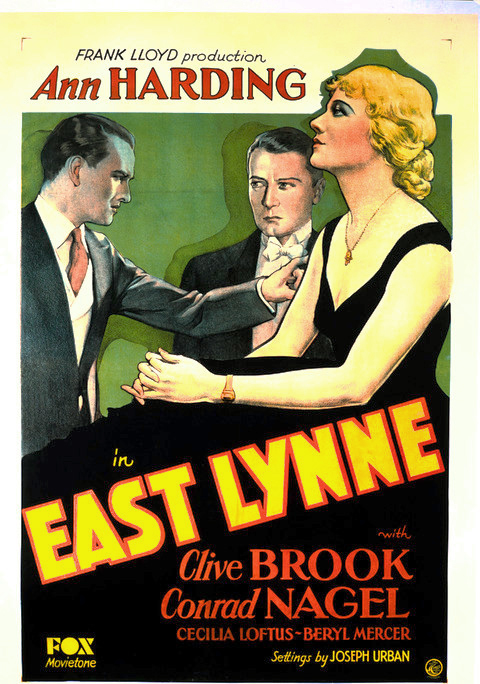
Lisa Reviews An Oscar Nominee: East Lynne (dir by Frank Lloyd)


In the history of the Academy Awards, East Lynne is a curiosity.

Released in 1931, East Lynne was one of the five films to be nominated for Best Picture at the fourth annual Academy Awards.  Best Picture was the only nomination that East Lynne received, which of course leaves you to wonder just what exactly was so good about it.  Why was it nominated as opposed to something like A Free Soul, which received nominations for Best Actress and Director and which won the Best Actor Oscar for Lionel Barrymore?  East Lynne was a success at the box office but so were The Public Enemy, Little Caesar, and Scarface.  None of those classic gangster films made much of an impression with the Academy but all of them are better remembered today than East Lynne.

One reason why East Lynne has fallen into obscurity is because it’s not an easy film to see.  There is only one complete print of East Lynne still in existence.  It’s housed at the UCLA’s Instructional Media Lab but it can only be viewed by appointment.  There are, however, a few bootleg copies on DVD.  The picture is grainy.  The sound is inconsistent.  Even worse, the bootleg is missing the last 12 minutes of the film.  Still, for those of us who don’t live near UCLA, that bootleg copy is the only convenient way to watch East Lynne.

That’s how I watched it.  (I also looked up how the film ended so I know where the story eventually led, despite those missing 12 minutes.)  Having now seen the film, I can now say that it makes even less sense that the film was nominated because it’s pretty bad.  I can only imagine that it received its nomination as a result of Fox Film Corporation (which would later merge with 20th Century Pictures to be come 20th Century Fox) demanding that its employees vote for it.

Based on a Victorian novel that had already been filmed several times during the silent era, East Lynne tells the story of Lady Isabella (Ann Harding), a British noblewoman who marries a stuffy attorney named Robert Carlyle (Conrad Nagel).  From the beginning it’s an awkward marriage.  Isabella is sociable and popular and wants to enjoy life.  Carlyle is a humorless jerk.  Not even the fact that they live in a nice mansion called East Lynne provides much comfort.

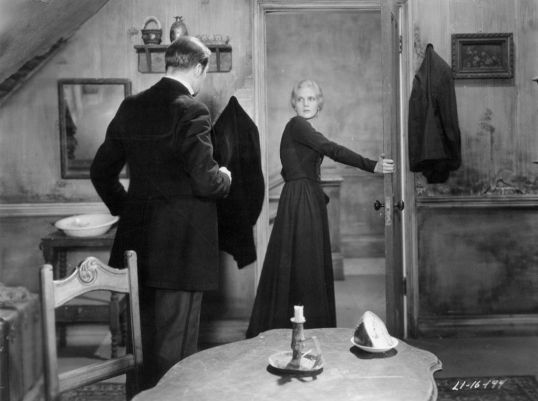
When Isabella accepts a kiss from a cad named Captain William Levinson (Clive Brook), Isabella’s sister-in-law uses it to drive a wedge between Isabella and Carlyle.  Carlyle, being a jerk, kicks Isabella out of the house and takes custody of their child.  Now viewed as being a figure of scandal, Isabella goes abroad with Levinson.  (Since this is a pre-code film, going abroad amounts to going to a then-racy show in Vienna.)  However, through a series of improbable events, Levinson ends up dead and Isabella ends up very slowly going blind.  However, Isabella is determined to see her child just once more before losing her sight so it’s up to her to convince a maid to sneak her back into East Lynne late at night….

And then the bootleg version of the film ends!  Now, I did my research and I discovered — here’s your SPOILER ALERT — that the film apparently ends with a blind Isabella stumbling over a cliff and her husband realizing too late that maybe he was kind of a jerk.  I’m kind of sorry that I didn’t get to see that.  I may have to book a flight to UCLA.

Anyway, from what I did see, East Lynne is a creaky old film.  This is one of those films where you can tell that the cast was still adjusting to the new sound era.  Ann Harding’s screen presence is a bit too insubstantial to keep the film’s melodramatic story grounded and neither Conrad Nagel nor Clive Brook seem to be worth all of the trouble that Isabella goes through.  Frank Lloyd’s direction is painfully slow and stagy, though things do pick up briefly when the action moves to Vienna.  Worst of all, the film is pretty much on Carlyle’s side.  He’s a jerk, the movie says, but Isabella should have made more of an effort to keep him happy.  Welcome to 1931!

East Lynne lost the best picture race to Cimarron, which was another fairly forgettable film.  Though there were plenty of good films to choose from in 1931, it doesn’t appear that the Academy nominated any of them.  Of course, that wouldn’t be the last time that would happen.


Horror on the Lens: The Hound of the Baskervilles (dir by Sidney Lanfield)


For today’s horror on the lens, we have 1939’s The Hound of the Baskervilles!

Based, of course, on the novel by Arthur Conan Doyle, The House of the Baskervilles is well-remembered for being the first of many Sherlock Holmes films to star Basil Rathbone as the detective and Nigel Bruce as his loyal sidekick, Dr. Watson.  Interestingly enough, Holmes is absent for a good deal of the film, leaving it up to Watson to do the majority of the investigating.  That said, you can still see why Rathbone’s interpretation of the character proved to be so popular that he would go on to play Holmes in a total of 14 movies and one radio series.

Enjoy!

Lisa Reviews an Oscar Winner: All Quiet On The Western Front (dir by Lewis Milestone)


all_quiet_on_the_western_front_1930_film_poster
“When it comes to dying for your country, it’s better not to die at all!”

— Paul Baumer (Lew Ayres) in All Quiet On The Western Front (1930)

Tonight, I watched the third film to ever win the Oscar for Best Picture, the 1930 anti-war epic, All Quiet On The Western Front.

All Quiet On The Western Front opens in a German classroom during World War I.  Quotes from Homer and Virgil, all exalting heroism, are written on the blackboard.  The professor, a man named Kantorek (Arnold Lacy), tells his all-male class that “the fatherland” needs them.  (It’s all very patriarchal, needless to say.)  This, he tells them, is a time of war.  This is a time for heroes.  This is a time to fight and maybe die for your country.  He beseeches his students to enlist in the army.  The first to stand and say that he will fight is Paul Baumer (Lew Ayres).  Soon, almost every other student is standing with Paul and cheering the war.  Only one student remains seated.  Paul and the others quickly turn on that seated student, pressuring him to join them in the army.  That seated student finally agrees to enlist, even though he doesn’t want to.  Such is the power of peer pressure.

A year later, a visibly hardened Paul returns to his old school.  He’s on furlough.  He’s been serving in a combat zone, spending his days and nights in a trench and trying not to die.  He’s been wounded but he hasn’t been killed.  He can still walk.  He can still speak.  He hasn’t gone insane.  He is one of the few members of his class to still be alive.  (That student who didn’t want to enlist?  Long dead.)  When Kantorek asks Paul to speak to his new class, Paul looks at the fresh-faced students — all of whom have just listened to Kantorek describe the glories of war — and Paul tells them that serving in the army has not been an adventure.  It has not made him a hero.  The only glory of war is surviving.  “When it comes to dying for one’s country, it’s better not to die at all!”  Kantorek is horrified by Paul’s words but he needn’t have worried.  The students refuse to listen to Paul, shouting him down and accusing him of cowardice and treason.

(This scene is even more disturbing today, considering that we live in a time when accusations of treason and calls for vengeance are rather cavalierly tossed around by almost everyone with a twitter account.)

What happened between those two days in the classroom is that Paul saw combat.  He spent nights underground while shells exploded over his head.  He watched as all of his friends died, one by one.  One harrowing night, spent in a trench with a French soldier who was slowly dying because of Paul stabbing him, nearly drove Paul insane.  In the end, not even his friend and mentor, Kat (Louis Wolheim), would survive.  From the first sound of bombs exploding to the film’s haunting final scene, the shadow of death hangs over every minute of All Quiet On The Western Front.  By the end of it all, all that Paul has learned is that men like Kantorek and the buffoonish Corporal Himmelstoss (John Wray) have no idea what real combat is actually like.

All Quiet On The Western Front may be 87 years old but it’s still an incredibly powerful film.  There are certain scenes in this pre-code film that, after you watch them, you have to remind yourself that this film was made in 1929.  I’m not just talking about a swimming scene that contains a split second of nudity or a few lines of dialogue that probably wouldn’t have made it past the censors once the production code started to be enforced.  Instead, I’m talking about scenes like the one where a bomb goes off just as a soldier attempts to climb through some barbed wire.  When the smoke clear, only his hands remains.  And then there’s the sequence where the camera rapidly pans by soldier after soldier falling dead as they rush the trenches.  Or the scene where Paul literally watches as one of his friends, delirious and out-of-his-mind, suddenly dies.  Or the montage where a pair of fancy boots is traded from one doomed soldier to another, with each soldier smiling at his new boots before, seconds later, laying dead in the mud.  Or the harrowing scene where Paul tries to keep a French soldier from dying.

All Quiet On The Western Front remains a powerful film.  It’s perhaps not a surprise that, when it briefly played in Germany, the Nazis released live mice in the theaters to try to keep away audiences.  (Both the film and the book on which it was based were later banned by the Nazi government.)  Sadly, we’ll never get to see All Quiet On The Western Front the way that it was originally meant to be seen.  A huge hit in 1930, All Quiet On The Western Front was rereleased several times but, with each rerelease, the film was often edited to appease whatever the current political climate may have been.  Over the years, much footage was lost.  The original version of All Quiet On The Western Front was 156 minutes long.  The version that is available today is 131 minutes long.  But even so, it remains a harrowing and powerful antiwar statement.

With all due respect to both Wings and Broadway Melody, All Quiet On The Western Front was the first truly great film to win the Oscar for Best Picture.  Sadly, it remains just as relevant today as when it was first released.

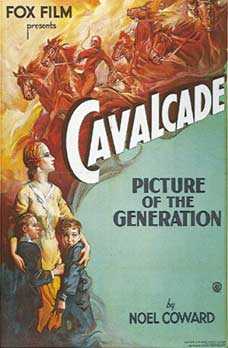
Cleaning Out The DVR, Again #11: Cavalcade (dir by Frank Lloyd)


Cavalcade_film_poster

So, I’ve been cleaning out the DVR for the past week.  Fortunately, I’m going to be off work for this upcoming week, which should give me a lot of extra film-watching time.  That’s a good thing because I’ve got 36 movies that I’ve recorded on the DVR since Thursday and, over the past seven days, I’ve only watched 13 of them!  That’s 23 movies to go and I hope to be finished by the end of the next week.

The 11th film that I found on my DVR was the 1933 film, Cavalcade.  I recorded it off of FXM on April 3rd.

The main reason that I recorded Cavalcade was because it was the 6th film to win the Oscar for Best Picture.  Now, I have to admit that I wasn’t expecting much from Cavalcade.  It’s a film that many Oscar historians tend to list as being one of the lesser best picture winners.  Cavalcade is often unfavorably compared to the films that it beat — movies like I Am A Fugitive From A Chain Gang, A Farewell To Arms, Little Women, and The Private Life of Henry VIII.  Cavalcade was the first British to ever win the Best Picture and its victory is often cited as the beginning of the Academy’s love affair with British productions.

And really, Cavalcade couldn’t be more British if it tried.  Based on a play by Noel Coward, Cavalcade follows two families through several decades in British history.  One family is wealthy and is anchored by a patriarch who is knighted in the Boer War.  The other family is lower middle class, anchored by a patriarch who starts out as a butler but who eventually manages to open up his own pub.  Through the eyes of these two families, we view what, in the 1930s, was recent British history.

For modern viewers, it may be helpful to watch Cavalcade while consulting Wikipedia.  For instance, the film starts with the two father figures preparing to leave to fight in the Boer War and I’m sorry to admit that I really wasn’t totally sure what that was.  I had to look it up in order to discover that it was a war that the British fought in South Africa.

But you know what?  That’s not really a complaint.  I may not have known what the Boer War was before I started the film but that had changed by the time that I finished watching Cavalcade.  Several times, I’ve mentioned on this blog how much I love history but watching Cavalcade made me realize that I still have more to learn.  Even more importantly, it encouragds me to learn.  That’s always a good thing.

Certain other historical events were more familiar.  As soon as I saw the title card announcing that the date was 1914, I knew that I would soon be seeing a World War I montage.  And, as terrible as World War I was (though, naturally, the film refers to it as being “the Great War,” and, for a few moments, I considered the fact that there was a time when nobody thought there would ever be a second world war), I was actually kind of happy for the montage because it got the characters out of the drawing room and out of the pub.  Cavalcade is a very stagey film.  Though there are a few attempts to open up the action, you’re always very aware that you’re essentially watching a filmed play.

Of course, the film’s best historic moment comes when a recently married couple goes on their honeymoon.  We see them standing on the deck of a cruise ship, talking about how much they love each other and how wonderful life will be.  They then step to the side and we see the name of the ship: RMS Titanic.

In many ways, those dismissive Oscar historians are correct about Cavalcade.  It’s stagey and it’s old-fashioned and some of the performances are better than others.  But, dammit, I liked Cavalcade.  As the upper class couple, Diana Wynyward and Clive Brook made for a likable couple and they got to exchange some sweet-natured dialogue at the beginning and the end of the film.   Add to that, it was a film about history and I love history.

Cavalcade is hardly a perfect film and it probably didn’t deserve to win best picture.  But it’s still better than its reputation suggests.

Embracing the Melodrama Part II #6: Berkeley Square (dir by Frank Lloyd)


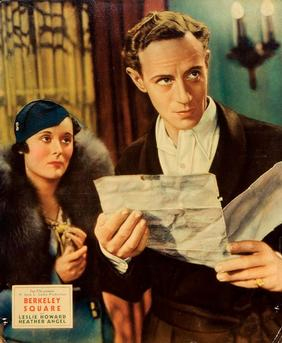
Berkeley_Square_(1933,_Lobby_Card)For today’s final entry in Embracing the Melodrama Part II, we take a look at the 1933 film, Berkeley Square.

Berkeley Square opens in 1784.  An American named Peter Sandish (Leslie Howard) has come from New York to England.  Stopping off at an inn, he explains that he’s on his way to London.  He has distant relations who live in a mansion located in Berkeley Square and it’s been arranged that Peter is going to marry his cousin, Kate Pettigrew (Valerie Taylor).  As Standish talks, he’s interrupted by another man who excitedly announces that a Frenchman has flown across the English Channel in something called a “balloon.”

“It’s beginning,” Peter says, “A new age of speed and innovation…”

Suddenly, the film jumps forward over a hundred years.  In 1933, Standish’s descendant — also named Peter and also played by Leslie Howard — has inherited the family’s old house at Berkeley Square.  He’s spent several days locked away in the mansion, obsessively reading the first Peter’s diary and refusing to see his fiancée, Marjorie (Betty Lawford).

It turns out that Peter — much like Owen Wilson in Midnight in Paris — is frustrated with the modern world and desperately wants to live in the past.  He believes that if he continues to stay in the house, he will eventually be transported back to 1784.  When a friend points out that, even if time travel was possible, Peter would end up changing the past, Peter explains that he’s memorized the first Peter’s diary and, therefore, he knows everything that he needs to say and do.

And then, one night, Peter suddenly does find himself in 1784.  Having taken his ancestor’s place, he meets the Pettigrews, makes plans to marry Kate, and attempts to adapt to 18th century London society.

Unfortunately, this turns out to be not as easy as he thought.  Despite his best efforts, Peter keeps using 1930s slang and alluding to events that will happen in the future.  At first, he explains away his habit of using modern phrases by saying that he’s using common New York expressions.  However, the increasingly suspicious Kate takes a list of Peter’s phrases to the U.S. Ambassador (who is none other than future President John Adams) and is informed that nobody in New York speaks that way.  As well, Peter’s insistence on regular bathing is viewed as odd by the members of upper class London society.  (“I heard he used three buckets of water,” someone accusingly whispers.)  Soon, Kate is convinced that Peter has been possessed by a demon.

An even bigger problem for Peter is that he’s not in love with Kate.  Instead, he’s fallen in love with Kate’s headstrong younger sister, Helen (Heather Angel).  When Helen discovers that Peter is from the future, Peter is forced to decide whether to continue to stay among the “living ghosts” or whether to return to his own time.

Berkeley Square shows on up on TCM fairly frequently and I absolutely love it.  To a certain extent, of course, this is because I’m a secret history nerd and there’s a part of me that will always wish that I could travel in time and experience the past firsthand.  (That said, after watching Berkeley Square, I don’t think I could handle 18th century hygiene.  Agck!)  But the main reason that I love Berkeley Square is because I love a good romance.  And this is such a romantic film!  Heather Angel and Leslie Howard have a really sweet and likable chemistry and, with his performance here, Howard shows why he would be the perfect choice to play the earnest, well-meaning, and ultimately tragic Ashley Wilkes in Gone With The Wind.

Keep an eye out for Berkeley Square.  You won’t be sorry.