The Pumaman (1980, directed by Albert De Martino)


Dr. Kobras (Donald Pleasence) has got an evil scheme.  He’s going to use an ancient gold mask to take over people’s mind and eventually take over the world.  Only the Pumaman, a man who has inherited God-like powers, can defeat Dr. Kobras and keep the mask from falling into the wrong hands.  Unfortunately, Prof. Tony Farms (Walter George Alton) doesn’t understand that he’s the Pumaman.  Vadinho (Miguel Angel Fuentes), an indigenous shaman, travels to London to convince him.

Perhaps the worst super hero movie ever made, Pumaman was an attempt to cash in on the popularity of the Superman movies.  Pumaman didn’t start out in a comic book.  He was created directly for the screen and his first movie was obviously meant to be the start of many adventures.  It didn’t work out that way.  Pumaman has plenty of fantastic powers but he’s not sure how to use them and he spends a lot of the movie complaining.  He might as well just be called Whinyman.  From the minute that he meets Tony, Vadinho has an expression on his face that reads as, “I’ve made a terrible mistake.”  Beyond Pumaman just being plain unlikable, the movie also features some of the worst special effects that I’ve ever seen.  The success of a film like that depends on whether or not you believe that a man can fly.  Pumaman flies but he looks really stupid doing it.  That was the failure of Pumaman.

How bad is Pumaman?  Even Donald Pleasence looks embarrassed.  Pleasence always made a good villain.  He set the standard for Bond villains in You Only Live Twice.  Pleasence also had the right sensibility for a good super hero film.  If he had been born a decade or two later, he would have been equally well-cast as either Professor X or Magneto in the first X-Men film.  In Pumaman, he rolls his eyes while delivering his lines.  Not even he can believe this movie.

Pumaman saved the day and then disappeared.  Earth already had enough heroes.
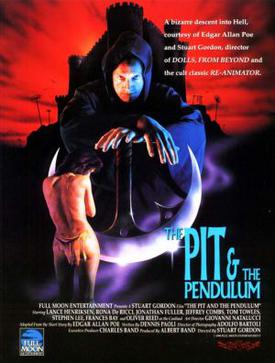
Horror Film Review: The Pit and the Pendulum (dir by Stuart Gordon)


AGCK!

That was my reaction when I watched the 1991 film, The Pit and the Pendulum.  Based very narrowly on several Edgar Allan Poe short stories, The Pit and the Pendulum takes place at the height of the Spanish inquisition.  Despite the objections of the Pope, Grand Inquisitor Torquemada (Lance Henriksen) is leading a reign of terror though 15th Century Spain.  In his torture chambers, Torquemada forces confessions from accused witches and other criminals.  The dirty prison cells are full of starving and beaten partners.  Witches are burned at the stake and explode while the crazed citizenry calls for blood and Torquemada tests out new torture devices.

Torquemada presents himself as being a grim and emotionless man, someone who is above all sin and who is allowed to sit in judgment of the people who are brought before him.  However, Torquemada is hardly the sinless figure that he portrays himself as being.  His actions are fueled by his repressed lust and his anger.  Maria (Rona De Ricci) has been brought before him, accused of being a witch and Torquemada is determined to get her to confess.  Maria’s refusal to be broken by Torquemada only increases Toquemada’s anger but, at the same time, Torquemada has also decided that he’s in love with Maria.  While Maria waits in the prison and takes advice from the witch Esmerelda (Frances Bay), Maria’s husband, Antonio (Jonathan Fuller), attempts to break Maria out of prison.  When Antonio is captured, Torquemada decides to try out his latest device, a swinging and sharpened pendulum that hangs in a pit….

The Pit and the Pendulum is not always an easy movie to watch.  I have to admit that I spent the majority of the movie with my hands over my eyes, not wanting to watch the extremely graphic torture scenes.  Like many of director Stuart Gordon’s film, The Pit and the Pendulum is gripped by an atmosphere of pervasive corruption and the movie captures the feeling of not being able to escape from the worst place on Earth.  Poor Maria spends a good deal of the movie naked and chained to various devices but Rona De Ricci gives such a strong and such a committed performance as Maria that, instead of being offended by the obvious exploitation element of the scenes, you instead find yourself admiring Maria and her strength.

It’s probably not a coincidence that Oliver Reed shows up in the film as a Cardinal because The Pit and the Pendulum, with its portrayal of blood frenzy and hypocrisy, is definitely influenced by Ken Russell’s The Devils.  The imagery is graphic and often disturbing but the most memorable thing about the film is Lance Henriksen’s intense performance as the evil Torquemada.  Henriksen plays Torquemada as being a hateful and self-loathing figure, a man who deals with his own demons by bringing his fury down on the innocent.  It’s a truly frightening villainous performance, one that carries shades of Vincent Price’s excellent performance in The Witchfinder General.

The Pit and the Pendulum is not an easy film to watch and I doubt I’ll watch it a second time.  In the end, it’s a disturbing film but one that definitely leaves an impression.