Back To School #11: The Last Picture Show (dir by Peter Bogdanovich)


Monday is the first day of school down here in Dallas so it seems only appropriate that this latest entry in our Back to School series should be a look at one of those most quintessential Texas films ever made, the 1971 best picture nominee, The Last Picture Show.

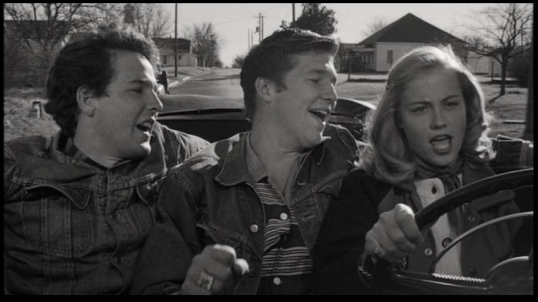
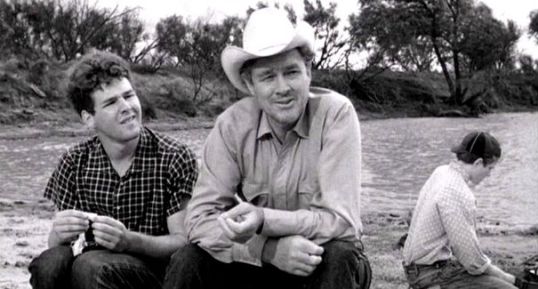
Directed by Peter Bogdanovich and based on a novel by Larry McMurtry, The Last Picture Show takes place in 1951 and tells the story of two high school seniors, best friends Sonny Crawford (Timothy Bottoms) and Duane Jackson (Jeff Bridges, reminding us once again why everbody loves him).  Sonny and Duane live in the rural town of Anarene, Texas.  With little to look forward to in the future, beyond perhaps getting a job working in the oil fields, Sonny and Duane are both intent on enjoying their final year of high school.  Sometimes, that means driving down to Mexico for the weekend.  Sometimes, it means going to the only theater in town and seeing a movie.  Most of the time, however, it means hanging out in a pool hall owned by the strict but fatherly Sam (Oscar winner Ben Johnson).  Often times they are accompanied by the intellectually disabled Billy (Sam Bottoms), who responds to everything with a blank smile and spends most of his spare time wandering around with a broom, futilely trying to sweep the dusty streets.
last-picture-show

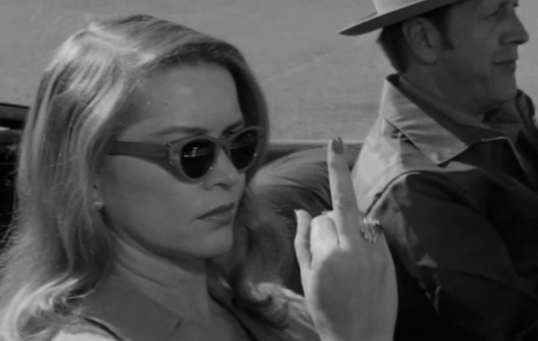
The charismatic and impetuous Sonny is dating the beautiful and self-centered Jacy Farrow (Cybil Shepherd), who is the daughter of the wealthiest woman in town.  Jacy knows that her cynical mother (Ellen Burstyn) is having an affair with an oil worker named Abilene (Clu Gulager) but she’s more concerned with her own future.  Even though she’s dating Sonny, Jacy still accepts an invitation from the awkward Lester Marlow (played by a memorably goofy Randy Quaid) to attend a naked indoor pool party.  At the party, she meets Bobby Sheen (Gary Brockette), who is rich and will be able to provide her with the future that Duane never will.  However, Bobby tells Jacy that he isn’t interested in her because she’s a virgin.  If nothing else, this gives Jacy a reason to stay with Duane, at least until after they have sex.

Meanwhile, the far more sensitive Sonny ends up having an affair with Ruth Popper (Cloris Leachman, who won an Oscar for her performance in this film), the wife of the high school football coach.  It appears that Sonny truly cares about Ruth but then he finds himself being tempted by none other than his best friend’s girlfriend…

Sonny and Ruth

At heart, The Last Picture Show really is basically a small town soap opera, a Texas version of Peyton Place.  The difference between the two films — beyond the fact that The Last Picture Show just happens to be a 1oo times better than Peyton Place — is that The Last Picture Show doesn’t take place in a beautiful, idealized small town.  Instead, the town of Anarene is a believably bleak location, one that will be familiar to anyone who, like me, grew up in the American southwest.  A good deal of the success of The Last Picture Show is due to the fact that it was actually filmed on location in Archer City, Texas.

(Nothing annoys me more than when I see the mountains of California in the background of a movie that’s supposed to be taking place in North Texas.  We don’t have mountains up here.  For the most part, we don’t even have hills.  The land is flat.  You can see forever, if you know where to look.)

Of course, you can’t talk about The Last Picture Show without talking about Robert Surtees’s stunning black-and-white cinematography.  Not only does the black-and-white remind us that this is a film about a fading way of life but it drives home the fact that Sonny and Duane don’t have much to look forward to.  Growing up in Anarene means they are destined for lives without color or excitement.  In the end, can you really blame them for occasionally acting before they think?
Ben Johnson

Ultimately, the success of The Last Picture Show is due to a lot of things.  This was Peter Bogdanovich’s second film as a director and he did such an excellent job here that he’s basically spent the rest of his career trying to live up to this one film.  (That said, Bodganovich also left his wife for Cybill Shepherd — despite the fact that his wife was the one who suggested that he make this film and cast Cybill in the first place!  Don’t worry though — Polly Platt got her revenge by having a far more successful career than her ex-husband and she even produced Say Anything, a film that we will soon be looking at.)  The screenplay, by McMurtry and Bogdanovich, is full of sharp dialogue and memorable characters.  As for the performers, this is probably one of the best acted films ever made.  Jeff Bridges and Timothy Bottoms play off each other well, Cybill Shepherd is the epitome of casual destructiveness, and Ben Johnson is brilliantly cast as the film’s moral center.  My favorite performance comes from Ellen Burstyn, who delivers every line with just the right combination of contempt and ennui.
Ellen Burstyn in The Last Picture Show

Ellen Burstyn in The Last Picture Show

If you’re a Texan, The Last Picture Show is one of those films that you simply have to see.  And if you don’t enjoy it and if you don’t relate to at least a few of the characters (I related to Jacy, though I like to think that I’m a lot nicer in the way I treat people), then you’re not a real Texan.

It’s as simple as that.

the-last-picture-show-poster


The Daily Grindhouse: The Town That Dreaded Sundown (dir. by Charles B. Pierce)


Down here in Texas, we love our legends and the Phantom Killer is one of the most haunting.  In 1946, as American soldiers were returning from World War II and the country was looking forward to a future of peace and prosperity, an unknown killer stalked the moonlit streets of my former hometown of Texarkana, Texas.  (Technically, of course, Texarkana is located in both Texas and Arkansas.  In Texas, it’s usually assumed that the killer had to be from the Arkansas half of the town.)  From February until May, he attacked 8 people and killed 5 of them.  He stalked lovers who were parking at night and those that survived said that he hid his face underneath a white mask.  Despite the best efforts of both the Texas Rangers and the Texarkana police, the Phantom Killer was never captured and his reign of violence ended just as mysteriously as it began.

(My personal theory is that he ended up moving to California where he later became the Zodiac killer because, seriously, the two cases are so disturbingly similar.  Eventually, he left California and moved to Ohio and, living under a false name, he killed himself in 2002. )

When you read the facts of the Phantom Killer’s murder spree (not to mention all of the rumors and urban legends that have sprung up around the case), the main thing that jumps out at you is just how much it all truly does sound like a low-budget horror film.  Therefore, it’s not surprising to discover that, in 1976, the case served as the basis for just that.  What is surprising is just how effective The Town The Dreaded Sundown is.

The film was directed by Charles B. Pierce, an independent filmmaker who was based in Arkansas.  Pierce had previously directed The Legend of Boggy Creek, a “documentary” that was about the mysterious Bigfoot-like creature who is rumored to live in Fouke, Arkansas.  (Fouke, incidentally, is a town that my family briefly called home though none of us ever saw or heard any Bigfoots wandering about.)  Using the money that he made off of the Boggy Creek film, Pierce wrote, directed, and produced The Town The Dreaded Sundown.

Using the same technique that made The Legend of Boggy Creek such a success, Pierce filmed The Town That Dreaded Sundown on location in Texarkana and, along with established actors like Ben Johnson, Andrew Prine, and Tina Louise Dawn Welles, Pierce cast the film with local citizens.  When seen on screen, it’s obvious that these citizens are not professional actors.  However, what they may lack in talent they make up for authenticity.  (If nothing else, The Town That Dreaded Sundown is a rare Texas-set film in that it doesn’t feature any yankees butchering the dialect.)  The fact that the film is narrated by a grim-sounding narrator only adds to the film’s documentary-like feel.

Admittedly, the film does take some liberties with the story of the Phantom Killer but what’s important is that it’s accurate when it matters.  The film gets the basic facts correct and even the most outlandish of embellishments (such as a scene where the killer uses a trombone to kill one of his victims) don’t detract from the film’s power to frighten and disturb.  If nothing else, these feel like the type of details that one might spontaneously mention while telling an old ghost story.  Unlike a lot of “true crime” films, The Town The Dreaded Sundown never devotes too much time to trying to figure out the killer’s motives or drop hints as to his identity.  Instead, the film emphasizes the fact that the Phantom Killer could never be understood and was never stopped.  He simply existed, a malevolent force of evil.  This makes the film far more effective than it would have been if Pierce had spent the movie trying to explain that which can not be explained.

Unfortunately, The Town That Dreaded Sundown has never been released on DVD but it does show up occasionally on TCM.  Keep an eye out for it!

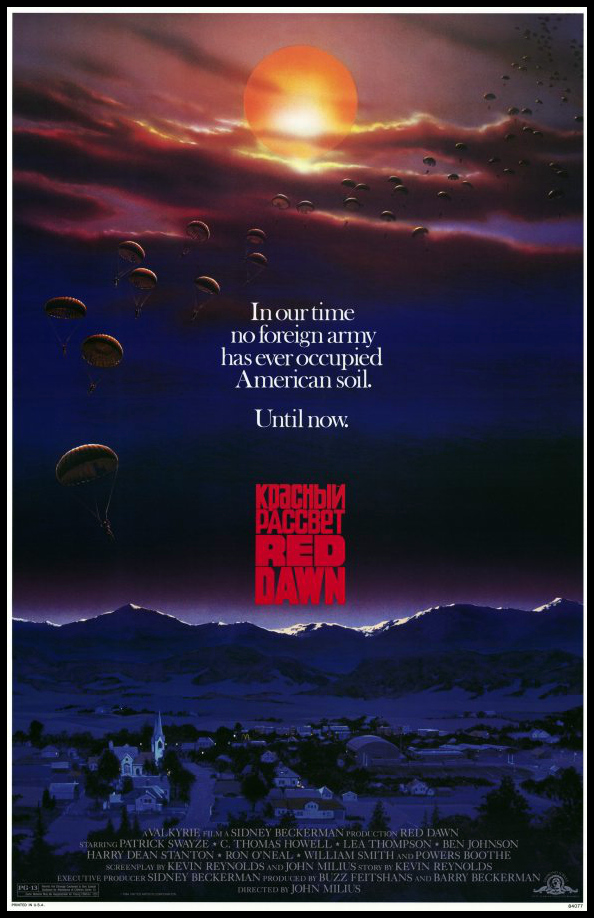
Review: Red Dawn (dir. by John Milius)


“I don’t know. Two toughest kids on the block I guess. Sooner or later they’re going to fight.”

[guilty pleasure]

Anyone who grew up during the 1980’s would say that some of the best action films were made and release during this decade. I won’t disagree with them and probably would agree to a certain point. This was the decade when action films evolved from the realism of the 70’s to the excess and ultra-violence of the 80’s. This was the decade which ushered in such action heroes as Schwarzenegger, Stallone and Willis. It was also the decade which released one of the most violent films ever released by a major motion picture studio. It’s a film that has been remembered through the prism of nostalgia. I speak of the 1984 war film by John Milius simply titled Red Dawn.

John Milius is one of those filmmakers who never conformed to the stereotype of liberal Hollywood. He was an unabashed Republican (though he considers himself more of a Zen anarchist) in a liberal studio system who happened to have written some of the most revered films of the 1970’s (Jeremiah Johnson, Apocalypse Now, Dirty Harry). He came up with a follow-up to his hugely successful Conan the Barbarian in the form of a war film set in current times (mid-80’s) America that he called Red Dawn. It was a story which takes an alternate history of the Cold War where Soviet forces and it’s allies launch a successful preemptive invasion of the United States. Before people think that this was the idea born of a conservative, warmongering mind it’s been documented that Milius’ inspiration for this film was a real Pentagon hypothetical exercise of what would happen if the Soviet Union conducted a conventional invasion of the United States and how the government and it’s population would react and resist such an occupying force. The  story would finally get it’s final treatment with major input from screenwrtier Kevin Reynolds’ own story which added a certain Lord of the Flies vibe to the group of teenagers who form the bulk of the film’s cast.

The film actually starts off with an impressive sequence of your typical Midwestern high school day with students seated in their classrooms. One moment this Rockwellian image gets a surprise from soldiers parachuting in the field outside the school. Thus we have the beginning of the Soviet invasion with one of the teachers being gunned down for trying to peacefully interact with the airborne troopers. The rest of the film is about a group of highschoolers led by senior Jed Eckert (Patrick Swayze) and his younger brother Matt (Charlie Sheen) as they flee with a handful of their classmates the massacre at their school and soon their whole town as well.

Red Dawn uses the first half of the film to show the confusion and chaos created by the sudden appearance of foreign soldiers on America soil attacking civilians and, soon enough, whatever American military response that manages to react in the area. We’re put in the shoes of Jed and his band of teenagers as they try to survive the roving bands of Soviet and Cuban soldiers patrolling the plains and countryside surrounding their hometown of Calumet, Colorado. We see American civilians packed into re-education camps and rumors of KGB secret police making certain troublemakers disappear and worst. It’s the America Cold War nightmare scenario where the Soviet Evil Empire has taken a foothold on US soil and the government and military nowhere in sight to help it’s population.

The second half of the film solves this scenario by arming the teenagers led by Jed into a sort of teen guerrila force using their school’s mascot as their rallying cry. It’s the shouts of “Wolverines!” which has become part of American pop-culture as we get to see these teenagers conduct hit-and-run strikes on enemy patrols and forward bases while at the same time arming those they free from camps. It’s during this part of the film where the violence gets ramped up to an almost ridiculous level. It’s no wonder that for almost two decades this film would be considered by Guinness World Records as the most violent film ever put on the big-screen. Milius and his filmmaking crew do not skimp on the use of blood squibs as Jed and his ragtag band of teen fighters gun down Soviets, Nicaraguans and Cuban soldiers by the score every minute during a long montage in the middle of the film.

Red Dawn in terms of storytelling is actually quite good in the grand scheme of the narrative being told, but even through the prism of nostalgia and rose-tinted glasses the characters in the film get the short-end of the stick. With the exception of Swayze’s eldest teen Jed as leader of the Wolverines the rest of the band’s teenage characters look like your typical casting call stereotypes who fill in the required roles in any ensemble cast. There’s Darren Dalton as the high school class president jealous of the group’s leader Jed, but unable to act on it. We have C. Thomas Howell as Robert the mousy one when the film begins who becomes a hardened and cold-hearted killer as the film goes on. Everyone fits in neatly to their assigned role and noen of the young actors (at the time) bring much to their characters.

This film continues to be remembered fondly by it’s fans both new and old because of the “what-if” scenario being played out on the screen. I would say that if there ever was a pure American film I would think Red Dawn manages to fit the bill. It’s a film which highlights the so-called individualism and can-do attitude Americans see for themselves. How it’s up to each individual to fight to protect their loved ones and for what is theirs. Some have called this film as a conservative’s wet-dream, but I rather think it’s a film that should appeal more to Libertarians as it focuses on individual liberties and self-preservation when the government and military tasked to protect them have failed.

John Milius has always been a maverick in Hollywood and his unpopular political beliefs have kept him from doing more work in the film industry, but one cannot deny the fact that he made one of the most iconic films of the 1980’s. Whether one agreed with the film’s politics and thought it to be a good film or not was irrelevent. Red Dawn has become part of American pop-culture and will continue to be a major example of the excess of 80’s action filmmaking for good or ill. Plus, even the most liberal people I know find the basic story of fighting to protect the nation from invaders something that feeds their innermost fantasy of playing the good guys fighting the good fight. Red Dawn is a great example of the underdog film that just happens to have teenagers kicking Soviet military ass.

6 Trailers To Kick Off A Horrific October


Well, here it is October 1st and you know what that means. It’s time for horror, horror, and more horror.  This edition of Lisa Marie’s Favorite Grindhouse and Exploitation Trailers is dedicated to just that.  So, without further ado, let’s jump into the world of ghosts, zombies, maniacs, and Paul Naschy…

1) Terror Train (1980)

Though this appears to be a fairly standard old school Jamie Lee Curtis slasher film, I like this trailer a lot.  The opening shots of the train are nicely ominous, the shots of winter are perfectly matched with the trailer’s grim atmosphere, and it’s interesting to see Ben Johnson in one of these films.

2) Bloody Birthday (1981)

I love this trailer solely for that final shot with the birthday cake.

3) The House Where Evil Dwells (1982)

Despite the odd looking crab-thing that shows up about halfway through, this is a creepy little trailer.

4) The Hunchback of the Morgue (1973)

Can you believe it took me over 60 entries before I finally included a Paul Naschy film?  Better late than never…

5) Flesheater (1988)

This film was directed by Bill Hinzman, best known as the graveyard zombie from Night of the Living Dead.

6) Lair of White Worm (1988)

Agck!  Snake people!