Quickie Review: 30 Days of Night (dir. by David Slade)


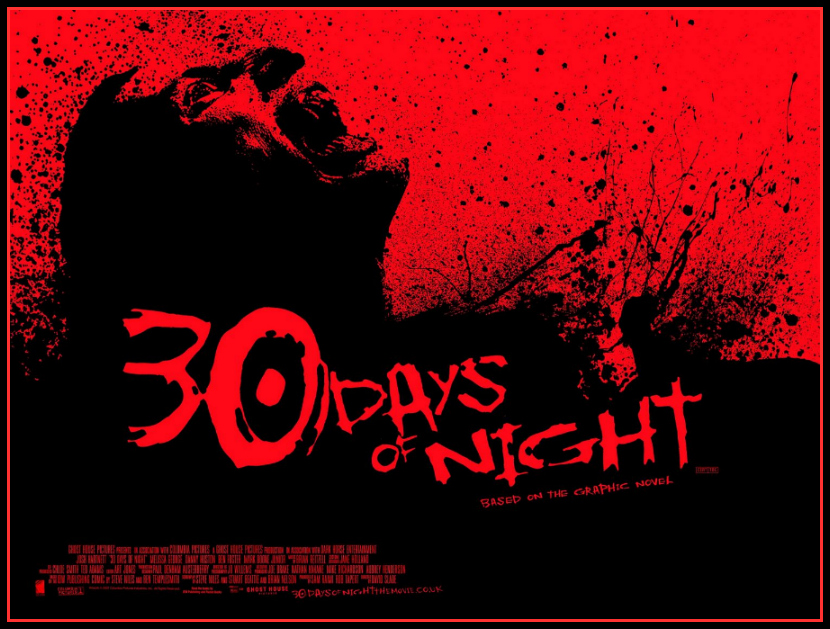
30 Days of Night is pretty much a siege movie with heavy elements of horror and gore. Siege movies always succeed and fail depending on whether the tension and dread built up from the beginning of the film suspends the audience’s disbelief. Siege films like The Thing and Romero’s Living Dead trilogy works well because right from the get-go we see the tension build not just on the location the cast are put in but within the besieged survivors as well. Survival becomes that much more difficult due to human frailties and an inability to work together bringing the whole group down. The monsters outside are bad enough, but sometimes it’s the survivors themselves who must share the blame.

David Slade’s (director of the excellent Hard Candy) movie does a very good job of bringing the initial tension and dread the comic brought to life in its first chapter. The story takes place in Barrow, Alaska which happens to be located within the Arctic Circle. This location allows it a very peculiar yearly event of having pitch-black night which lasts for a period of an entire month. The movie begins just as the town of Barrow prepares for this month-long prolonged night. Most of the town decide to move down south for the month where the night doesn’t last as long, but enough stay in Barrow to give it a semblance of life and activity.

The build-up of the characters in 30 Days of Night marks one of the weaknesses in the film. There’s barely much characterization in distinguishing one Barrow, Alaskan from another. The lack in character development from all the characters whether human or vampire doesn’t invest the film with anyone we want to see make it out through the night and into dawn. Even Danny Huston, a very underrated and overly capable actor in past films fails to elevate his lead vampire character Marlowe beyond it’s genre trappings. Known only as The Stranger in the credits, Ben Foster’s Renfield-like character edges between caricature and genuine creepiness in his performance. Foster knows he’s in a genre movie and has fun with the character. He’s the only one to truly take on his character and roll with it.

I now get to the subject of the vampires themselves. Most vampire movies seem enamored in portraying the vampire as some sort of seductive, fashion-obsessed, or in the case of the Anne Rice-type anachronistic in their dress, with an unnatural immortality they either live as hedonistically as possible or bemoan their cursed existence. Then there’s the more recent trend that Twilight has brought into the vampire mythology and it’s not good.  There’s never been a true portrayal of the vampire as a pure, hunger-driven monster with an appetite to match their status as one of folklore and legend’s top-tier boogeymen. Slade goes for speed and agility in his vampires instead of hypnotizing and mesmerizing their victims. The vampires in this movie owes much to the frenetic and over-amped infecteds of 28 Days Later.

The attack itself and the subsequent siege worked well enough in the early going. There were some great overhead shots of the town’s people losing it’s fight during the initial feeding frenzy as the camera shoots the scene high overhead. The only thing Slade had a misstep in terms of the siege itself was after those first couple of nights. The rest of the 30 days didn’t seem to show enough desperation on the faces and bodies of the last few survivors. Really, the only way the audience even knew a couple weeks have passed were the caption telling them how many days into the month-long night has passed. I think with some better editing and a better sense of structure in the middle section of the movie to show time actually progressing the movie would’ve been better on so many levels.

All in all, 30 Days of Night was just good enough to be a fun watch. The premise itself was original and put a new spin on the vampire genre that has rarely been tapped. The performances were pretty average with no one bringing the whole film down with a misstep performance or raising the bar with a great one. The final product had a chance to be something great, but just ends up being a good and original take on the vampire story with elements of Night of the Living Dead.

Review: Hostage (dir. by Florent Siri)


The five years or so has seen the rise of several new directors from France who’ve made quite a splash with their Hollywood debuts. There’s Alejandro Aja with Haute Tension (or Switchblade Romance/High Tension) who brought back the late 70’s early 80’s sensibilities of what constitutes a good slasher, exploitation film. Then there’s Jean-Francois Richet whose 2005 remake of John Carpenter’s early classic, Assault on Precinct 13 surprised quite a bit in the industry. Neither film made too much in terms of box-office, but they did show that a new wave of genre directors may not be coming out of the US but from France of all places. Another name to add to this list is Florent Siri and his first major Hollywood project Hostage shows that he has the style and skills to make it in Hollywood.

Hostage
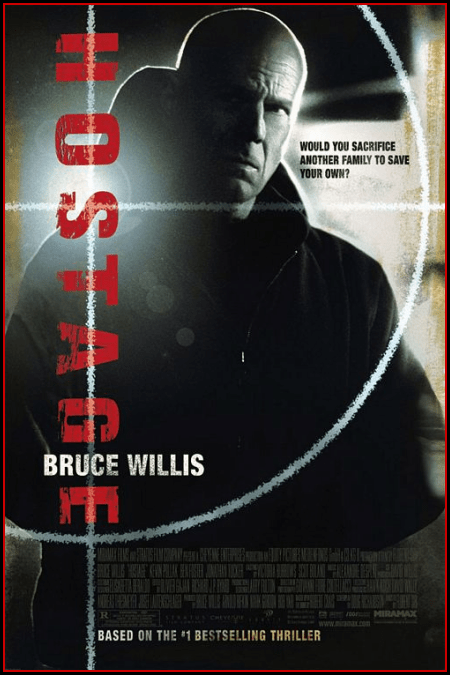
is another Bruce Willis vehicle that was adapted by Doug Richardson (wrote the screenplay for Die Hard 2) from Robert Crais’ novel. Hostage is a very good thriller with a unique twist to the hostage-theme. Willis’ character is a burn-out ex-L.A. SWAT prime hostage negotiator whose last major case quickly ended up in the death of suspect and hostages. We next see him as chief of police of a small, Northern California community where low-crime is the norm. We soon find out that his peace of mind and guilt from his last case may have eased since taking this new job, but his family life has suffered as a consequence. All of the peace and tranquility is quickly shattered as a trio of local teen hoodlums break into the opulent home of one Walter Smith (played by Kevin Pollak). What is originally an attempt to steal one of the Smith’s expensive rides turn into a hostage situation as mistakes after mistakes are made by the teens.

From this moment on Hostage would’ve turned into a by-the-numbers hostage thriller, but Richardson’s screenplay ratchets things up by forcing Willis’ character back into the negotiator’s role as shadowy character who remain hooded and faceless throughout the film kidnap his wife and daughter. It would seem that these individuals want something from the Smith’s home and would kill Willis’ character’s family to achieve their goals. The situation does get a bit convoluted at times and the final reel of the film ends just too nicely after what everyone goes through the first two-third’s of the film.

The character development in the film were done well enough to give each individual a specific motivation and enough backstory to explain why they ended up in the situation they’ve gotten themselves into. Willis’ performance in Hostage was actually one of better ones in the last couple years. The weariness he gives off during the film was more due to his character’s state of mind rather than Willis phoning in his performance. I would dare say that his role as Chief of Police Jeff Talley was his best in the last five years or so. The other performance that stands out has to be Ben Foster as the teen sociopath Mars. Foster’s performance straddles the line between being comedic and over-the-top and could’ve landed on either side. What we get instead is one creepy individual who almost becomes the boogeyman of the film. In fact, the last twenty minutes of Hostage makes Mars into a slasher-film type character who can’t seem to die.

The real star of the film has to be Florent Siri’s direction and sense of style. From the very first frame all the way to the last, Siri gives Hostage the classic 70’s and 80’s Italian giallo look and feel. Siri’s use of bright primary colors in conjuction with the earthy, desaturated look of the film reminds me of some of the best work of Argento, Bava and Fulci. In particular, Siri’s film owes alot of its look to films such as Tenebrae, The Bird with the Crystal Plumage, and The Psychic. Certain scenes, especially the penultimate climax in the Smith home, take on an almost dreamlike quality. Siri’s homage to the classic gialli even gives Hostage some sequences that would comfortably fit in a 70’s slasher film.

Florent Siri’s Hostage is not a perfect film and at times its increasing tension without any form of release can be unbearable to some people, but it succeeds well enough as a thriller. It also shows that Siri knows his craft well and instead of mimicking and cloning scenes from the gialli he’s fond of, he emulates and adds his own brushstrokes. The film is not for everyone and some people may find the story convoluted if not dull at times, but for me the film works well overall. Siri is one director that people should keep an eye on.