Horror Scenes That I Love: Bela Lugosi in Dracula


Dracula (1931, starring Bela Lugosi as the Count, Dir by Tod Browning, DP: Karl Freund)

On this day, 143 years ago Bela Lugosi was born in what is now Romania.  Lugosi began his career in his native country, appearing on stage.  After serving as an infantryman in World War I, Lugosi moved into the movie industry and appeared in silent Hungarian films.  The young Lugosi was an activist, involved in labor issues and trying to unionize the Hungarian film industry.  When a new government came to power in Hungary in 1920, the politically-active Lugosi moved first to Germany and then eventually ended up in the United States.  After a period of working as a merchant seaman, Lugosi returned to acting.

He first played Dracula on stage in New York City.  In 1928, while touring in the role of Dracula, he moved out to California and quickly became a part of the Hollywood community.  When Universal produced a film adaptation of Dracula in 1931, Lugosi was the obvious choice for the lead role.  The film made Lugosi a star and it also typecast him.  Lugosi never stopped acting, though the films varied widely in quality.  By the end of his career, Lugosi was a member of the Ed Wood stock company.  Even appearing in something like Bride of the Monster, Lugosi still made an impression.

In the scene below, from 1931’s Dracula, Lugosi suggests that Edward van Sloan’s Van Helsing should perhaps leave the country.

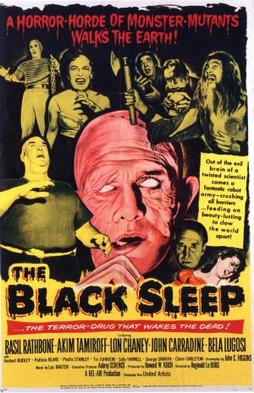
Horror Film Review: The Black Sleep (dir by Reginald Le Borg)


1956’s The Black Sleep opens in a London prison cell.  The year is 1872 and Dr. Gordon Ramsay (Herbert Radley) awaits execution.  He’s accused of murdering a chef who twice sent rubbery scallops to the pass …. wait, a minute, sorry.  Wrong Gordon Ramsay!  This Gordon Ramsay is accused of murdering a man named Curry and he’s considerably more whiny than the modern-day Gordon Ramsay.

Ramsay is visited by Sir Joel Cadman (Basil Rathbone) and Cadman’s associate, Odo the Gypsy (Akim Tamiroff).  Cadman explains that he has developed a potion called “The Black Sleep.”  Drinking it will put the drinker in a state of suspended animation that can pass for death.  And, indeed, it will turn into death unless Cadman administers the antidote.  Cadman offers to give the potion to Ramsay, in return for Ramsay helping Cadman out with his own experiments.  Ramsay agrees.

Ramsay is found “dead” in his cell.  His body is claimed by Cadman and Odo.  (Odo mentions that, in a past life, he was a grave robber and that he died as a result of the guillotine.)  Ramsay is revived and goes to work with Cadman.  As soon as Ramsay enters Cadman’s mansion, he finds himself surrounded by several familiar faces.  For instance, Lon Chaney, Jr. plays the twisted Mungo, who stumbles through the hallways of the mansion and can only be controlled by Daphnae (Phyllis Stanley).  Bela Lugosi plays Casimir, the mute butler.  Bohemud (John Carradine) is a bearded man who rants and raves and calls for Biblical vengeance.  And finally, in the basement, there’s Mr. Curry (Tor Johnson), the man who Ramsay was convicted of murdering!  It turns out that Cadman isn’t quite as benevolent as he presented himself as being.

The Black Sleep may feature an incoherent story but it has a great cast and it is entertaining to see Carradine, Chaney, Tor Johnson, Akim Tamiroff, Bela Lugosi, and Basil Rathbone all living under the same roof and trying to outdo each other as far as the scenery chewing is concerned.  Admittedly, some members of the cast look healthier than others.  Rathbone is as imperiously dashing as always and John Carradine appears to be having a lot of fun with his role.  Akim Tamiroff gets all of the best lines as Odo and he delivers them with just the right amount of wit.  Unfortunately, neither Chaney and Lugosi were in good shape when they appeared in this film.  Lugosi was ill when he did the film.  Chaney, meanwhile, had seen his one-promising career sabotaged by his own alcoholism and, by the time the 50s rolled around, his once handsome features were now ravaged by his drinking.  It transformed him from being a somewhat dull leading man to a craggly character actor.  (Producer/director Stanley Kramer considered Chaney to be one of the best character actors in Hollywood and cast him in both High Noon and The Defiant Ones.)  In The Black Sheep, Chaney’s face is twisted and almost ravaged.  It works for the film but it’s still sad to see.  As for Tor Johnson …. hey, he’s Tor Johnson.  He growls and he tosses things around and he does so convincingly.

(In an interview shortly before his death, Tor said he was offered the role of Oddjob in Goldfinger.  It’s sad to think the world was robbed of the Sean Connery/Tor Johnson team-up it needed.)

This was Bela Lugosi’s final film performance before his death in 1956.  (The footage that appears in Plan 9 From Outer Space was filmed before The Black Sleep.)  It’s a shame that Lugosi wasn’t given more to do in his final film.  Lugosi, with that famous voice, ending his career playing a mute just doesn’t seem right.

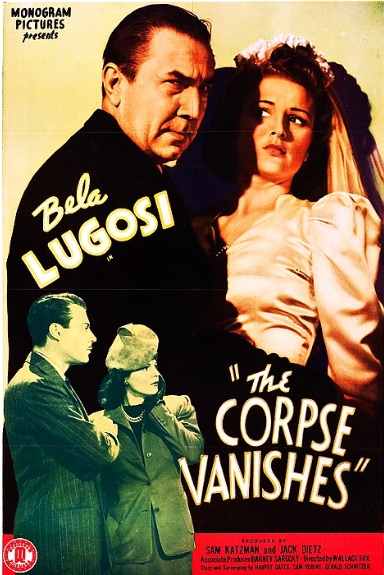
Horror Film Review: The Corpse Vanishes (dir by Wallace Fox)


1942’s The Corpse Vanishes opens with a young bride collapsing at her wedding.  A doctor runs over to her and says that she’s died.  A hearse — or a “stiff wagon,” as one witness puts it — pulls up and takes the body.  However, the body never reaches the morgue!

It turns out that this is not the first time this has happened.  In fact, there’s an epidemic of brides dying on their wedding day and their bodies disappearing.  One would think that this would cause a citywide panic or, at the very least, it would cause some people to maybe get married out-of-town.  Considering that the most recent victim was the daughter of one of the richest families in the community, you would think solving this mystery would be the police’s number one priority.

However, the police are useless.  And when the police can’t get the job done, it falls to journalists.  At least, that’s the way it worked in movies from the 1930s and the 40s.  While the cops were busy saying, “Scram!” and “Beat it, buster!,” it fell to the cynical and quick-witted journalist to find out what was going on.  In this case, Patricia Hunter (Luana Walters) investigates and discovers that all of the brides received an orchid on their wedding day.  (How the police didn’t notice this, I don’t know.)  Patricia tracks down the eccentric Dr. Lorenz (Bela Lugosi), who was once quite renowned for his orchids.

Dr. Lorenz now lives in a secluded mansion.  He’s polite when Patricia comes to speak to him but it’s obvious that he’s hiding something.  A sudden thunderstorm leads to Patricia and Dr. Foster (Tristram Coffin) getting stranded at Lorenz’s mansion.  Foster was visiting the mansion to examine Lorenz’s wife, the Countess (Elizabeth Russell).

Lorenz, as you probably already guessed, is behind the corpse abductions.  Except, of course, the brides aren’t dead.  Instead, the orchid has put them into a state of suspended animation.  Lorenz is extracting their blood and using it to keep his wife young.  Helping him out are his servants, a dwarf named Toby (Angelo Rossitto), Toby’s hulking half-brother, Angel (Frank Moran), and their mother, Fagah (Minerva Urecal).  Patricia figures out what is going on but will she be able to convince anyone else!?

From what I read about the film online, it would appear that The Corpse Vanishes has got a terrible reputation but, when I watched it, I actually found it to be entertaining when taken on its own Poverty Row terms.  No, the plot doesn’t make any sense.  But Bela Lugosi’s smile manages to be both sinister and inviting and Toby and Angel make for good henchmen.  The movie only has a 64-minute runtime and, as a result, the plot has to keep moving fairly quickly.  The film also features a lot of snappy “newsroom” dialogue between Patricia and her easily-annoyed editor (Kenneth Harlan), all delivered at a fast pace and with the the casually cynical outlook that makes 1940s newspaper movies so entertaining.  The Corpse Vanishes is a thoroughly ludicrous film that epitomizes an era and, as such, it’s far more diverting than one might otherwise expect.

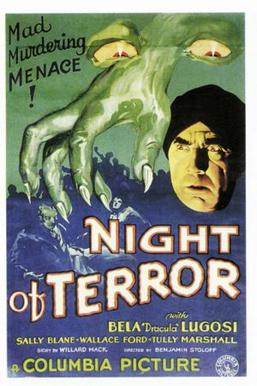
Horror Film Review: Night of Terror (dir by Benjamin Stoloff)


1933’s Night of Terror opens with a character known simple as The Maniac (Edwin Maxwell) attacking random people with a knife.  The Maniac is on a murder spree.  He leaves taunting newspaper articles on the bodies.  (Don’t look at me, I didn’t write the script,)  Wisecracking newspaper reporter Tom Hartley (Wallace Ford ) would love to track the Maniac down.

Meanwhile, the richest man in town has been murdered.  Was he killed by the Maniac?  No one is sure.  What is known is that he divided his large fortune amongst not only his heirs but also his servants.  Of course, if an heir or a servant should die, that just means more money for everyone else!  Meanwhile, the man’s nephew — scientist Arthur Hornsby (George Meeker) — is busy trying to talk his family into burying him alive so that he can test his new suspended animation serum.  Arthur swears that he’s figured out a way for people to live without oxygen for a period of time!

Okay, Arthur, that’s great.  Anyway….

This sixty-one minute horror film features Bela Lugosi as Degar, the butler.  Degar and his wife, Sika (Mary Frey), are regularly referred to as being “heathens” by some of the other members of the family.  And yet, when the family needs someone to hold a seance so that they can figure out who is trying to kill all of them, who do they ask to conduct it?  Degar’s not happy about it but Sika agrees to do so.  Needless to say, things don’t go well.

It’s a bit of silly film and the final twist doesn’t make much sense.  One gets the feeling that the script was written over the course of one night and no one really spent that much time worrying about whether or not it all came together to tell a coherent story.  Moments of humor are mixed in with moments of would-be terror.  The family chauffeur is easily scared.  The members of the family all toss out insults at each other.  When the police show up, they speak in the rat-a-tat fashion of 1930s police officers.  No one in the film yells, “Scram!” and yet it seems like they should have.  It’s that type of movie.  My favorite scene featured a handcuffed Lugosi offering a police officer a cigarette from “Asia.”  Needless to say, the cigarette caused the cop to pass out.  Its 1930s stoner humor.

Bela Lugosi got top-billing but his role is actually pretty small.  Still, Lugosi gives a good performance and delivers his lines with a straight face.  He gets the honor of explaining the mystery to all of the police officers and family members.  That said, the film is stolen by Edwin Maxwell as the Maniac.  Maxwell gets to break the fourth wall at the end of the film and he probably sent many young audience members home with nightmares.  The Maniac tells the audience not to reveal how the film ended, lest they want to be haunted by him.  Hitchcock would have been proud.

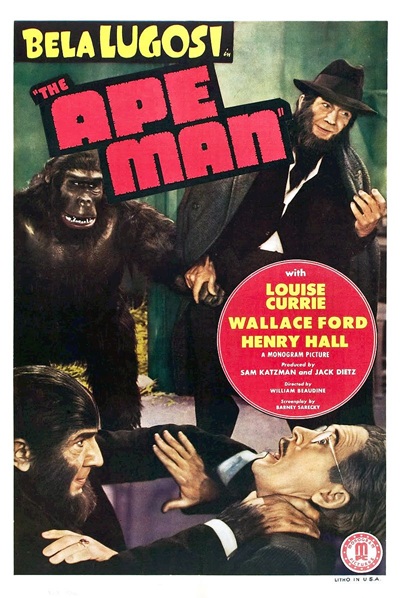
Horror Film Review: The Ape Man (dir by William Beaudine)


In this 1943 film, a mysterious man suggests to reporter Jeff Carter (Wallace Ford) that he should go out to the mansion of Dr. James Brewster (Bela Lugosi) and look into the recent disappearance of the doctor.  Dr. Brewster’s sister (Minerva Urecal) is a well-known ghost hunter and Carter’s editors likes the idea of Carter and photographer Billie Mason (Louise Currie) heading out to the mansion and getting a picture of a ghost.

Carter is upset because he’s having work with a — gasp! — woman.  Bliie is not impressed by the fact that Carter is still in America while all the other men his age are fighting overseas.  Carter explains that he’ll be enlisting in the Navy in a week.  Billie realizes that Carter is not an unpatriotic coward and we, the viewers, are reminded that this film was made during World War II.  I like the fact that America was so unified during World War II that even fictional characters were expected to explain what they were doing for war effort.

For the record, Dr. Brewster’s mansion is not haunted by ghosts.  Instead, the problem is that Dr. Brewster’s experiments have turned him into a man-ape hybrid.  He has a beard, he walks like a monkey, and he fears that he’s turning more into an ape everyday.  He spends almost all of his time locked up in a cage with a gorilla.  Dr. Brewster has (somehow) discovered that the only way to reverse the process is to get regular injections of spinal fluid.  However, it’s impossible to extract the spinal fluid without also killing the donor.  Dr. Brewster’s colleague, Dr. Randall (Henry Hall), refuses to be a party to murder but he still wants to help Brewster.  Unfortunately, Brewster is beyond saving and he’s also losing his mind as he finds himself slowly becoming more and more of an ape.

The Ape Man was directed by William Beaudine, a filmmaker who directed 179 movies over the course of his long career.  Beaudine worked in all genres, starting off as a major director during the silent era before then becoming a prolific B-movie maker during the sound era.  As a B-movie director, Beaudine was famous for rarely doing second take.  If someone flubbed a line or a piece of scenery nearly fell over, that was too bad.  Of course, it should be noted that Beaudine was working for various Poverty Row production companies and he probably didn’t have the budget to do multiple takes.  His job was to get the film shot quickly and for as little money as possible.

That certainly seems to be the philosophy between The Ape Man, which is only a little over an hour long and which features all of the usual plot holes and continuity eras that one might expect to find in a film that was tossed together in just a few days.  That said, The Ape Man is kind of a fun movie.  Bela Lugosi does his best, even when he’s wearing a totally ludicrous beard.  Wallace Ford and Louise Currie deliver their lines in the rat-a-tat fashion that seemed to be popular with journalists in the films of the 30s and 40s.  The plot’s cheeful lack of coherence actually becomes rather charming and the story ends with a nice moment of 4th wall breaking, as the film itself is saying, “Hey, we had fun, didn’t we?”

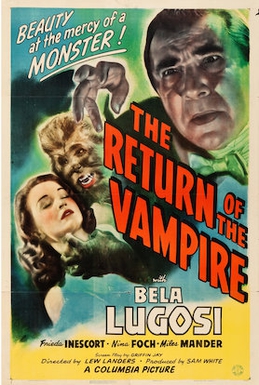
Horror Film Review: The Return of the Vampire (dir by Lew Landers)


1943’s The Return of the Vampire opens in 1918.

Lady Jane Ainsley (Frieda Inescort) and her colleague, Dr. Walter Saunders (Gilbert Emery), suspect that there might be a vampire active in London.  After reading a book on vampirism that was written by Dr. Armand Tesla, they manage to find the vampire’s coffin.  As the vampire’s servant — a werewolf named Andreas (Matt Willis) — watches, Lady Jane and Dr. Saunders drove a metal stake through the vampire’s heart.  It turns out that the vampire was none other than Armand Tesla himself!  Andreas turns back into a normal person and becomes Lady Jane’s assistant.

Jump forward to the 1940s.  During an attack by the Germans, a bomb explodes over Tesla’s grave and exposes not just his coffin but also the metal pole in the middle of his skeleton.  Two workmen assume that the pole is just bomb debris and they remove it.  Tesla (Bela Lugosi) promptly comes back to life and Andreas turn back into a werewolf.  Tesla sets out to get revenge on Lady Jane and the daughter of Dr. Saunders, Nicki (Nina Foch).

The Return of the Vampire is an interesting film.  Since the film was not made by Universal Pictures, it could not use the name “Dracula” for its vampire but it’s obvious from the start that Armand Tesla is meant to be Dracula.  Tesla wears his Dracula costume, speaks in his Dracula voice, and gives his Dracula performance.  To his credit, Lugosi actually gives a very strong performance in The Return of the Vampire.  His anger towards the people who staked him feels very real and there’s nothing of the intentional campiness that marred some of Lugosi’s later performances.  Lugosi leaves little doubt that Tesla is not only evil but he’s someone who truly enjoys being evil.  He can’t leave England until he gets his revenge on the people who previously defeated him.  For all the talk of stakes, sunlight, and crosses, the vampire’s true weakness is its own vanity and its inability to let go of a grudge.

As a history nerd, I found myself fascinated with how the film worked the then-current Blitz into its story.  The main villain may have been played by Bela Lugosi but the Germans definitely played their role as well, launching the bombing raids that distracted the authorities from the vampire in their midst.  Indeed, it’s probably not coincidence that it was a German pilot who brought Tesla back to life in the first place.  The German pilot is shot down but not before he drops a bomb on Tesla’s crypt.  The film says to be aware of the outside threat but to also be aware that threats can come from the inside as well.  While the Germany terrify the citizens of London, the vampire coolly moves through the night.

Clocking in at a fast-paced 69 minutes, The Return of the Vampire also features a stiff upper lip Scotland Yard inspector (Miles Mander) who, of course, is skeptical of the existence of vampires.  At the end of the film, he asks his subordinates if they believe in vampires.  They reply that they do.  He then looks at the camera and asks us, “And do you, people?”

Well, do you?

Bonus Horror On The Lens: The Devil Bat (dir by Jean Yarborough)


Because today would have been Bela Lugosi’s birthday, it seems appropriate to showcase him in a bonus horror on the lens!

In the 1940 film, The Devil Bat, the owners of a company in the small town of Heathville are super-excited because they’re going to be given their head chemist, Dr. Paul Carruthers (Bela Lugosi), a bonus check of $5,000.  However, since Carruthers’s inventions have made millions for the company, he is offended by the small check and decides that the best way to handle this would be to sue in court and demand fair compensation …. just kidding!  Instead, Dr. Carruthers sends his army of giant bats to kill the families of his employers.

The Devil Bat was produced by Production Releasing Corporation, a poverty row studio that specialized in shooting quickly and cheaply.  Going from Universal to PRC was technically a step down for Lugosi but The Devil Bat is actually an excellent showcase for Lugosi and he gives one of his better non-Dracula performances as the embittered Dr. Carruthers.  Indeed, one can imagine that Lugosi, who played such a big role in putting Universal on the map, could relate to Carruthers and his bitterness over not being fairly rewarded for the work he did to make others wealthy.

Enjoy The Devil Bat, starring the great Bela Lugosi!

Horror Scenes That I Love: Bela Lugosi in Bride of the Monster


“Home?  I have no home.”

So begins the monologue that serves as the centerpiece of the 1955 Ed Wood film, Bride of the Monster.  The monologue is delivered by Bela Lugosi, appearing in one of his final roles.

Far too often, people tend to be snarky about the work that Lugosi did under the direction of Ed Wood.  But you know what?

He actually delivers a pretty good performance in Bride of the Monster.

Ignore all of the stuff about atomic supermen and instead, just pay attention to the way Lugosi delivers the lines.  Pay attention to the pain in his voice as he says that he has no home.  Pay attention and you’ll discover that Lugosi actually gave a good performance in Bride of the Monster.  He delivers the lines with such wounded pride that you can’t help but think that maybe we should let him create a race of atomic supermen.

Among the old horror icons, Lugosi has always been the most underrated actor.  He got typecast early and he appeared in some unfortunate films but Bela Lugosi had real talent and you can see it in this scene.

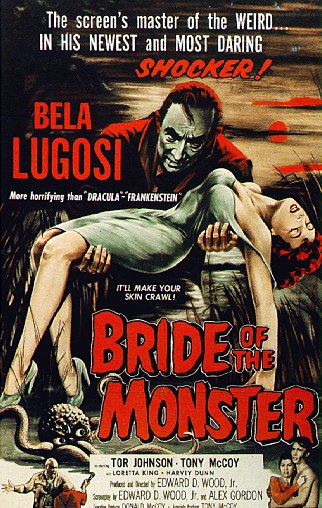
Horror On The Lens: Bride of the Monster (dir by Edward D. Wood, Jr.)


Oh, how I love Bride of the Monster.

First released in 1955 and directed by the legendary Ed Wood, Bride of the Monster is a classic mix of a haunted house, a mad scientist, a lumbering assistant, and a giant octopus.  The plot may be impossible to follow but it doesn’t matter when you’ve got Tor Johnson grunting and Bela Lugosi giving a surprisingly good performance as the persecuted Dr. Vornoff, a man who “tampered in God’s domain.”

A lot of people consider this to be Wood’s best film.  Personally, I would go with Plan 9 From Outer Space but Bride of the Monster is still an entertaining look at monsters and madmen.


Horror On The Lens: Plan 9 From Outer Space (dir by Edward D. Wood, Jr.)


Today, we pay respect to Edward D. Wood, Jr. on the date of his birth.  He was born 101 years ago today.

Some films need no introduction and that’s certainly the case with Wood’s 1957 masterpiece, Plan 9 From Outer Space.

Plan 9 is a film like no other, a film that mixes UFOs with zombies and which ends with a rather sincere plea for world peace.  When Eros the Alien explains that the Solarnite bomb could destroy the entire universe, the film’s hero, airline pilot Jeff, doesn’t point out that Eros’s logic doesn’t make sense.  Instead, he just says that he’s glad that America is the one that has the bomb.  “You’re stupid!  Stupid minds!” Eros shouts before Jeff flattens him with one punch.  Go Jeff!  Don’t take any backtalk from that judgmental alien!

From Criswell’s introduction to Tor Johnson’s rise from the dead to Lyle Talbot casually standing with his hands in his pockets while a UFO explodes above him, Plan 9 is a true classic of some sort.

Can you prove it didn’t happen?