Cleaning Out The DVR #23: The Adventures of Robin Hood (dir by Michael Curtiz)


(For those following at home, Lisa is attempting to clean out her DVR by watching and reviewing 38 films by this Friday.  Will she make it?  Keep following the site to find out!)
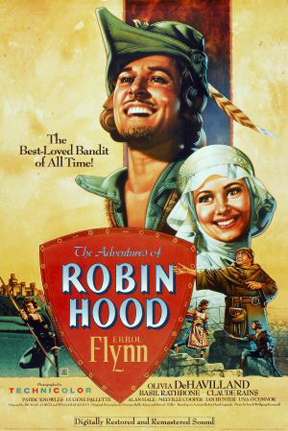
Robin_hood_movieposter

Flamboyant.  Athletic.  Joyous.  Determined.  Handsome.  Outspoken.  Bigger than life.  Revolutionary.  Anarchist.  Sexy.  Libertarian.  Is there any doubt why Errol Flynn remains the definitive Robin Hood?

And. for that matter, is there any doubt why the 1938 film The Adventures of Robin Hood remains not only the definitive Robin Hood film but also one of the most influential action films in history?

The Adventures of Robin Hood tells the story that we’re all familiar with.  The King of England, Richard The Lionhearted (Ian Hunter), is captured while returning from the Crusades.  His brother, King John (Claude Rains, in full autocratic villain mode), usurps the throne while Richard is gone and immediately raises taxes.  He claims that he’s only doing this to raise the money to set Richard free.  Of course, the real reason is that John is a greedy tyrant.

The only nobleman with the courage to openly oppose John is Sir Robin of Locksely (Errol Flynn).  Sir Robin protects his fellow citizens from John’s main henchman, Sir Guy of Gisbourne (Basil Rathbone, also in full autocratic villain mode).  In fact, Robin is so brave that, on multiple occasions, he even enters Sir Guy’s castle so that he can specifically tell King John and Sir Guy that he has no use for their laws.  This, of course, always leads to Robin having to make a dramatic escape while arrows flies and swords are unsheathed all around.

And through it all, Robin Hood keeps smiling and laughing.  He’s a wonderfully cheerful revolutionary.  He may be fighting a war against a ruthless and unstoppable enemy and he may be the most wanted man in England but Robin is determined to have fun.  One need only compare Robin to his humorless foes to see the difference between freedom and bureaucracy.

(We could use Errol Flynn’s Robin Hood today, though I suspect our government would just blow him up with a drone and then issue a statement about how, by stealing money from the rich and giving it to the poor, Robin was keeping the government from being able to rebuild bridges and repair roads.)

When Robin isn’t exposing the foolishness of organized government, he’s hanging out in Sherwood Forest.  He’s recruiting valuable allies like Friar Tuck (Eugene Pallette) and Little John (Alan Hale, Sr.)  He’s playing constant pranks and promoting revolution and, to his credit, he’s a lot more fun to listen to than that guy from V For Vendetta.  He’s also romancing Maid Marian (Olivia de Havilland) and good for him.  Two beautiful people deserve to be together.

Even better, he’s doing it in glorious Technicolor!  There’s a lot of great things about The Adventures of Robin Hood.  The action scenes are exciting.  The music is thrilling.  The film is perfectly cast.  Errol Flynn may not have been a great actor but he was a great Robin Hood.  But what I really love about the film is just the look of it.  We tend to take color for granted so it’s interesting to watch a film like The Adventures of Robin Hood, one that was made at a time when color film was something of a novelty.  For those of us who spend a lot of time talking about how much we love old school black-and-white, The Adventures of Robin Hood is a film that says, “Hey, color can be great too!”

But what I mostly love about The Adventures of Robin Hood is just the pure joy of the film.  Just compare this Robin Hood to the grimly tedious version played by Russell Crowe.

(True, nobody in The Adventures of Robin Hood shouts, “I declare him to be …. AN OUTLAAAAAAAAAAAAWWWWWWWW!”  Actually, now that I think about it, Ridley Scott’s Robin Hood would have worked much better if Oscar Isaac and Russell Crowe had switched roles.)

The Adventures of Robin Hood was nominated for best picture and it probably should have won.  However, the Oscar went to Frank Capra’s You Can’t Take It With You.

Shattered Politics #14: The Last Hurrah (dir by John Ford)


Last_Hurrah

Down here in Dallas, we have a county commissioner named John Wiley Price.  Even if you don’t live in Texas, you might have heard about him.  A few years ago, Price stormed out of a commissioners meeting while shouting, “All of you are white!  Go the Hell!”  It was a popular YouTube video for a while and attracted all of the usual type of comments that you see online.  It even made the national news.

Nobody down here in Dallas was surprised by Price’s outburst.  To us, that was just John Wiley being John Wiley.  For that matter, nobody was particularly surprised when it was reported that he was being investigated by the FBI.  Everyone always took it for granted that John Wiley Price was taking bribes and receiving kickbacks.  That’s just the way that things are done down here in Dallas, by politicians both white and black.  (Of course, most of the white politicians who do it don’t get publicly investigated by the FBI.)

Now, if you ask the majority of people in Dallas county what they think about John Wiley Price and they’ll probably say something negative.  I’ll admit that I would probably be among them.  But the thing is — John Wiley Price’s constituents love him.  John Wiley Price was first elected to the commissioner’s court before I was even born and, as long as he’s on the ballot, he will be reelected.  Even if Price is convicted on corruption charges, he will still be reelected.

I can still remember the night that it was announced that John Wiley Price was on the verge of being arrested by the FBI.  All across his district, emergency meetings were held in churches and ministers stood behind the pulpit and, while the TV cameras rolled, they called upon everyone to pray for John Wiley Price.  In Price’s district, he’s known as “our man downtown,” the idea being that John Wiley Price is standing up to the rich and white Dallas establishment and, if he makes some money for himself in the process, so be it.  As long as he’s doing right for the people who elected him, who cares how he does it?

And, as much as we may want to judge the John Wiley Prices of the world, the fact that of the matter is that he’s a part of a long American political tradition.  That political tradition is also the driving force behind today’s final entry in Shattered Politics.

First released in 1958 and directed by John Ford, The Last Hurrah tells the story of Frank Skeffington (Spencer Tracy), the mayor of an unnamed city in New England that’s obviously meant to be Boston.  Skeffington is the flamboyant head of a large and powerful (but, as the film makes clear, aging) Irish-American political machine.  He’s preparing to run for his fifth term for mayor, a campaign that he says will be his last.

Whether Frank Skeffington is a good mayor or not depends on who you ask.  The poor and the disenfranchised love him.  Skeffington, after all, is the son of Irish immigrants.  He was born poor.  His mother worked as a maid and was even fired by a member of the wealthy and influential Force family.  They know that Skeffington has had to cut corners and that he’s gone out of his way to reward his cronies but they also know that Skeffington is on their side.  Though the phrase is never used in the film, Skeffington is “their man downtown.”

Meanwhile, the wealthy and the upper class see Frank Skeffington as being a crook, a man who has run a corrupt administration and who uses class warfare to keep the city divided against itself and to make himself and his cronies rich.  Newspaper editor Amos Force (John Carradine) has thrown his considerable influence between Skeffington’s opponent, a wealthy but dull man named Kevin McCluskey.

Reporter Adam Caulfield (Jeffrey Hunter) is in an interesting position.  On the one hand, he is Skeffington’s nephew.  On the other hand, as a journalist, he works for Amos Force.  Skeffington invites Adam to follow and record his final campaign for posterity.

It’s interesting to compare The Last Hurrah to films like The Boss or All The King’s Men.  Whereas those two films came down squarely on the sides of the reformers, The Last Hurrah is firmly on the side of Frank Skeffington.  It presents Skeffington as being a sentimental figure, the type of old-fashioned, populist politician who won office by going out and meeting the people face-to-face and personally giving them a reason to vote for him.  As Skeffington himself points out, he’s the type of politician that will soon be made obsolete by television and modern campaigning.

And it’s impossible not to enjoy The Last Hurrah‘s refusal to pass judgment on its lead character.  It helps, of course, that Spencer Tracy plays Skeffington with a twinkle in his eye while all of his opponents are played by villainous and aristocratic character actors like John Carradine and Basil Rathbone.  Yes, the film says, Skeffington may have been corrupt but at least he wasn’t boring!

Finally, I enjoyed the film because all of the “good” guys were Irish Catholic and all of the bad guys most definitely were not.

So, with that last hurrah, we conclude Shattered Politics for today.  We’ll be back tomorrow, when we’ll start to get into the 1960s.

Sláinte!

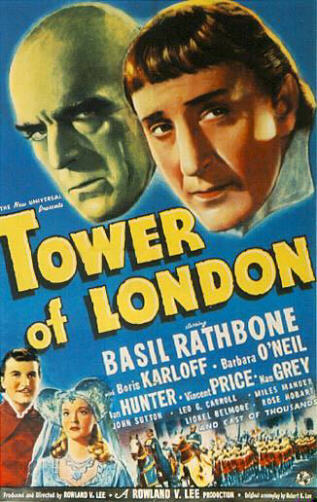
Horror On The Lens: Tower of London (dir by Rowland V. Lee)


Toweroflondonfilm

Today’s horror movie comes from 1939 and is presented in glorious black-and-white.  Tower of London tells the famous (and historically controversial) story of King Richard III (Basil Rathbone).  With the help of the club-footed executioner Mord (Boris Karloff), Richard murders his way to the throne of England.

Technically, The Tower of London is more of a historical film than a horror film but, in order to tell its story, it uses many of the techniques that had been previously perfected by the famous Universal monster movies.  Rathbone turns Richard III into a chilling and plausible human monster while Karloff is obviously having a lot of fun in the role of the twisted Mord.

Also of historical interest is the fact that Vincent Price plays the Duke of Clarence, making Tower of London his first horror film and the first film in which he would appear alongside fellow horror icon, Boris Karloff.