
Night Gallery was a horror anthology series that aired on NBC in the early 70s. Each episode featured Rod Serling, of Twilight Zone fame, serving as the curator of a museum where all of the paintings have a somewhat macabre theme. (One could even say that the museum was a …. wait for it …. night gallery!) Serling would give each painting a properly pithy introduction and then the audience would see the story behind the artwork. It was a bit like the Twilight Zone, except the Night Gallery episodes were in color, they were all horror-themed, and, for the most part, they steered away from social commentary. The series ran from 1970 and 1973 and it still airs in syndication and on some of the retro stations. (I believe it currently airs on Comet TV.) Even if it wasn’t as consistently good as Twilight Zone, it’s still a pretty fun little series.
Two Christmases ago, I was gifted Night Gallery: The Complete Series on DVD. Though I’ve watched several episodes from the DVD, I recently realized that I have never actually sat down and watched every episode in order. With the world currently shut down due to the pandemic (a development that, if we’re going to be honest, sounds like something Rod Serling would have used on the Twilight Zone), I figured what better time to watch the entire series then now?
I started out by watching the Night Gallery pilot film. This originally aired on November 8th, 1969, a full year before Night Gallery became a weekly series. It features three different stories (all written by Rod Serling) of the macabre. As with every episode of the subsequent series, each story is introduced by Serling standing in front of a painting. In the pilot, though, the museum is rather bare and the painting’s are a bit minimalist. I have to admit that, as a lover of the baroque, I was a bit disappointed in that aspect of the pilot.
But what about the stories themselves? Read on!
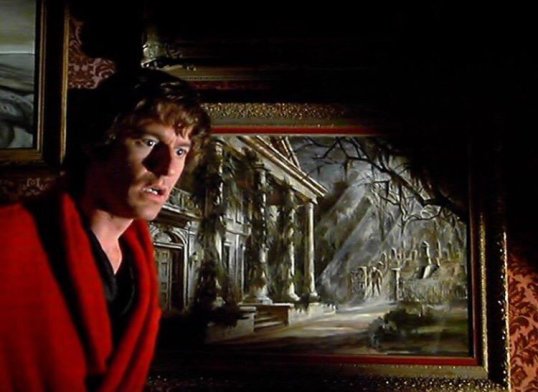
The Cemetery (dir by Boris Sagal)
The first story was The Cemetery, a cheerfully gruesome little tale that featured Roddy McDowall and Ossie Davis. McDowall plays Jeremy, a spoiled young man who murders his uncle so that he might inherit the dead man’s estate. At first, it looks like McDowall’s plot is a complete success but then McDowall notices a painting of the family graveyard hanging above a staircase. (To be honest, it seems odd to hang a painting of a graveyard in the foyer but I guess that’s something old rich people do.) The painting keeps changing. One minute, the painting looks normal. The next minute, it features a newly dug grave. And then something emerging grave. And then something heading towards the house….
Is Jeremy losing his mind or is the painting warning him that his uncle has risen from the dead and is seeking revenge!? You’ll probably be able to guess the answer long before poor Jeremy but no matter. This is a fun little horror story and it benefits from two enjoyably arch performances, from McDowall and, in the role of a butler who may have an agenda of his own, Ossie Davis.

Eyes (dir by Steven Spielberg)
Of the three stories presented in the pilot, Eyes probably gets the most attention from critics because it not only stars Joan Crawford in one of her final performances but it was the professional directorial debut (if you don’t count Amblin’) of 22 year-old Steven Spielberg. Spielberg apparently had some issues dealing with the veteran crew members, many of whom didn’t like the idea of taking orders from a 22 year-old. (It probably didn’t help that pictures from that era suggest that Spielberg looked several years younger than his age. Let’s just say that it’s easy to understand why he eventually grew that beard.) I’d like to think that Joan Crawford yelled at everyone and defended Spielberg and maybe even Rod Serling came down with Luca Brasi and said, “You’re going to the give this kid the respect he deserves or your brains are going to be all over that union contract.” I don’t know if that’s true but it’s a nice thought.
That said, Eyes is pretty good. Even if the crew doubted him, Spielberg proved himself as a director with this story. It’s about a hateful and selfish woman (Joan Crawford) who happens to be both rich and blind. She has manipulated a doctor into performing an experimental operation that will allow her to see. The only catch is that the operation will only be good for 22 hours and a donor (Tom Bosley, as a bookie who is in trouble with the mob) will be required to give up his eyes so that Crawford can have those 22 hours.
On the one hand, this is very-much a Rod Serling-type tale. It’s easy to imagine Eyes, with its belief in karma and its final macabre twist, as a Twilight Zone episode. At the same time, Spielberg very much brings his own signature style to the film, livening up dialogue-heavy scenes with interesting camera angles and getting good performances from Crawford, Barry Sullivan, and Tom Bosley. Eyes is a clever story but, for modern viewers, the most interesting thing about it will be discovering that, even at the age of 22, Spielberg already had a clear directorial style.
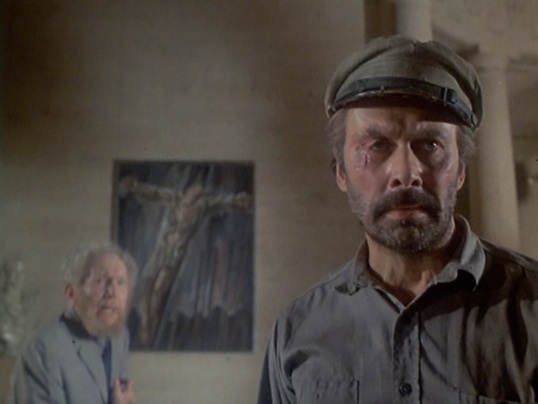
The Escape Route (dir by Barry Shear)
The Escape Route is about an Nazi war criminal named Joseph Strobe (played by Richard Kiley) who is hiding out in South America and spending all of his time nervously looking over his shoulder. One day, he enters a museum where he finds himself drawn to two paintings. One painting features a man who has been crucified in a concentration camp, which we learn was Strobe’s trademark back when he, himself, was a camp commandant. The other painting features a fisherman in a peaceful setting. Even though Strobe imagines himself as the peaceful fisherman, his attention keeps getting redirected to the painting of the concentration camp. Soon, Strobe realizes that a survivor of the camp (played by Sam Jaffe) is also in the museum and that he is studying the painting as well.
Compared to Eyes and especially The Cemetery, The Escape Route may seem like a rather low-key story but it has a power that sneaks up on you. Hiding out (as many real-life Nazi war criminals did) in South America, Strobe is full of excuses for his past and he may indeed be sincere in his wish that he had just become a fisherman as opposed to a brutal Nazi. But, in the end, Strobe can neither escape his past nor his final punishment. Justice cannot be escaped, no matter how hard Strobe tries to outrun it. In the end, there is no escape for the wicked. Richard Kiley and Sam Jaffe both give excellent performances. The Escape Route will stick with you.
As a series, Night Gallery was a bit uneven but the pilot stands as a classic of its type, featuring three short films that all deserve to be remembered.
As for me, I’m going to try to watch an episode or two a day. I may review a few more Night Gallery episodes here on the Shattered Lens. As I said, the series itself was a bit uneven and not every episode is as good as the pilot. Still, there’s definitely some gems to be found in the Night Gallery and I’ll share them as I come across them.



 Through the Shattered Lens