18 Days of Paranoia #14: The Organization (dir by Don Medford)


Sidney Poitier played Detective Virgil Tibbs for the third and final time in the 1970 film, The Organization.

This time, Virgil is investigating a murder at an office building in San Francisco.  It’s a very odd murder, in that an executive was shot, a security guard was bludgeoned, and even though it looks like there was a robbery taking place, nothing appears to have actually been stolen.  Since neither the company nor the executive were believed to be involved in anything shady, Virgil finds himself perplexed as to why any of this has happened at all.

Fortunately, the local urban revolutionaries are here to help!  They contact Virgil and Virgil reluctantly agrees to meet with the group, which is made up of the usual collection of angry 1970s activists — i.e., a dissident preacher, a reformed drug dealer, a guy who won’t stop yelling, and a woman who is obviously going to be killed before the movie is over.  The revolutionaries explain that they were the ones who broke into the office but they also say that they didn’t kill anyone.  Instead, they broke into the office because they wanted the police to investigate the break-in and discover that the company was a front for a bunch of drug dealers.  “The Organization” is flooding poor and minority neighborhoods with heroin and the revolutionaries want to stop them.  In fact, the revolutionaries have stolen four million dollars worth of heroin.  Now, they want Virgil to help them.

Even though Virgil is sympathetic to the revolutionaries, he’s still a cop and he can’t get directly involved with illegal activities.  Instead, he agrees to not arrest the revolutionaries and to continue his investigation, in the hope of bringing down the Organization.  It’s not going to be easy, of course.  There’s evidence that the Organization may even have agents inside the San Francisco police department.

As far as the Virgil Tibbs movies are concerned, The Organization is slightly better than They Call Me Mister Tibbs! but it’s nowhere near as good as the one that started it all, In The Heat of the Night.  Probably the biggest flaw with The Organization is that Virgil has to share the spotlight with the revolutionaries.  With the exception of Raul Julia (who plays a former drug dealer named Juan), none of the revolutionaries are particularly memorable characters and their plan for taking down The Organization is so unnecessarily convoluted that it’s hard to believe that Virgil would go along with it.

On the plus side, The Organization works fairly well as a conspiracy thriller.  It does manage to create a consistent atmosphere of unease and mistrust.  This is one of those films where people are constantly getting shot by unseen gunmen mere minutes after getting arrested and the fact that even cool and in-control Virgil Tibbs can’t save them does a lot towards creating a nice sense of paranoia.  The films end on perhaps the most downbeat note of all of the Virgil Tibbs movies, suggesting that, in the end, everything we’ve just watched was for nothing.


Other Entries In The 18 Days Of Paranoia:

  1. The Flight That Disappeared
  2. The Humanity Bureau
  3. The Private Files of J. Edgar Hoover
  4. The Falcon and the Snowman
  5. New World Order
  6. Scandal Sheet
  7. Cuban Rebel Girls
  8. The French Connection II
  9. Blunt: The Fourth Man 
  10. The Quiller Memorandum
  11. Betrayed
  12. Best Seller
  13. They Call Me Mister Tibbs


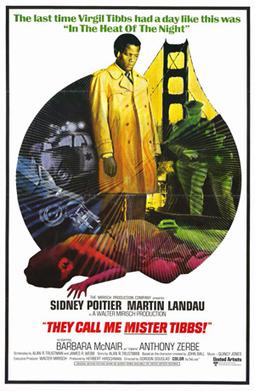
18 Days of Paranoia #13: They Call Me Mister Tibbs! (dir by Gordon Douglas)


The 1970 police procedural, They Call Me Mister Tibbs!, opens with a murder in San Francisco.

A prostitute has been found dead in a sleazy apartment building and, according to witnesses, she was visited, shortly before her death, by the Reverend Logan Sharpe (Martin Landau).  Rev. Sharpe is a prominent civic leader, an outspoken liberal who is a friend of the civil rights movement.  Sharpe is currently at the forefront of a campaign to pass a city referendum that will add a “mini city hall” to every neighborhood and will help to fight against the gentrification of San Francisco.  If Sharpe’s guilty, it will mean the death of the referendum.

Despite the fact that there’s a ton of evidence piling up against him and he kind of comes across as being a little bit creepy (he is, after all, played by Martin Landau), Rev. Sharpe insists that he’s innocent.  Yes, he’s been visiting prostitutes but he’s not a client.  No, of course not!  Instead, Sharpe explains that he’s simply counseling them and praying for their souls.  In fact, as far as Sharpe is concerned, this whole thing is just an attempt by the establishment to discredit his efforts to help the poor and underprivileged.

Heading up the investigation is a friend and supporter of Sharpe’s, Detective Virgil Tibbs (Sidney Poitier).  That may seem like a good thing for Sharpe, except for the fact that Tibbs is an honest cop and he’s not the type to let friendship stand in the way of doing a thorough investigation.  Tibbs admits that he supports Sharpe’s campaign and he wants the reverend to be innocent.  But Tibbs is all about justice.  Whether it’s teaching his son an important lesson about smoking or tracking down a potential serial killer, Virgil Tibbs is always going to do the right thing.

There are other suspects, all of whom are played by suitably sinister character actors.  Anthony Zerbe plays a criminal who lived near the prostitute.  Ed Asner plays her landlord, who may have also been her pimp.  Is Sharpe being set up by the powers that be or is Tibbs going to have to arrest a man whom he admires?

They Call Me Mister Tibbs! was the second film in which Sidney Poitier played Virgil Tibbs.  The first time he played the role was in 1967, when he co-starred with Rod Steiger in the Oscar-winning In The Heat of the Night.  In that film, Poitier was a Philadelphia cop in the deep south who had to work with a redneck sheriff.  In They Call Me Mister Tibbs!, Virgil is now working in San Francisco and he has to work the case on his own.

They Call Me Mister Tibbs! is a far more conventional film than In The Heat of the Night.  Whereas In The Heat of the Night had a wonderful sense of place and atmosphere, They Call Me Mister Tibbs! could just as easily have taken place in Los Angeles, Phoenix, or even Philadelphia.  With the exception of some slight profanity, They Call Me Mister Tibbs! feels more like a pilot for a TV show than an actual feature film.  Perhaps the biggest problem with the film is that there’s no real surprises to be found within the film.  You’ll guess who the murderer is within the first 10 minutes of the film and you’ll probably even guess how the movie will eventually end.

On the plus side, just as he did in In The Heat of the Night, Sidney Poitier brings a lot of natural authority to the role of Virgil Tibbs.  He’s actually allowed to show a sense of humor in this film, which is something that the character (understandably) couldn’t do while he was surrounded by bigots and rednecks during his previous adventure.  Virgil gets a few family scenes, where we watch him interact with his wife and his children.  The scenes feel out of place but, at the same time, Poitier plays them well.

With Sharpe attempting to get his referendum passed and the possibility that riots could break out if Sharpe is indeed guilty of murder, there’s a slight political subtext to They Call Me Mister Tibbs!  Sharpe’s argument that he was being set up by the establishment undoubtedly carried a lot of weight in 1970.  Still, this is ultimately a shallow (if adequately entertaining) film that, for the most part, is only made memorable by Poitier’s commanding performance.

Other Entries In The 18 Days Of Paranoia:

  1. The Flight That Disappeared
  2. The Humanity Bureau
  3. The Private Files of J. Edgar Hoover
  4. The Falcon and the Snowman
  5. New World Order
  6. Scandal Sheet
  7. Cuban Rebel Girls
  8. The French Connection II
  9. Blunt: The Fourth Man 
  10. The Quiller Memorandum
  11. Betrayed
  12. Best Seller

Lisa Cleans Out Her DVR: Change of Habit (dir by William A. Graham)


(Lisa is currently in the process of cleaning out her DVR!  How long is it going to take?  Some would say forever but, here at the Shattered Lens, we’re hoping that she might have it all done by August.  Anyway, she recorded the 1969 film Change of Habit off of Starz on March 20th!)

It’s Elvis vs. God for the heart of Mary Tyler Moore!

(Okay, so that may be a little bit glib on my part but, seriously, that pretty much sums up Change of Habit.)

Change of Habit opens with three nuns walking through New York City.  There’s the forgettable nun, Sister Barbara (Jane Elliott).  There’s the black, streetwise nun, Sister Irene (Barbara McNair).  And then there’s the idealistic and wholesome nun, Sister Michelle (Mary Tyler Moore).  Because they’re nuns, even notoriously rude New Yorkers are nice to them.  They walk across a busy intersection and all of the cars stop for them.  A cop sees them jaywalking and just smiles and nods at them.  In case you were ever wondering why someone would become a nun, it’s because nuns always have the right-of-way and they don’t have to obey arbitrary laws.  It’s a good life.

The sisters are shopping and, as the opening credits roll, the three of them duck into a dressing room and change into contemporary civilian clothing.  Obsessively, the camera keeps zooming in on everyone’s bare legs.  You can literally hear the film’s producers telling all the boys in the audience, “This may be a G-rated Elvis film but that’s not going to stop us from implying nun nudity!”

It’s Sister Michelle’s idea that the nuns should wear contemporary clothing, the better to relate to the Godless youth of the 1960s.  Unfortunately, now that they’re dressed like everyone else, they have to actually obey traffic laws.  When they attempt to cross the street for a second time, cars honk at them and the cop yells at them for jaywalking.

Michelle, Irene, and Barbara get jobs working at a free clinic.  The clinic is run by John Carpenter (Elvis Presley).  Carpenter is looking for aspiring actresses to appear in a movie about a babysitter being stalked by a masked murderer on Halloween and … oh sorry.  Wrong John Carpenter.  This John Carpenter is a no-nonsense doctor who will stop at nothing to bring peace and good health to the most poverty-stricken neighborhoods in New York!

That’s right.  It’s an Elvis film with a social conscience!

And that probably sounds like a joke but Change of Habit‘s heart is in the right place.  It’s intentions are good.  At least a few of the people involved in the film were probably trying to make the world a better place.  There’s a subplot involving an autistic child that, when you consider this film was made in 1969, is handled with unusual sensitivity.  Of course, that doesn’t mean that the rest of Change of Habit doesn’t feel totally and completely out-of-touch.  The entire film feels so dated that I imagine it probably even felt dated when it was initially released.  This is one of those films where the local black militants give Sister Irene a hard time about being a sell-out, just to eventually admit, during a block party, that maybe white folks aren’t so bad after all.  By the end of the movie, they’re even joking with the cops.  All that was needed was for Elvis to sing a song or two.  To be honest, there are times when Change of Habit feels like the 1969 version of Kendall Jenner’s Pepsi commercial.

Of course, the majority of the film deals with Elvis falling in love with Mary Tyler Moore.  He doesn’t know that she’s a nun and, as she falls in love with him, she’s forced to make a difficult choice.  Does she follow God or does she follow Elvis?  Actually, the film ends before she officially makes that choice but there’s little doubt as to what she’s going to eventually do.  In his final non-concert film appearance, Elvis is totally miscast as a serious-minded doctor and, it must be said, he looked miserable throughout the entire film.  You get the feeling he’d rather be doing anything than starring in Change of Habit.  (Maybe he was already thinking about how much he wanted a special FBI badge.)  Mary Tyler Moore is a bit more believable as a nun.  Fortunately, both Moore and Elvis were likable performers and their likability makes Change of Habit, as ludicrous as it often is, far more watchable than it has any right to be.

In the end, Elvis may not have saved society but he did get to sing a gospel song or two.