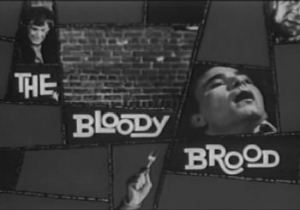
As part of my ongoing mission to see all of the film’s featured in Mill Creek’s 50 Chilling Classics box set, I watched a 65-minute Canadian film called The Bloody Brood last night.
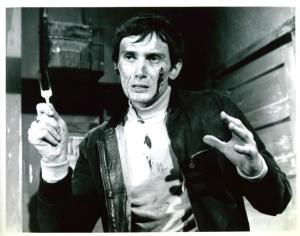
First released in 1959 and filmed in moody, noir-ish black-and-white, The Bloody Brood tells the story of a low-level drug dealer and aspiring beatnik named Nico (Peter Falk). One night, while hanging out at the local coffeehouse and listening to decadent jazz, Nico witnesses a man drop dead of a heart attack. Intrigued by the man’s sudden death, Nico and his nervous friend, a tv director named Francis (Ron Hartmann), decide that they want to experience what it would be like to deliberately kill someone. Before you can say “Leopold and Loeb,” Nico and Francis are feeding a random stranger a hamburger laced with ground glass. That stranger, a hard-working telegram delivery man named Ricky (George Sperdakous), later dies of an intestinal hemorrhage.
Unknown to Nico and Francis, Ricky has an older brother named Cliff (Jack Betts) and Cliff doesn’t believe that his brother’s death was an accident. With the covert help of Detective McLeod (Robert Christie), Cliff starts to investigate his brother’s death. Cliff eventually meets Ellie (Barbara Lord), a disillusioned woman who has fallen in with Nico and his murderous crowd.
The Bloody Brood is an unexpected surprise, a genuinely entertaining B-movie that more than overcomes the confines of its low-budget and limited running time. While Peter Falk is the obvious center of the picture and steals every scene that he’s in with his coldly charismatic style of evil, the entire film is well cast and well acted with Hartmann and Betts both bringing unexpected nuance to their roles. However, the real star of the film is director Julian Roffman who gives the film a shadowy and threatening noir-look.
In many ways, The Bloody Brood represents everything I love about the low-budget, often sordid B-movies of the 50s and 60s. Working with limited resources and a small cast, director Julian Roffman managed to create a genuinely memorable movie. Films like The Bloody Brood continue to serve as proof that you don’t need millions of dollars to make a good film. You just need a strong creative vision and the imagination to make that vision a reality.

 Through the Shattered Lens