Halloween Havoc!: THE LIVING DEAD AT MANCHESTER MORGUE (Hallmark Releasing 1974)


gary loggins's avatarcracked rear viewer

manchester1

While doing some background research on actor Arthur Kennedy for my post about DESPERATE JOURNEY  back in June, I came across an IMDb entry for a movie titled THE LIVING DEAD AT MANCHESTER MORGUE. It’s description is as follows: “A cop chases two hippies suspected of a series of Manson-family like murders; unbeknownst to him, the real culprits are the living dead, brought to life with a thirst for human flesh by chemical pesticides being used by area farmers”. Sounded right up my alley, and a perfect candidate for this year’s ‘Halloween Havoc!’ horrorthon!

manchester2

Though the description isn’t 100% accurate, THE LIVING DEAD AT MANCHESTER MORGUE is a surprisingly good Italian-Spanish made chiller with elements of giallo movies, as our lead George is traveler who stumbles into murder. His motorcycle (a nice looking vintage Norton) is backed into by Edna on his way to Wyndhamere. She gives him a lift, and…

View original post 468 more words

Cleaning Out the DVR Pt 9: Film Noir Festival Redux


gary loggins's avatarcracked rear viewer

prev

Welcome back to the decadently dark world of film noir, where crime, corruption, lust, and murder await. Let’s step out of the light and deep into the shadows with these five fateful tales:

redux1

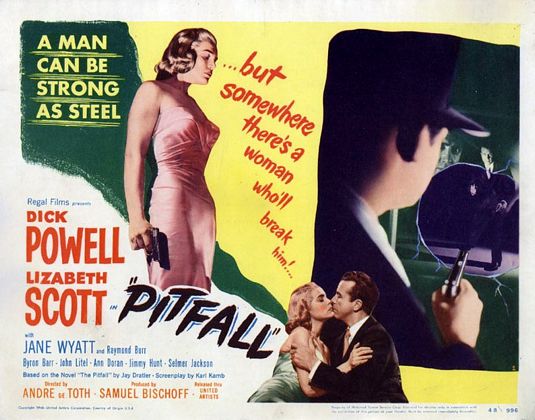
PITFALL (United Artists 1948, D: Andre DeToth) Dick Powell is an insurance man who feels he’s stuck in a rut, living in safe suburbia with his wife and kid (Jane Wyatt, Jimmy Hunt). Then he meets hot model Lizabeth Scott on a case and falls into a web of lies, deceit, and ultimately murder. Raymond Burr  costars as a creepy PI who has designs on Scott himself. A good cast in a good (not great) drama with a disappointing ending. Fun Fact: The part of Scott’s embezzler boyfriend is played by one Byron Barr, who is not the Byron Barr that later changed his name to Gig Young.  

redux2

THE BRIBE (MGM 1949, D:Robert Z. Leonard) Despite an…

View original post 759 more words

Happy Birthday Errol Flynn: DESPERATE JOURNEY (Warner Brothers 1942)


gary loggins's avatarcracked rear viewer

desp1

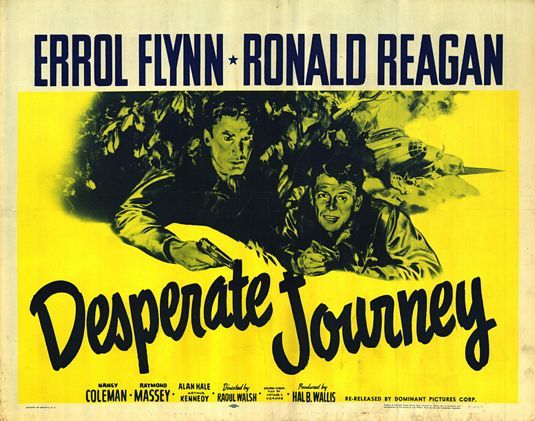
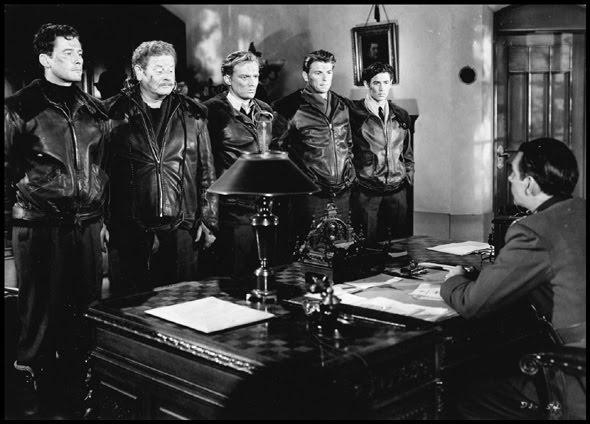
The actor known for his “wicked, wicked ways”, Errol Flynn was born June 20, 1909 in Hobart, Australia. The dashing Flynn skyrocketed to fame with a series of swashbuckling exploits: CAPTAIN BLOOD , THE SEA HAWK, and most notably THE ADVENTURES OF ROBIN HOOD. He was also featured in some of the great Westerns of the era (THEY DIED WITH THEIR BOOTS ON, SANTA FE TRAIL). Like all stalwart screen heroes, during the 1940’s Flynn made a number of wartime propaganda films to boost morale for the masses. One of these was DESPERATE JOURNEY, a totally improbable but highly exciting action yarn from the two-fisted, one-eyed Raoul Walsh, director of such macho fare as THE ROARING TWENTIES, HIGH SIERRA, and WHITE HEAT.

desp2

An RAF bomber squad is sent on a dangerous mission behind enemy lines to take out a train depot. They accomplish the task, but are shot down by Nazi heavy artillery. Forced to…

View original post 795 more words

Sci-Fi Film Review: The Humanoid (dir by Aldo Lado)


humanoid

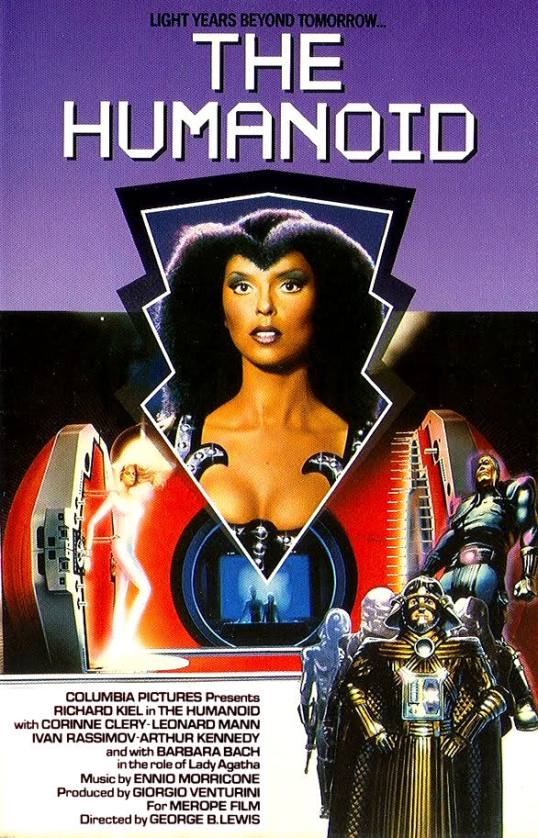
When all the editors of the site got together at the TSL offices and discussed who would review what during our sci-fi month, there were two films that I immediately claimed for myself.  One was Luigi Cozzi’s Starcrash, which is one of the best-known and most popular of all the Italian Star Wars rip-offs.  The other was The Humanoid, which is considerably less known.

What is The Humanoid?  It’s an Italian film from 1979 that was designed to capitalize on the popularity of both Star Wars and James Bond.  While the plot was largely ripped off from Star Wars (with a dash of The Golem tossed in for good measure), the film’s cast featured three performers best known for their roles in two then-recent James Bond films.  The Spy Who Loved Me’s Barbara Bach played the evil Lady Agatha.  Moonraker‘s Corinne Clery played heroic scientist Barbara Gibson.  Finally, the title character — the Humanoid — was played by none other than Richard Kiel, who previously played evil henchman Jaws in both of those films.

The main reason that I wanted to see it was because the film was directed by Aldo Lado.  Aldo Lado may not be as well-known as Mario Bava, Dario Argento, Lucio Fulci, and Ruggero Deodato but he still directed some very memorable films.  Short Night of Glass Dolls, Who Saw Her Die?, and The Night Train Murders are all classics of their genre, combining shocking violence with Marxist political subtext.  What, I wondered, would an Aldo Lado-directed Star Wars rip-off be like?  Fortunately, The Humanoid has been uploaded to YouTube and I was able to find out.

The answer, to that question, is that the Aldo Lado-directed Star Wars rip-off isn’t very good.  But it’s so strange that it’s never less than watchable.

Allow me to attempt to explain the film’s plot.  If things get confusing … well, it can’t be helped.  That’s just the way this film works.  The Humanoid opens in outer space, with a lengthy opening title crawl that informs us that evil Lord Graal has escaped from prison and is planning on attacking the planet Metropolis (yes, the planet is named Metropolis) and overthrowing his brother, the benevolent ruler known as Great Brother.  As the title crawl disappears into space, the camera pans over to a giant spaceship and basically, it’s the exact same shot that opened Star Wars.  You have to admire a film that, in less than a minute, can rip-off Star Wars, Superman, and George Orwell.

Anyway, it turns out that Lord Graal is a tall and imposing figure who dresses in black armor, a black cape, and a black helmet.  (Sound familiar?)  He’s played by Ivan Rassimov, who played a lot of villains in a lot of Italian exploitation films.  Sadly, he never takes off that helmet so we never get to see the truly impressive head of hair that was almost always a highlight of every Rassimov performance.
humanoid_07

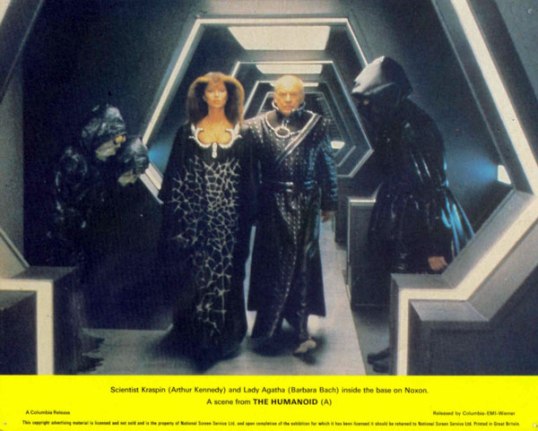
Graal’s main ally is Lady Agatha (Barbara Bach), who is actually several centuries old but she remains young by daily injections of a serum that is made up on virgin blood.  (The Bathory Method, in other words.)  Lady Agatha is really evil but she does have really great hair and she gets to wear this V-neck dress that is simply to die for and provides an interesting contrast to the amazingly boring white jumpsuits that all of the good people seem to be wearing.

The youth serum was developed by a mad scientist named Dr. Kraspin (played by five-time Oscar nominee Arthur Kennedy).  And Dr. Kraspin is good for more than just youth serums!  He’s also developed a method of mind control, a way to turn humans into … humanoids!

(“Come quickly!” Dr. Kraspin cries, at one point, “I am creating my first humanoid!”)

Dr. Kraspin tests his method out on interstellar police officer, Golob (Richard Kiel).  Good Golob has a beard and mustache and spends most of his time talking to his pet robot, Robodog.  (“This is my robot dog!” Golob enthusiastically says at one point.)  However, when Golob gets hit by Kraspin’s Humanoid Ray, the beard and the mustache vanish and Golob just growls.  Much as in The Golem, Kraspin places a device on Golob’s forehead which allows him to control Golob’s actions.
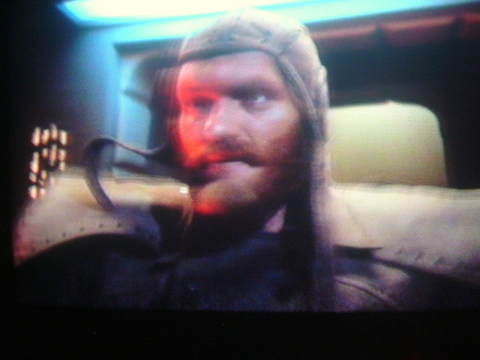
Good Golob
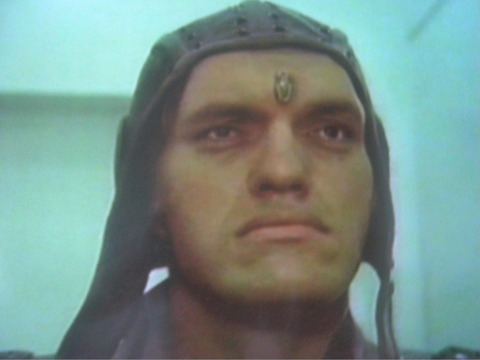
Good Golob

Bad Golob

Bad Golob

Meanwhile, Kraspin also has a grudge against Dr. Barbara Gibson (Corrine Clery) and sends Golob to destroy her.  However, Barbara is hiding out with enigmatic child genius Tom Tom (Marco Yeh) and the Han Soloish Nick (Leonard Mann).  And, fortunately for all of them, Tom Tom has the power to make crossbow-wielding angels descend from the heavens…

One of the things that makes The Humanoid an interesting viewing experience is that it’s essentially a kid’s film that was made for an exploitation audience.  Hence, scenes featuring cute Robodog and precocious Tom Tom are mixed in with scenes of brutal violence and a naked virgin being drained of her blood so that Agatha can remain young.  It makes for a notably odd viewing experience.

But that’s appropriate because The Humanoid is one weird movie.  Much as he did with Night Train Murders (which was “inspired” by Wes Craven’s Last House On the Left), Aldo Lado doesn’t allow The Humanoid‘s rip-off status to prevent him from tossing almost everything you could imagine into The Humanoid.  Full of melodrama, bad special effects, over-the-top performances, and way too much plot for a 90 minute movie, The Humanoid is one of those movies that simply has to be seen to believed.  It’s utterly ludicrous and, as a result, oddly likable.  It may not be good but it’s never less than watchable.
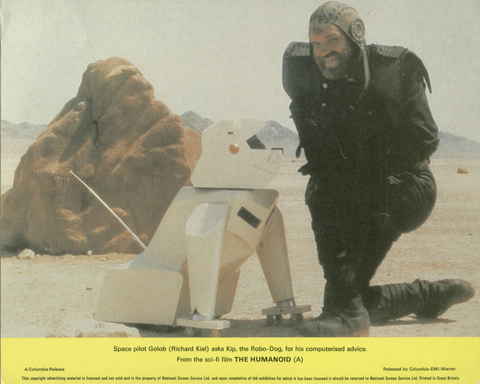
Golob and RoboDog

Golob and RoboDog


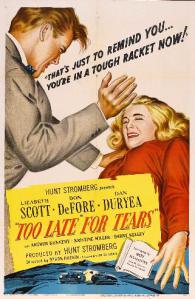
Bad Blonde: TOO LATE FOR TEARS (1949)


too_late_for_tears_dvd

I just finished viewing the 1949 feature TOO LATE FOR TEARS on TCM. The title may sound like a weepy tearjerker, but this is film noir dynamite. Once incomplete due to falling into public domain, the UCLA Film & Television Archive have restored it to its black & white glory. I’d never seen this one before, and it was time well spent. It’s based on a Saturday Evening Post serial by screenwriter Roy Huggins, who later went on to produce television classics like MAVERICK, RUN FOR YOUR LIFE, and BARETTA. TOO LATE FOR TEARS can hold it’s own with the better known noirs of the era.

Alan and Jane Palmer are driving down a lonely LA highway when a satchel is tossed in their car by another driver. They discover the bag’s loaded with cold, hard cash. They’re chased by the intended party, but manage to elude them. When the couple opens the bag at their apartment, Jane’s money lust is palpable. See, she was married once before to a man who committed suicide when he lost his fortune. Jane yearns to return to the easy life and sees this cash as a way out. Sensible Alan argues they should turn it over to the cops, but greedy Jane persuades him to stash it in a train station locker for a week, until cooler heads can prevail.

While Alan’s at work, Jane gets a visit from slimeball Danny who says he’s a cop. After nosing around a bit, he tells her he’s the guy the bag was intended for and threatens her. Not willing to give up her claim on the dough, Jane entices the bum into helping get the money in exchange for half. Danny goes along and agrees to meet her at the lake. Alan and Jane go on a fateful boat ride, where she shoots her husband and has Danny switch clothes with the corpse. Then they tie an anchor to him and drop the poor sap at the bottom of the lake. Jane creates an elaborate ruse to convince everyone that Alan’s run off. But Alan’s little sister Cathy has her doubts, and grows suspicious. An old Army buddy of Alan’s named Don drops by to visit his pal. But Don’s not what he seems to be (no one is in this movie!). Jane plots with Danny to poison little sister and get her out of the way. Instead, Danny ends up poisoned by duplicitous Jane. She ends up hightailing it with the loot to Mexico. Jane’s really living it up on her ill-gotten gains, until Don shows up and the truth is revealed…..

late 1

The ending’s a doozy, and Jane gets her final comeuppance in the film’s climax. TOO LATE FOR TEARS is all about crosses and double-crosses, greed, lust, and murder. The cast is full of dependable actors. Lizabeth Scott stars as Jane, the ultimate femme fatale. Scott got her big break in DEAD RECKONING (with Humphrey Bogart), and went on to film noir stardom in I WALK ALONE, DARK CITY, and THE RACKET. She even played opposite Elvis in LOVING YOU. Dan Duryea (Danny) has long been one of my favorite actors. His sleazy touch can be seen in SCARLET STEET (a real gem), LARCENY, CRISS CROSS, and WINCHESTER ’73. Don Defoe (Don), usually cast as the lead’s sidekick, is more recognizable for the sitcoms OZZIE & HARRIET and HAZEL. Always dependable Arthur Kennedy doesn’t make it through the first third of the movie, but is fine as straight laced Alan. If you don’t blink, you’ll spot Denver Pyle, Billy Halop of the Dead End Kids, and MICKEY MOUSE CLUB host Jimmy Dodd in small uncredited roles.

                    TooLateForTears03_0

Byron Haskin was a top cinematographer and headed Warner Brothers’ special effects department before turning to directing in the late 40s. He keeps a tight reign on this one, but is best known for his work in science-fiction films like WAR OF THE WORLDS, CONQUEST OF SPACE, ROBINSON CRUSOE ON MARS, and the 60s TV anthology THE OUTER LIMITS. TOO LATE FOR TEARS, despite the sappy title, is a great little piece of filmmaking. Independently produced by Hunt Stromberg (RED DUST, THE THIN MAN) and originally released through United Artists, this is a movie that will satisfy any film noir buff. Thank you UCLA for your continued work in saving these lesser known pieces of  Hollywood history. And as always, thanks to TCM for giving us all the privilege of watching them again and again.

Embracing the Melodrama #16: A Summer Place (dir by Delmer Daves)


A Summer Place

Judging from the films I’ve seen from the decade, the 50s were a time when everyone was obsessed with sex but nobody felt comfortable talking about it.  Boys were, of course, allowed to do whatever they wanted, as long as they kept their hair perfectly straight and went out for a school team or two.  Girls, meanwhile, were divided into “good girls” and “bad girls.”  The most important thing in the world was to remain a good girl and to understand that the bad girls really weren’t having as much fun as they appeared to be having.  As for adults, their lives apparently revolved around sheltering their daughters and encouraging their sons to go get laid.  Now, to be honest, the culture really hasn’t changed that much.  I guess what distinguished 50s hypocrisy from the hypocrisy of today is that people in the 50s were apparently so much more sincere about that hypocrisy.

Case in point: 1959’s A Summer Place.  A Summer Place is one of those films where everyone is obsessed with sex but nobody can ever come right out and admit it.  It’s a film where people seem to exclusively speak in the language of euphemism.  It’s a film, about sex, in which you never see anyone actually having sex though, of course, there is an unplanned pregnancy towards the end of it.  That was the 50s for you.  Have sex outside of marriage once and you’re pretty much guaranteed to get knocked up.  You just better hope that the father is played by Troy Donahue.

(Has ever an actor has a more appropriate name than Troy Donahue?  The name itself just resonates a certain handsome blandness.)

In A Summer Place, Troy Donahue plays all-American boy Johnny Hunter.  Johnny’s father (played by Arthur Kennedy) is an alcoholic.  Johnny’s mother, Sylvia (Dorothy McGuire), is frustrated with her perpetually drunk husband and spends her days dreaming of a lifeguard that she once knew.  The Hunters own an inn, located on beautiful Pine Island off the coast of Maine.

One summer, Ken (Richard Egan) and his cold wife Helen (Constance Ford) come to stay at the inn.  Accompanying them is their teenage daughter, Molly (Sandra Dee).  Helen insists on trying to control every aspect of Molly’s life.  Ken, on the other hand, takes a much more relaxed attitude towards his daughter.  When Molly complains that Helen forces her to wear a bra and a girdle, Ken grabs his daughter’s underwear and tosses it all into the ocean.

(Uhmmm …. yeah, that’s more than a little creepy…)

Molly meets Johnny and, despite the fact that the stiff Troy Donahue generates absolutely zero romantic  sparks, the two of them soon fall in love. (It probably has something to do with the Theme From A Summer Place, a hypnotic piece of music that plays on the soundtrack whenever the two of them so much as even glance in each other’s direction.)  Helen, however, doesn’t want Molly to have anything to do with Johnny.  When Molly and Johnny spend a day stranded on an island together, Helen forcefully checks to make sure that Molly’s virginity is still intact while Molly repeatedly shouts, “I WANT MY FADDAH!  I WANT MY  FADDAH!”

However, her father is not there because he’s too busy having an affair of his own.  It turns out that Ken is the former lifeguard who Sylvia Hunter once loved…

And through all of the complications and the melodrama (and believe me, there’s a lot), the Theme From A Summer Place keeps on playing in the background.

Apparently, A Summer Place was considered to be incredibly risqué back in 1959.  Watched today, it all seems to be rather quaint and, in its way, oddly likable.  It’s not necessarily a good film but it’s an agreeable enough offering if you’re looking to waste two hours with whatever happens to be on TCM.  As opposed to some of the other regular directors of 50s melodrama —  like Douglas Sirk and Nicholas Ray — director Delmer Daves made films where the only subtext was unintentional.   As a result of Daves’s direction and Donahue’s “nice young man” blandness, A Summer Place is a pleasant film that never quite becomes a memorable one.

Still, just try to get that music out of your head…

a summer place, sandra dee, troy donahue


Embracing The Melodrama #13: Peyton Place (dir by Mark Robson)


Poster - Peyton Place_04

“Just remember: men can see much better than they can think. Believe me, a low-cut neckline does more for a girl’s future than the entire Britannica encyclopedia.” — Betty (Terry Moore), speaking the truth in Peyton Place (1957)

Sex!  Sin!  Secrets!  Scandal!  It’s just another day in the life of Peyton Place, the most sordid little town this side of Kings Row!  It’s also the setting of the 1957 best picture nominee, Peyton Place.

Peyton Place is a seemingly idyllic little village in New England.  The town is divided by railroad tracks and how your fellow townspeople views you literally depends on which side of the tracks you live on.  As the film itself shows us, the right side of tracks features pretty houses and primly dressed starlets.  The wrong side of the tracks features shacks and a bunch of people who look like the ancestors of the cast of Winter’s Bone.  The difference in appearance is not particularly subtle (but then again, the same thing could be said for the entire film) but, regardless of which side of the tracks live on, chances are that you’re keeping a few secrets from the rest of the town.

On the right side of the tracks, you can find Constance McKenzie (played by Lana Turner, who is just about as convincing as a New England matron as you would expect a glamorous Hollywood star to be), a dress shop owner who is so prim and proper that she literally flies into a rage when she comes across her daughter kissing a boy.  Could it be the Constance’s repression is the result of her once having been a rich man’s mistress?  And will the new high school principal, the progressive and rather dull Mr. Rossi (Lee Phillips), still love her despite her sordid past?

Constance’s daughter is Allison (Diane Varsi) and poor Allison just can not understand why her mother is so overprotective.  Will Allison ever find true love with the painfully shy Norman Page (Russ Tamblyn) or will she be forced to settle for someone like the rich and irresponsible Rodney Harrington (Barry Coe)?

Rodney, for his part, is in love with Betty (Terry Moore), a girl from the wrong sides of the tracks.  Rodney’s father (Leon Ames) is the richest man in town and makes it clear that he will not allow his son to marry someone with a “reputation.”  Will Rodney get a chance to redeem himself by going off to fight in World War II?

And what will happen when Rodney and Betty go skinny dipping and are spotted by a local town gossip who promptly mistakes them for Norman and Allison?  Reputations are at stake here!

Meanwhile, over on the bad side of the tracks, Lucas Cross (Arthur Kennedy) sits in his shack and drinks and thinks about how the world has failed him.  His long-suffering wife (Betty Field) works as housekeeper for the McKenzie family.  Meanwhile, his abused daughter Selena (Hope Lange, giving the film’s best performance) is Allison’s best friend.  When Lucas’s attempt to rape Selena leads to a violent death, the sins and hypocrisy of Peyton Place are revealed to everyone.

Peyton Place is a big, long  movie, full of overdramatic characters, overheated dialogue, and over-the-top plotting and, for that reason, I absolutely love it!  Apparently, the film was quite controversial in its day and the scenes where Arthur Kennedy attacks Hope Lange still have the power to disturb.  However, the main reason why I enjoy Petyon Place is because anything that could happen in Peyton Place does happen in Peyton Place.

Seriously, how can you not love a film this sordid and melodramatic?