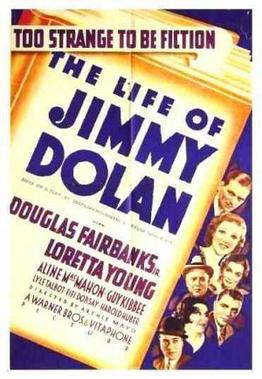
The Life of Jimmy Dolan (1933, directed by Archie Mayo)


Jimmy Dolan (Douglas Fairbanks Jr.), the light heavyweight champion of the world, goes out of his way to present himself as being a wholesome boxer who loves his mom and is as saintly outside the ring as he’s fearsome inside.  Instead, in private, Jimmy is a hard-drinking cynic with a corrupt manager (Lyle Talbot) and a wild girlfriend (Shirley Grey).  When a reporter (George Meeker) threatens to reveal the truth, Jimmy’s manager punches him and accidentally kill him.  The manager frames Jimmy for the crime and then flees with Jimmy’s girlfriend, just to suffer a fiery end in a car accident.

Everyone except for weary Inspector Phalanxer (Guy Kibbee) thinks that Jimmy is dead.  Jimmy goes on the run, hitching rides on freight trains and nearly starving to death before he stumbles over a home for orphans.  Peggy (Loretta Young) takes Jimmy in and gives him food and a place to live.  Jimmy helps with the kids (including Mickey Rooney).  When Jimmy learns that the orphanage might be shut down, he agrees to fight in a charity boxing match against the fearsome King Cobra (Sammy Stein).  King Cobra is so tough that even John Wayne (playing a boxer named Smith) is scared to get in the ring with him.  Jimmy risks his life and his freedom for the orphanage.

This is a good pre-code melodrama.  Because this was a pre-code film, it doesn’t have to shy away from portraying Jimmy’s decadent lifestyle outside of the ring.  Douglas Fairbanks, Jr. was a likable actor and easy to root for.  He was athletic enough to be convincing as someone who could handle himself in a fight.  When he finds himself down-and-out, he’s standing in for everyone who was struggling during the Depression.  The great character actor Guy Kibbee also has some great moments as the inspector, especially towards the end of the film.  Fans of John Wayne won’t see much of him here but it’s still interesting to see Wayne play a character who is frightened of something.

All in all, The Life of Jimmy Dolan is a good, pre-code boxing movie.

Horror Film Review: The Devil-Doll (dir by Tod Browning)


devil_dollposter

Paul Lavond (Lionel Barrymore) was just your ordinary Parisian bank owner until he was wrongly convicted of robbery and murder.  Sentenced to Devil’s Island and estranged from his beloved daughter, Lorraine (Maureen O’Sullivan), Paul spends 16 years plotting how to clear his name and progressively growing more bitter and angry.

He also befriends a scientist named Marcel (Henry B. Walthall).  Marcel has figured out the formula for shrinking people.  He’s convinced that shrunken people will eat less, use less fossil fuels, and take up a lot less space on the planet.  They’ll probably also be less likely to wage war on each other.  That’s right — the secret to world peace is shrinking the population.

However, Paul has other plans for that shrinking formula!  What better way to clear his name and seek revenge than by using a shrunken army of henchmen?

Uhmmm — okay, it sounds a little bit overcomplicated to me but who am I to doubt the wisdom of Lionel Barrymore?

(Yes, I know he’s Paul Lavond but, honestly, Lionel Barrymore is Lionel Barrymore regardless of who he’s playing.)

Anyway, Paul and Marcel escape from Devil’s Island but Marcel dies shortly afterward.  Paul, however, forms a partnership with Marcel’s widow, Maleta (Rafaela Ottiano).  Disguising himself as an elderly woman, Paul returns to Paris.  Not only does he use his disguise to watch over his daughter (who doesn’t realize that the kindly old woman is actually her father) but he also starts to develop quite a reputation for selling incredibly realistic dolls…

The Devil-Doll is an odd little mix of comedy and melodrama and, to be honest, it’s a bit too uneven to really work.  That said, the film is definitely worth watching just for the sight of Lionel Barrymore playing an elderly woman.  (Classic film lovers will immediately notice that, when in disguise, Lionel greatly resembles his sister, Ethel.)  This Christmas, when I’m watching It’s A Wonderful Life for the 100th time and Mr. Potter is cackling and plotting to put the Bailey Building and Loan out of business, I’ll have a hard time not thinking about The Devil-Doll.

The Devil-Doll was one of the final films to be directed by the legendary horror specialist, Tod Browning.  I’ve read that Browning’s later films suffered because Browning plunged into depression after the death of Lon Chaney, Sr. and he never quite recovered.  And, really, The Devil-Doll feels like a film that would have been perfect for Chaney’s unique talent.

But, that said, Lionel Barrymore appears to be having a lot of fun as Paul and his performance is the main reason to watch the film today.

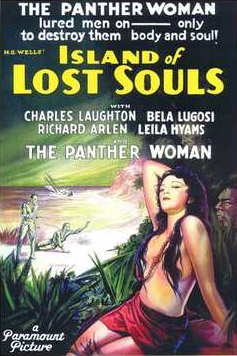
Horror Film Review: Island of Lost Souls (dir by Erle C. Kenton)


islandoflostsouls

In the 1932 film Island of Lost Souls, Ruth Thomas (Leila Hyams) has reason to be concerned.  She’s on the island of Samoa, awaiting the arrival of her fiancée, Edward Parker (Richard Arlen).  When Parker’s boat doesn’t show up, it can only mean one thing.  He’s been shipwrecked!  Did he survive or was he lost at sea?

Well, Ruth need not worry.  Parker did survive being shipwrecked.  He was picked up by a freighter carrying a wide selection of animals to an isolated island.  Unfortunately, when Parker complained about the way that Parker was abusing some of his admittedly odd-looking passengers, the captain responded by dumping Parker on that island as well.

On the island, Parker becomes the guest of Dr. Moreau (Charles Laughton) and his assistant, Montgomery (Arthur Hohl).  Parker also meets and finds himself becoming attractive to the seemingly naive Lota (Kathleen Burke).  Though Moreau seems to be a good host, Parker grows suspicious of him.  It turns out that there’s a room in Moreau’s compound, a room that Lota calls “the house of pain.”  At night, Parker can hear horrifying screams coming from the room.

Initially believing the Moreau is torturing the island’s natives, Parker soon discovers an even more disturbing truth.  Moreau has been experimenting with trying to transform animals into humans.  Lota, it turns out, was once a panther and the woods surrounding the compound are full of other Moreau creations.  Though Moreau claims that his intentions are benevolent, he rules his island like a dictator.  The animal-men are kept in line by the Sayer of the Law (Bela Lugosi) and any transgressions are punished in the House of Pain…

The Island of Lost Souls was the first cinematic adaptation of H.G. Wells’s The Island of Dr. Moreau.  (Perhaps the most famous adaptation came out in 1996 and is the subject of Lost Souls, a fascinating documentary that, I believe, can still be found on Netflix.)  I watched it last night on TCM and I have to admit that I had a mixed reaction to it.  On the one hand, the film’s atmosphere of mystery and danger is palpable and Charles Laughton’s performance definitely set a standard for all misguided scientists to follow.  The human-animals are fantastic creations and  the film’s ending still has some power.  Bela Lugosi’s performance of the Sayer of the Law was superior to his work as Dracula.  (As shown by both this film and Ninotchka, Lugosi was an outstanding character actor.)  Kathleen Burke also does a great job as Lota, which makes it all the more interesting that she was apparently cast as a result of winning a contest that was sponsored by Paramount Pictures.

(On a personal note, I always find it amusing that pre-code films always feature at least one scene of an actress removing her stockings, even if the scene itself has next to nothing to do with the rest of the film.  In this case, the legs belong to Leila Hyams.)

On the negative side, Richard Arlen is not a particularly interesting hero and, from a contemporary point of view, Island of Lost Souls is a rather slow-moving film.  Watching it today requires modern audiences to make a bit of an adjustment to their expectations.

With all that in mind, I still recommend Island of Lost Souls.  Watch it for Charles Laughton and Bela Lugosi.  Watch it as a valuable piece of cinematic history.