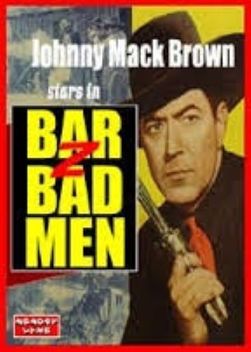
Bar-Z Bad Men (1937, directed by Sam Newfield)


After getting kicked out of town for shooting the place up during a night of friendly fun, cowboy Jim Waters (Johnny Mack Brown) drops in on his old friend, rancher Ed Parks (Jack Rothwell).  Ed has got a strange problem.  There are cattle rustlers about but instead of stealing Ed’s cattle, they’re adding cattle to Ed’s herd.  It’s an obvious scheme to try to create a feud between Ed and his neighbor, rancher Hamp Harvey (Frank LaRue).  Before Jim and Ed can solve the problem, Ed is gunned down.  Harvey is the number one suspect but Jim figures out the truth, that Harvey has been betrayed by one of his own employees and that all of this is a part of a scheme by Sig Bostell (Tom London) to take control of both ranches.

Bar-Z Bad Man is a B-western with a notably twisty plot as Bostell plays both sides against each other for his own benefit.  As usual, Johnny Mack Brown makes for a good and convincing western hero.  Whether he’s chasing someone on his horse or drawing his guns, Brown is always a convincing cowboy.  What makes this film interesting is that it opens with Johnny Mack Brown engaging in the type of behavior that most B-western heroes would never think of doing.  Shooting up the town and then getting exiled for his actions adds an element of redemption to Jim’s efforts to get to the bottom of Bostell’s schemes.  Or it would if Jim ever really seemed to feel bad about shooting the town up.  His excuse is that he was just having a good time.  Try to get away with that in the real old west, Jim!

Bar-Z Bad Men is a good B-western for those who like the genre.  The story is solid and Johnny Mack Brown is as convincing saving the west as he was shooting it up.


The Lone Hand Texan (1947, directed by Ray Nazarro)


Oil’s been discovered on the Texas frontier and Sam Jason (Fred Sears) has got the rights to several wells.  Someone in town keeps sabotaging his operations and blowing up his oil wells.  Sam sends a telegram to his old friend, Steve Driscoll (Charles Starrett).  Steve shows up in town to help Sam set up his business.  Meanwhile, Steve’s alter ego, the masked Durango Kid, works to discover who has been targeting Sam.

This is actually more of a Smiley Burnette movie than a Durango Kid film.  As always, Smiley is the Kid’s sidekick in the movie.  Smiley owns a general store and he’s the towns postmaster.  Everywhere Smiley goes, he is followed by two musicians, Mustard and Gravy.  Smiley sings even more songs than usual in this movie and he even has a brief romance with the local widow (Mary Newton), who unfortunately is also behind the efforts to drive Sam out of business.  Smiley may be the sidekick but he gets more screentime than the Durango Kid in The Lone Hand Texan and he does a mighty fine job with it.

One of the curious things about The Lone Hand Texan is that one of the bad guys also decides to wear a mask and claim to be The Durango Kid.  I wish the movie has done more with that because I have never really understood why Steve feels like he has to pretend to be Durango in the first place.  It’s not as if it’s difficult to recognize Steve, even when he’s wearing a mask.  I have never understood why no one in his movies ever notices that you never see Steve and the Durango Kid in the same place at the same time.  Even Lois Lane should have been able to figure out Durango’s secret identity.

The Lone Hand Texas is a standard Durango Kid outing, albeit not as dependent on stock footage as some of Durango’s other films.  Smiley gets to do more than usual, which is the only thing that really sets it apart.  As with most of the Durango Kid films, it will be best appreciated by those who are already fans.

Law of the Canyon (1947, directed by Ray Nazarro)


When a gang of outlaws starts hijacking freight wagons and then ransoming them back to their owners, government agent Steve Langtry (Charles Starrett) is sent to investigate.  He both goes undercover as an inexperienced traveler and as the masked Durango Kid.  As always, he is accompanied by Smiley Burnette.  In this installment, Smiley tries to invent a machine that can find silver and he also sings a few songs.  His backing band, The Lone Star Cowboys, follow him everywhere that he goes but they don’t actually get involved in the action.

This is another Durango Kid movie, with all of the usual horse chases and shootouts.  The same action montage that started Phantom Valley also starts this movie.  As always, Charles Starrett is convincing when riding a horse or shooting a gun.

What sets this Durango Kid movie apart from the others is the main villain.  Dr. Middleton (played by a regular member of the Durango Kid stock company, Fred F. Sears) appears to be a kindly man who serves as a middleman between the citizens and the outlaws.  Actually, he is working with the outlaws and receives a commission of every ransom that he negotiates.  The reason he can get away with it is because he’s drugged the Sheriff (George Cheseboro)!  He attempts to drug Durango too but luckily, Smiley drinks the water instead.

While it won’t convert anyone who isn’t already a fan of the genre or the character, this is another entertaining outing for the Durango Kid.