Lisa Reviews An Oscar Nominee: Spellbound (dir by Alfred Hitchcock)


The 1945 Best Picture nominee, Spellbound, tells the story of Dr. Constance Petersen (Ingrid Bergman), a psychoanalyst at a mental hospital in my least favorite state, Vermont.

Constance has fallen in love with a man (Gregory Peck) who she believes to be Dr. Anthony Edwardes, the newly appointed director of the hospital.  Dr. Edwardes is youngish and handsome and idealistic and authoritative …. well, he’s Gregory Peck.  However, he also has an intense phobia about seeing any set of parallel lines.  Curious to discover the reason for Edwardes’s phobia, Constance does a little digging on her own and discovers that Dr. Anthony Edwardes is not a doctor at all!  Instead, he’s a guilt-stricken amnesiac who is convinced that he murdered Dr. Edwardes and took his place!

Constance, however, doesn’t believe that the Amnesiac is a murderer.  She thinks that he is suffering from some sort of deep-rooted guilt that had led him to believe that killed the doctor.  She wants a chance to psychoanalyze him and discover the truth about his background.  Unfortunately, the police do think that the Amnesiac is a murderer and their determined to arrest him.

Constance and the Amnesiac go on the run, heading to the home of Constance’s mentor, Dr. Alexander Brulov (Michael Chekhov, the nephew of Anton Chekhov).  With Brulov’s help, Constance analyzes a dream that the Amensiac had, one involving curtains decorated with eyes, the faceless proprietor of a casino, and a man falling off a mountain.  Can Constance and Brulov solve the mystery of the Amnesiac’s identity before the police take him away to prison?

Spellbound was the last of the four Hitchcock best picture nominees and it was also the last film that Hitchcock made for producer David O. Selznick.  Selznick was quite a fan of psychoanalysis and he insisted that Hitchcock not only make a movie about it but that he also use Selznick’s own therapist as a technical advisor on the project.  Hitchcock, for his part, was able to bring in the surrealist Salvador Dali to help design the Amnesiac’s dream sequence but Selznick felt that the 20-minute sequence was too long and too weird and, as a result, it was cut down to two minutes for the final film.  All this considered, it’s not a surprise that, despite the fact that Spellbound was a hit with critics and audiences, Hitchcock himself didn’t care much for it and considered it to be more of a Selznick film than a Hitchcock film.  And it is true that the film’s total faith is psychoanalysis feels more like something one would expect to hear from a trendy producer than from a director like Hitchcock, who was known for both his dark wit and his rather cynical attitude towards anyone in authority.

For a film like Spellbound to truly work, there has to be some doubt about who the Amnesiac is.  For the suspense to work, the audience has to feel that there’s at least a chance, even if it’s only a slight one, that the Amnesiac actually could be a murderer, despite the attempts of Constance and Brulov to prove that he’s not.  And Spellbound is full of scenes that are meant to leave the audience wondering about whether or not the Amnesiac should be trusted.  However, because the Amnesiac is played by Gregory Peck, there’s really no doubt that he’s innocent.  Hitchcock was not particularly happy with Gregory Peck as his leading man.  Peck projected a solid, middle-American integrity.  It made him ideal for heroic and crusading roles but made him totally wrong for any role that required ambiguity.  It’s difficult to believe that the Amnesiac is suffering from a guilt complex because it’s difficult to believe that Gregory Peck has ever done anything for which he should feel guilty.  Cary Grant could have played the Amnesiac.  Post-war Jimmy Stewart could have done an excellent job with the role.  But Peck is just too upstanding and stolid for the role.  In a role that calls from neurosis, Peck is kind of boring.

That said, the rest of the cast is fine, with Ingrid Bergman giving one of her best performance as Constance and Michael Chekhov bringing some needed nuance to a role that could have turned into a cliché.  Leo G. Carroll has a small but pivotal role and he does a good job keeping the audience guessing as to his motivation.  Even at a truncated two minutes, the Dali dream sequence is memorably bizarre and the famous shot of a gun pointed straight at the camera still carries a kick.  This is a lesser Hitchcock film but, that said, it’s still a Hitchcock film and therefore worth viewing.

As I mentioned previously, this was the last of Hitchcock’s films to be nominated for Best Picture.  Ironically, his best films — Rear Window, Vertigo, and Psycho among them — were yet to come. Spellbound was nominated for six Oscars but only won for Miklos Rozsa’s score.  (Ingrid Bergman was nominated for Best Actress that year, not for her role in Spellbound but instead for The Bells of St. Mary’s.)  The big Oscar winner that year was Billy Wilder’s The Lost Weekend.

Shattered Politics #9: State of the Union (dir by Frank Capra)


Sotu1948

“Politicians have remained professionals only because the voters have remained amateurs!” — State of the Union (1948)

Does anyone remember the Americans Elect fiasco of 2012?

Americans Elect was an organization set up by a bunch of businesspeople, attorneys, and out-of-office politicians.  Their stated goal was to challenge the political establishment, shake up the two-party system, and elect a president.  The idea was that the party would hold a nationwide primary.  Any registered U.S. voter could go online and cast their vote on what they thought should be in the party’s platform and who they thought should be the Americans Elect presidential candidate.  Whoever won this nationwide primary would be required to 1) run on the platform and 2) pick a vice presidential candidate from the opposite party.

And all would be right with the world, right?

Right.

Anyway, I did register as an American Elect delegate, just because I was curious to see who was getting votes in the nationwide primary and who wasn’t.  (And yes, I did cast a vote.  I voted for Dallas County Commissioner Elba Garcia.)  Looking over the site, I saw that all of the usual suspects were getting votes — Ron Paul, Hillary Clinton, Michael Bloomberg, Donald Trump, and even Barack Obama.  None of the big vote getters were exactly nonpartisan or independent figures.  With the possible exception of Ron Paul, all of them were members of the very establishment that Americans Elect was claiming to challenge.

Anyway, Americans Elect ended up nominating no one for President and, as we all know, the 2012 election came down to choosing between two candidates who both received money from the same millionaires and, in the end, the status quo was upheld.

To be honest, everyone should have realized that Americans Elect was a sham as soon as the New York Times printed a column praising the effort.  Any truly independent political organization would never be praised by the New York Times.  Instead, like most so-called independent political organizations, Americans Elect was just a case of certain members of the establishment slumming.

So, the lesson of American Elect would seem to be that any attempt to run outside of the mainstream will, in the end, simply lead you back to the mainstream.  That was an expensive lesson for all of the volunteers who devoted their time to getting Americans Elect on the ballot in 28 states.  It was a lesson that they could have learned much more easily by watching the 1948 film, State of the Union.

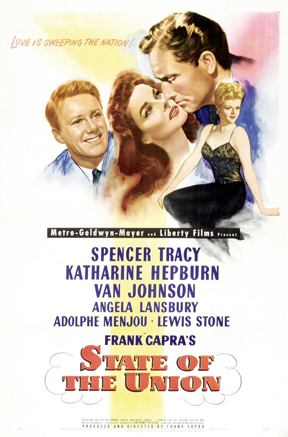
In State of the Union, newspaper publisher Kay Thorndyke (Angela Lansbury) wants to make her lover, Grant Matthews (Spencer Tracy), President of the United States.  Grant is a no-nonsense, plain-spoken businessman who is quick to explain that he loves and cares about his country but that he hates partisan politics.  (In many ways, it’s impossible not to compare Grant to … well, to just about every single wealthy businessman who has ever run for public office while claiming to essentially be nonpolitical.  The big difference is that Grant actually means it.)  However, by subtly appealing to both his ego and his patriotism, Kay convinces Grant to run.  With the help of sleazy Jim Conover (Adolphe Menjou) and the sardonic Spike McManus (Van Johnson), Kay uses her money and her newspapers to turn Grant into a viable candidate.

The only problem is that Grant is separated from his wife Mary (Katharine Hepburn) and, since this movie was made in the 1940s, everyone knows that Grant has to be seen as being a family man if he’s going to be elected.  For the election, Mary and Grant pretend to be happily married.

As the primary season continues, Grant finds himself being more and more manipulated by Kay and Jim.  Eventually, Grant is forced to make a decision between his campaign and his integrity…

Following Mr. Smith Goes To Washington and Meet John Doe, State of the Union was the third part of director Frank Capra’s political trilogy.  Based on a play (which, itself, was supposedly inspired by the 1940 Republican presidential candidate, Wendell Willkie), State of the Union never quite escapes its stage-bound origins.  Add to that, the film was probably a bit more shocking when it was first released in 1948.  In 2015, we’re used to idea of politicians being controlled by money.  But, in 1948, audiences were perhaps a little bit more innocent.

But, that said, State of the Union is still an entertaining film.  Needless to say, Spencer Tracy and Katharine Hepburn have a wonderful chemistry together and Hepburn gets a great drunk scene.  (Hepburn had such an aristocratic presence that it’s always fun to watch her do comedy.)  Angela Lansbury also does well, playing a character who could very well grow up to be the role she played in The Manchurian Candidate.

67 years after it was first released, State of the Union remains an entertaining film that makes some good and still relevant points.  In 2016, when you’re tempted to get involved with the latest version of Americans Elect, watch State of the Union instead.