Film Review: Two Mules For Sister Sara (dir by Don Seigel)


In 1970’s Two Mules For Sister Sara, Clint Eastwood and Shirley MacClaine take on the French!

It’s an often forgotten piece of history that, during the American Civil War, the French invaded Mexico and tried to turn it into a colony, one that was ruled by the hapless Archduke Maximillian.  The French were then led by Napoleon III, a rather enigmatic figure who spent his entire reign trying to live up to his namesake (and failing).  While the Americans would never have tolerated a French invasion of Mexico under normal circumstances, the Civil War provided enough of a distraction for Napoleon III to make his move in 1861.  Of course, as soon as the Civil War ended, America turned its attention to getting the French out of Mexico and, by the end of 1867, Maximillian had been executed and Napoleon III had withdrawn his forces.

Two Mules For Sister Sara takes place shortly after the end of the American Civil War, when the latest Mexican Revolution was in full swing.  Clint Eastwood plays Hogan, a former union officer who is now in Mexico working as a mercenary.  He’s been hired to help the revolutionaries attack a French garrison, in return for being given half of whatever is found inside.  Traveling through the desert, he comes across a group of bandits who are about to rape a woman named Sara (Shirley MacClaine).  Hogan guns down the bandits and is then shocked when Sara dons a habit and introduces herself as a nun who has been helping the revolutionaries.  She requests that Hogan travel with her and continue to protect her.  Hogan is reluctant, saying that he doesn’t want to become Sara’s mule when she already has one.  (That would be two mules for Sister Sara …. get it?)  But since Sara is a nun and claims to have no idea how to defend herself in the wilderness, Hogan agrees.  Sara and Hogan become unlikely allies as they get further and further involved in the Mexican Revolution.

Two Mules For Sister Sara owes a good deal to the Spaghetti westerns that were then coming out of Italy.  (Eastwood, of course, owed much of his stardom to his appearances in Sergio Leone’s Dollars trilogy.)  The Mexican Revolution was always a popular subject amongst the writers and directors of the Italian Spaghetti westerns.  Of course, Two Mules For Sister Sara is lacking in the political subtext that appeared in many of the Italian films.  Director Don Siegel may have been a liberal but, unlike many of his Italian contemporaries, he wasn’t a Marxist.  Instead, Two Mules For Sister Sara shows its Spaghetti influence in its panoramic visuals, it’s somewhat cynical sense of humor, and the casting of Eastwood as a taciturn mercenary whose main concern is using the revolution to make some money.  Eastwood plays a slightly more humorous version of his Man With No Name.  Hogan may be a cynic who doesn’t speak unless it’s absolutely necessary but he also possesses a good enough heart that there’s no way he’s going to abandon Sister Sara to fend for herself.  (The Man With No Name, on the other hand, would probably not have been so generous.)  Of course, Sister Sara has a secret of her own….

Supposedly, Eastwood and MacClaine didn’t get along particularly well while making Two Mules For Sister Sara.  (During preproduction, the film was envisioned as starring Eastwood and Elizabeth Taylor.)  If there was hostility between the two leads, it worked in the film’s favor because both Eastwood and MacClaine do a good job of playing off of each other.  MacClaine, at first, seems too contemporary for the role but, as the film progresses, she becomes more convincing.  There’s a revelation towards the end of the film that reveals that many of the moments that made MacClaine seem miscast were actually deliberate.  As for Eastwood, there’s a subtle humor running through his performance, as if he’s poking fun at his own tight-lipped persona. His performance here shows hints of the actor that he would become.

Two Mules For Sister Sara is an entertaining western, one that features Eastwood and Seigel celebrating and, at the same time, poking fun at the genre.  A year after this film, Eastwood and Seigel would make film history with Dirty Harry.
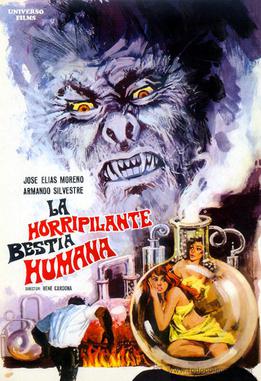
The TSL’s Horror Grindhouse: Night of the Bloody Apes (dir by Rene Cardona)


Okay, so this is a very weird movie.

Before I tell you too much about it, I do need to provide a few caveats.  In 1969, Mexican director Rene Cardona released a film called La Horripilante bestia humana.  When that film was released in the United States in 1972, it was retitled Night of the Bloody Apes.  The film was also badly dubbed into English.  The version that I watched was Night of the Bloody Apes, the dubbed version.  This editing in this version was notably ragged.  I don’t know if that was the result of the American distributors cutting scenes or if the Mexican version was just as bad.  American distributors were notorious for roughly editing foreign-language films but then again, director Rene Cardona was notorious for not exactly being the world’s most competent filmmaker.

I guess what I’m saying is that, for all I know, La Horripilante bestia humana could have been the greatest monster movie ever made before it was transformed into Night of the Bloody Apes.  However, I kind of doubt it.

Night of the Bloody Apes opens, like so many of Rene Cardona’s films, with a wrestling match.  Lucy Osorio (Norma Lazareno) is a famous wrestler who, during a match, seriously injures her opponent.  This leads to Lucy having a crisis of conscience.  Her boyfriend, Lt. Martinez (Armando Silvestre) tells her not to worry about it.  Her opponent will be fine and everyone understands that injuries are just a part of wrestling.  But Lucy isn’t so sure.  Is the fame worth it if it means hurting other people?

WELL, IS IT!?

Don’t worry too much about Lucy, though.  Immediately after providing Lucy with a huge subplot, the film pretty much abandons her.  Once Lt. Martienz encourages her not to give up, Lucy only appears occasionally throughout film, usually while naked in her dressing room.  Whatever inner conflicts she was dealing with, she apparently resolved them while no one was looking.  (This is one reason why I suspect that the film was re-edited by its American distributor.)

The film moves on to another plot.  Dr. Krallman (José Elías Moreno) is desperately trying to save his son’s life.  His angelic and kind of annoying son, who never says an unkind word about anything, is dying of leukemia.  Dr. Krallman thinks that he can save him by removing his defective heart and replacing it with the strong, healthy heart of gorilla.

Sure, why not?

Working in secret with the help of his deformed assistant, Dr. Krallman performs the operation.  (Cardona splices in footage of actual open heart surgery.)  His son survives but at what cost?  As a result of having a gorilla’s heart, Dr. Krallman’s son transforms into a body builder wearing a caveman mask.  His son is no longer a sweet, angelic, and dying.  Now, he’s a monosyllabic brute who runs around the city at night, attacking and killing women.  Lt. Martinez is assigned to the case but that doesn’t mean much because Lt. Matinez is kind of an idiot.

So, yes, Night of the Bloody Apes is one strange movie.  Actually, it’s more of a random collection of scenes than a movie.  It’s a mix of totally gratuitous nudity, over-the-top gore, random wrestling footage, actual open heart surgery footage, and scenes of the man-ape running through the city.  The film never seems to be quite sure whether the monster is actually an ape or some sort of hybrid.  Sometimes, he runs like an ape.  Sometimes, he staggers like Lon Chaney, Jr. playing the Wolfman after having had a drink or two.  It’s a very odd film.

And it’s the oddness of it all that makes the film watchable.  Some things are so weird that you just have to watch them once and that’s a fairly accurate description of Night of the Bloody Apes.  You probably won’t watch it a second time though.  It may be weird enough to sit through once but it’s never as compulsively rewatchable as an Ed Wood film or something like The Horror of Party Beach.  Once is enough.

http://www.youtube.com/watch?v=kQpU4skt5XE

Film Review: Barquero (1970, directed by Gordon Douglas)


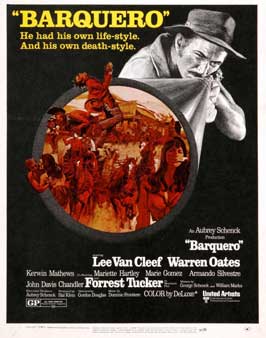
barquero-movie-poster-1970-1010695655Travis (Lee Van Cleef) is a former gunslinger who now makes his living taking settlers across a river on his small barge.  When we first meet him, he is telling a child to shut up and stop bothering him while he is guiding the barge.  He depends on the settlers on the other side of the river for his livelihood and they depend on him for transportation but he doesn’t like them and they don’t like him.  Travis only cares about two people, his Mexican lover, Nola (Maria Gomez) and an eccentric hunter named Mountain Phil (Forrest Tucker).

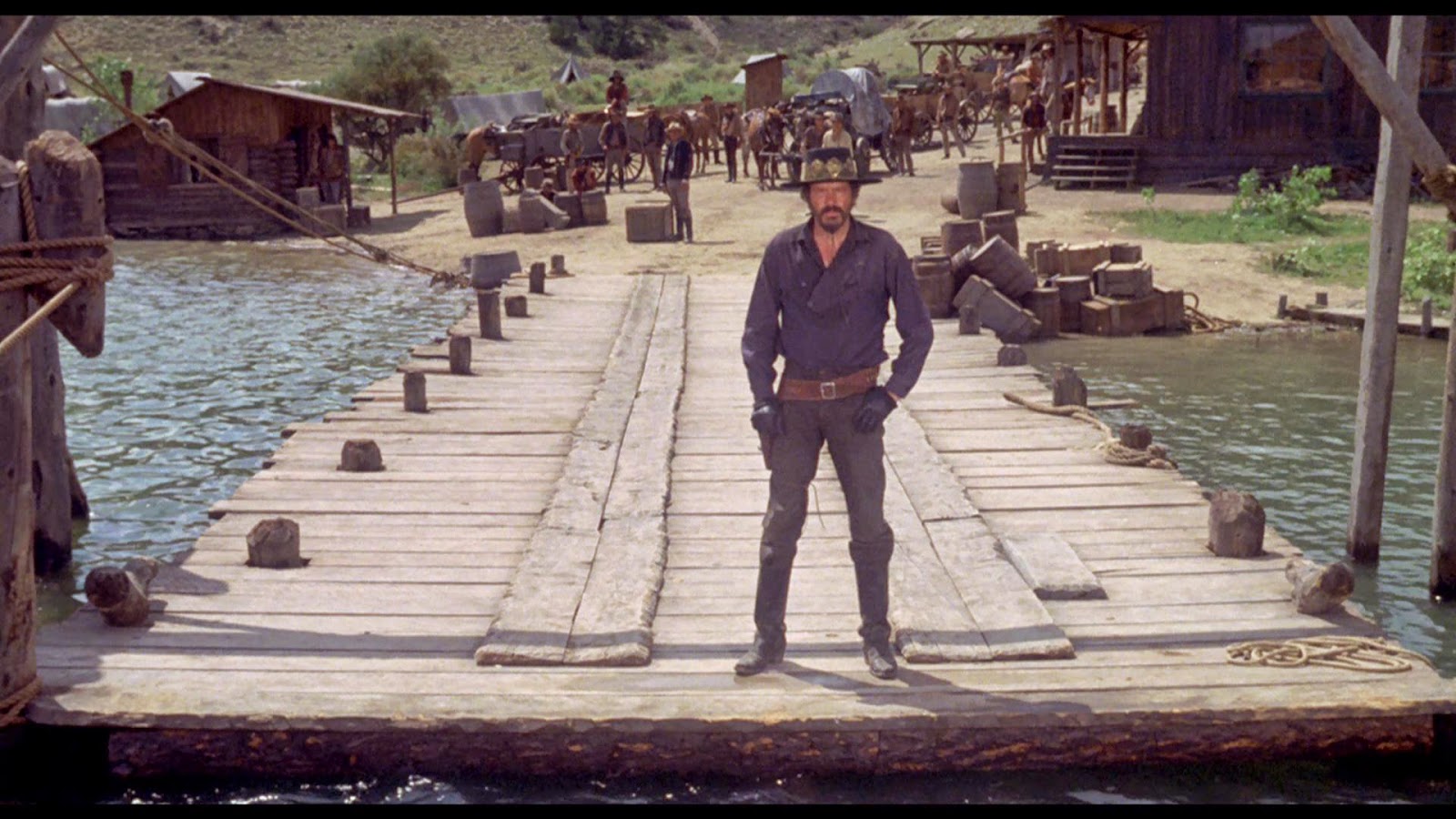
After stealing a shipment of silver, outlaw Jake Remy (Warren Oates) and his army of mercenaries need to cross the river to escape into Mexico.  To prevent anyone from following, they plan to destroy the barge afterward.  However, Travis and Phil find out that Remy is on the way and take the barge to the other side of the river.  When Jake and his gang arrive, a tense stand-off ensues, with the outlaws on one side of the river and Travis and the settlers trapped on the other.

Though Barquero was directed by the veteran American director Gordon Douglas (Douglas’s best known film is the 1950s giant ant film, Them!),  it was heavily influenced by contemporary Spaghetti Westerns and Sam Peckinpah’s The Wild Bunch.  This can be seen in both its graphic violence and in the casting of Lee Van Cleef and Warren Oates in the leading roles.

Travis was a perfect role for Van Cleef, a talented actor who was ignored by Hollywood until he found fame playing ruthless villains in European westerns.  Surly and unsmiling, Travis may seem like an unlikely hero but, like many of the best Spaghetti westerns, there are no traditional good guys in Barquero.  Travis is more interested in saving his boat than protecting the settlers.  He is a hero of circumstance.

As Jake, Warren Oates is a great villain.  In his very first scene, he and a prostitute watch as his gang massacre the citizens of a small town.  When the prostitute asks if she can come with them, Jake calmly replies, “I don’t think so” and shoots her dead.  Stuck on his side of the river, Jake smokes the local weed and starts to have violent hallucinations.  Soon, he is shooting bullets into the river.

Also doing good work are Forest Tucker as Mountain Phil and Kerwin Mathews.  Mathews, who is best remembered for starring in The 7th Voyage of Sinbad, plays the Marquette, a disgraced French nobleman who has started a second life as Jake Remy’s right-hand man.

Barquero starts with a bang but it struggles to keep up the momentum over its entire running time.  The opening shoot out is exciting but things slow down almost too much during the stand-off at the river.  It is an interesting but flawed western that deserves to be better known than it is and worth watching to see Lee Van Cleef and Warren Oates at their best.

Barquero-Oates-on-dock